

Key Takeaways
- Always discuss your experiment idea with your instructor and get approval before starting, especially if it involves human participants.
- Psychology textbooks and classic experiments are great sources of inspiration for designing your own experiment.
Psychology experiments can range from simple to complex. Students are often expected to design—and sometimes perform—their own experiments, but finding great ideas for psychology experiments can be a little challenging. Fortunately, inspiration is all around if you know where to look—from your textbooks to the questions that you have about your own life.
Always discuss your idea with your instructor before beginning your experiment, particularly if your research involves human participants. (Note: You’ll probably need to submit a proposal and get approval from your school’s institutional review board.)
Verywell / JR Bee
Explore Your Own Interests for Ideas
If none of the ideas in the list above grabbed your attention, there are other ways to find inspiration for your psychology experiments.
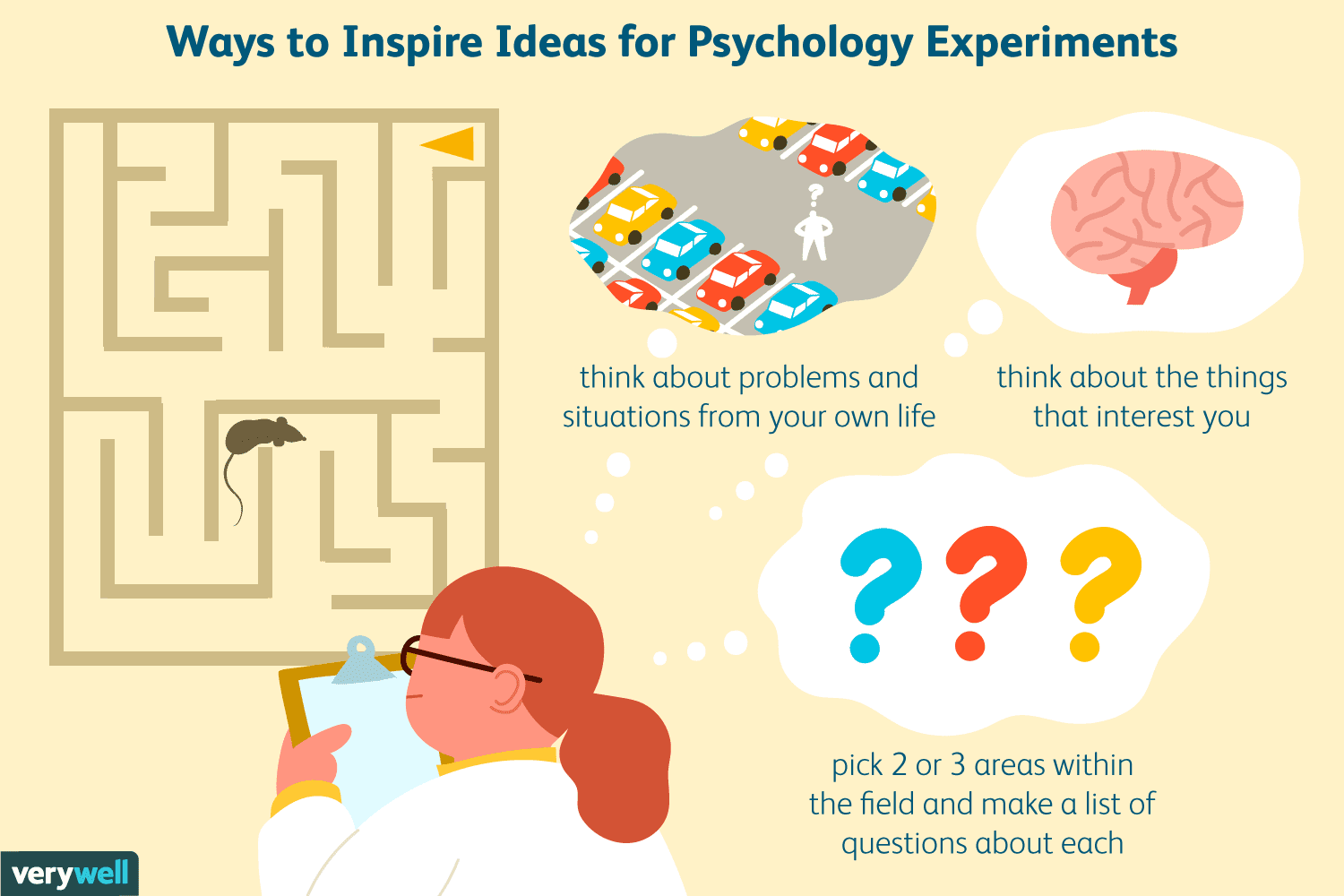
How do you come up with good psychology experiments? One of the most effective approaches is to examine the problems, situations, and questions you face in your own life.
You can also think about what interests you. Start by considering the topics you’ve studied in class thus far that have really piqued your interest. Then, whittle the list down to two or three major areas within psychology that seem to interest you the most.
From there, make a list of questions you have related to the topic. Any of these questions could potentially serve as an experiment idea.
Use Textbooks for Inspiration
Your psychology textbooks are another excellent source for ideas for experiments. Choose the chapters or sections that you find particularly interesting—perhaps it’s a chapter on social psychology or a section on child development.
Start by browsing the experiments discussed in your book. Then think of how you could devise an experiment related to some of the questions your text asks. The reference section at the back of your textbook can also serve as a valuable source of additional material.
Review the Literature on Psychology Experiments
If you have a general idea about what topic you’d like to experiment with, you might want to spend a little time doing a brief literature review before you start designing. In other words, do your homework before you invest too much time in an idea.
Visit your university library and find some of the best books and articles that cover the particular topic you are interested in.
- What research has already been done in this area?
- Are there any major questions that still need to be answered?
- What were the findings of previous psychology experiments?
Tackling this step early will make the later process of writing the introduction to your lab report or research paper much easier.
Ask Your Instructor For Suggestions
If you have made a good effort to come up with an idea on your own but you’re still feeling stumped, it might help to talk to your instructor. Ask for pointers on finding a good experiment topic for the specific assignment. You can also ask them to suggest some other ways you could generate ideas or inspiration.
While it can feel intimidating to ask for help, your instructor should be more than happy to provide some guidance. Plus, they might offer insights that you wouldn’t have gathered on your own. Your instructor probably has lots of ideas for psychology experiments that would be worth exploring.
Practical Considerations
If you are looking for ideas for psychology experiments:
- Start your search early and make sure you have the time you need
- Do plenty of background research
- Adapt ideas you find online for your own experiments
Before you get started, make sure that you are observing the guidelines provided by your instructor and always obtain the appropriate permission before conducting any research with human or animal subjects.
Finding a topic for a research paper is much like finding an idea for an experiment. Start by considering your own interests, or browse through your textbooks for inspiration. You might also consider online news stories or journal articles as sources of inspiration.
