

Key Takeaways
- When you feel irritable, take a few slow, deep breaths to calm down.
- Sometimes, taking a short break can help recharge your mind and help you feel less irritable.
Everyone feels irritable sometimes. But if you feel this way more often than not—such as if you find yourself repeatedly questioning, “Why am I so irritable all the time?”—it could cause bigger problems in your life.
Whether you say things you don’t mean and it harms your relationships or you struggle to stay productive at work because you’re annoyed by co-workers, it’s important to address your irritability. These strategies can help.
Acknowledge Your Irritability
When someone asks why you’re so grumpy, it’s tempting to snap at them and say, “I’m not grumpy!” You might even blame everyone else for being too sensitive, too loud, or too annoying. But denying your irritability can make you feel worse, even increasing your anxiety and contributing to emotional rigidity or detachment.
When you notice that you’re feeling annoyed with everything and everyone around you, acknowledge that you’re irritable. You don’t necessarily have to announce that you’re feeling irritable. You might just acknowledge it to yourself.
Naming your feelings can take a lot of the intensity out of them. You might even rate your irritability on a scale of 1 to 10. One study found that when individuals ranked their anger on a scale, their physiological symptoms declined and they felt calmer.
So take a minute to label your emotions when you’re feeling irritable. You might notice that you start to feel just a little better right away.
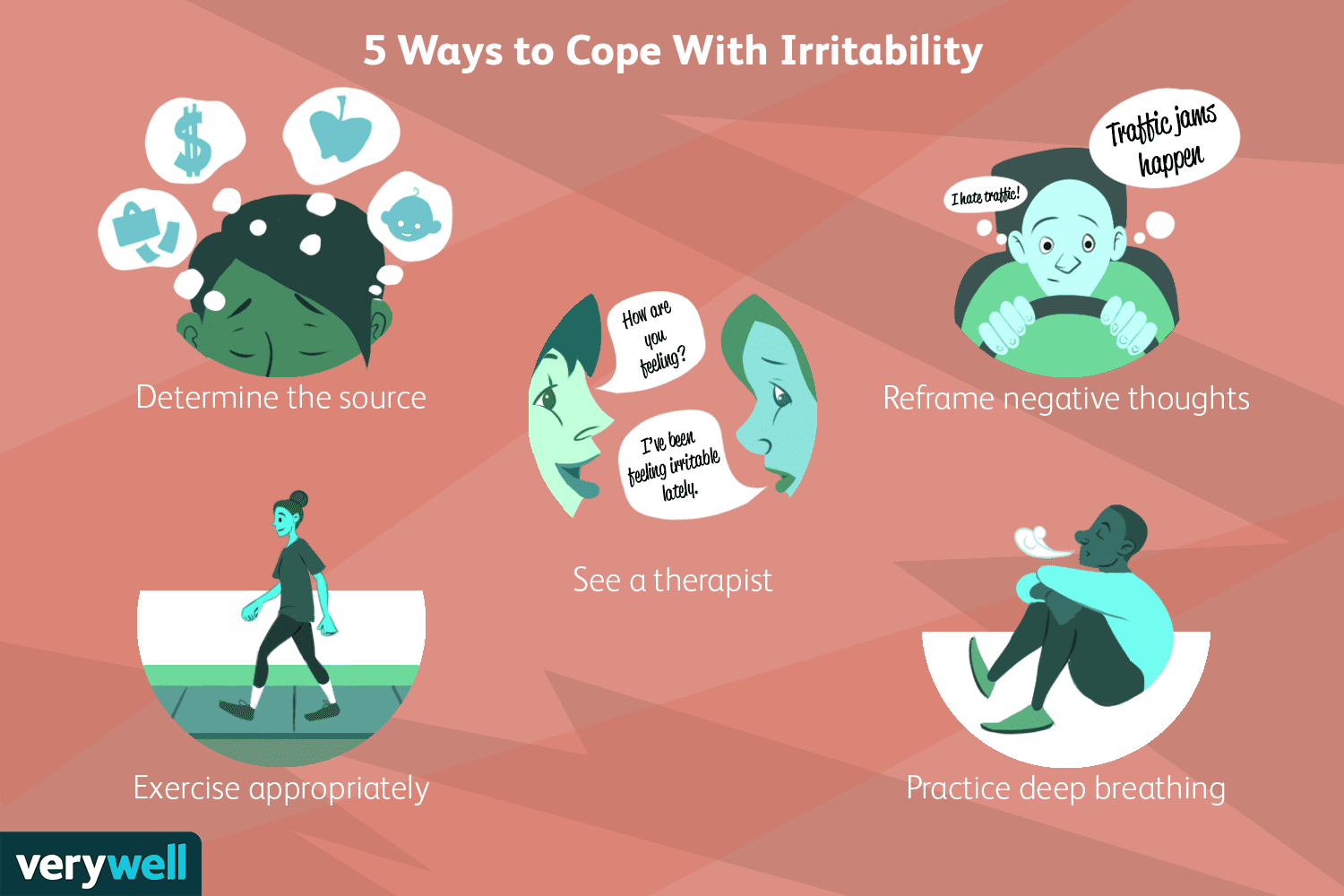
Determine if There Is a Clear Source
Sometimes, the source of irritability is obvious. Screaming children who won’t listen to your directions, for example, can ignite irritability after a long day.
At other times, you might just feel like you “woke up on the wrong side of the bed.” You may feel angry or frustrated without really knowing why. A little self-reflection might help you recognize that you’re stressed out or that you haven’t spent much time caring for yourself lately.
You might also consider if you need to get something to eat. Being “hangry” is a real thing. A drop in blood sugar might cause a spike in irritability.
If you can determine the source, you might be able to solve the problem. But keep in mind that, sometimes, irritability isn’t caused by anything external. Sometimes, it’s just a normal human experience. Or it may stem from something internal, like a hormone shift or a mental health issue like depression or anxiety.
Take a Few Deep Breaths
Thoughts like “I can’t stand to be here one more minute” can feed your irritability. Your body responds accordingly by releasing a stress hormone called cortisol. Then, your heart might beat faster. Your palms might grow sweaty. Your blood pressure might rise. Before you know it, your irritability is worse.
Taking a few slow, deep breaths can calm your physiological response. When your body grows a little calmer, it helps your brain grow calmer too.
When you’re feeling stressed and irritable, try inhaling slowly through your nose to the count of three. Hold your breath for one second, then exhale slowly through pursed lips for a count of three. Do this three times and see if you feel a little better.
Take a Break
When you’re working on a frustrating project or in an environment that is increasing your stress levels, sometimes the best thing you can do is take a break. Walk away for a minute and take a time-out.
Think of your irritability as a sign that you’re running low on batteries (similar to the way your digital devices do). Taking a quick break might be all you need to charge your batteries again so you can re-enter the situation feeling refreshed.
Whether a break for you means a quick walk around the building or a few minutes of listening to music in your bedroom with the door shut, find something that can help you calm down fast.
Get a Healthy Dose of Physical Activity
Research shows that getting exercise can be good for your mental health. Physical activity has been used as an effective treatment for anxiety, mood disorder, eating disorders, and substance use disorders. So if irritability stems from a mental health issue, working out can help.
On the flip side, however, too much exercise can increase irritability. This may be especially true if you’re dieting or overtraining. So, make sure you’re getting healthy doses of physical activity but not too much. If your exercise regimen seems to be worsening your mood, talk to your physician.
Chew Gum
Chewing gum can be a quick way to relieve stress, which may be helpful in reducing your irritability. A study found that people felt less anxious and less stressed when they were chewing gum. It also improved their focus and attention.
So the next time you feel a little irritable, reach for a piece of gum. You might find that it helps you feel a little calmer and happier.
Reframe Your Negative Thoughts
When you’re dealing with an inconvenience like a traffic jam, you might start thinking thoughts that fuel your irritability. Thinking something like, “I hate wasting my life in traffic!” can cause you to feel worse.
If you notice yourself dwelling on the unfairness of a situation or thinking about how much you dislike something, reframe it. Stick to the facts, rather than your judgments and emotions surrounding those facts.
In the case of a traffic jam, for example, you might remind yourself that there are millions of cars on the road every day and traffic jams are bound to happen.
Get Professional Help
Irritability can be a sign of a mental health issue, like depression or anxiety. So if your irritability lingers for a couple of weeks or you are concerned about it, talk to your physician or reach out to a mental health professional. Treating an underlying mental health issue can help resolve your irritability so you can feel better.
Press Play for Advice On Prioritizing Self-Care
Hosted by therapist Amy Morin, LCSW, this episode of The Verywell Mind Podcast, featuring TV Host Brooke Burke, shares ways you can make self-care a priority regardless of what your schedule may look like. Click below to listen now.
Follow Now: Apple Podcasts / Spotify / Google Podcasts
Verywell Mind uses only high-quality sources, including peer-reviewed studies, to support the facts within our articles. Read our editorial process to learn more about how we fact-check and keep our content accurate, reliable, and trustworthy.
-
Waqas A, Rehman A, Malik A, Muhammad U, Khan S, Mahmood N. Association of ego defense mechanisms with academic performance, anxiety and depression in medical students: A mixed methods study. Cureus. 2015;7(9):e337. doi:10.7759/cureus.337
-
Torre JB, Lieberman MD. Putting Feelings Into Words: Affect Labeling as Implicit Emotion Regulation. Emotion Review. 2018;10(2):116-124. doi:10.1177/1754073917742706.
-
Swami V, Hochstöger S, Kargl E, Stieger S. Hangry in the field: An experience sampling study on the impact of hunger on anger, irritability, and affect. PLoS One. 2022;17(7):e0269629. doi:10.1371/journal.pone.0269629
-
de Wit AE, Giltay EJ, de Boer MK, et al. Predictors of irritability symptoms in mildy depressed perimenopausal women. Psychoneuroendocrinol. 2021;126:105128. doi:10.1016/j.psyneuen.2021.105128
-
Vidal-Ribas P, Brotman MA, Valdivieso I, Leibenluft E, Stringaris A. The status of irritability in psychiatry: A conceptual and quantitative review. J Am Acad Child Adolesc Psychiatry. 2016;55(7):556-570. doi:10.1016/j.jaac.2016.04.014
-
Dziurkowska E, Weselowski M. Cortisol as a biomarker of mental disorder severity. J Clin Med. 2021;10(21):5204. doi:10.3390/jcm10215204
-
Perciavalle V, Blandini M, Fecarotta P, et al. The role of deep breathing on stress. Neurolog Sci. 2017;38:451-458. doi:10.1007/s10072-016-2790-8
-
Chekroud SR, Gueorguieva R, Zheutlin AB, et al. Association between physical exercise and mental health in 1.2 million individuals in the USA between 2011 and 2015: a cross-sectional study. Psychiatry. 2018;5(9):739-746. doi:10.1016/S2215-0366(18)30227-X
-
Gottschall JS, Davis JJ, Hastings B, Porter HJ. Exercise time and intensity: How much is too much? Int J Sports Physiol Perform. 2020;15(6):808-815. doi:10.1123/ijspp.2019-0208
-
Allen AP, Smith AP. Chewing gum: cognitive performance, mood, well-being, and associated physiology. Biomed Res Int. 2015;2015:654806. doi:10.1155/2015/654806
Thanks for your feedback!
What is your feedback?
Helpful
Report an Error
Other
