

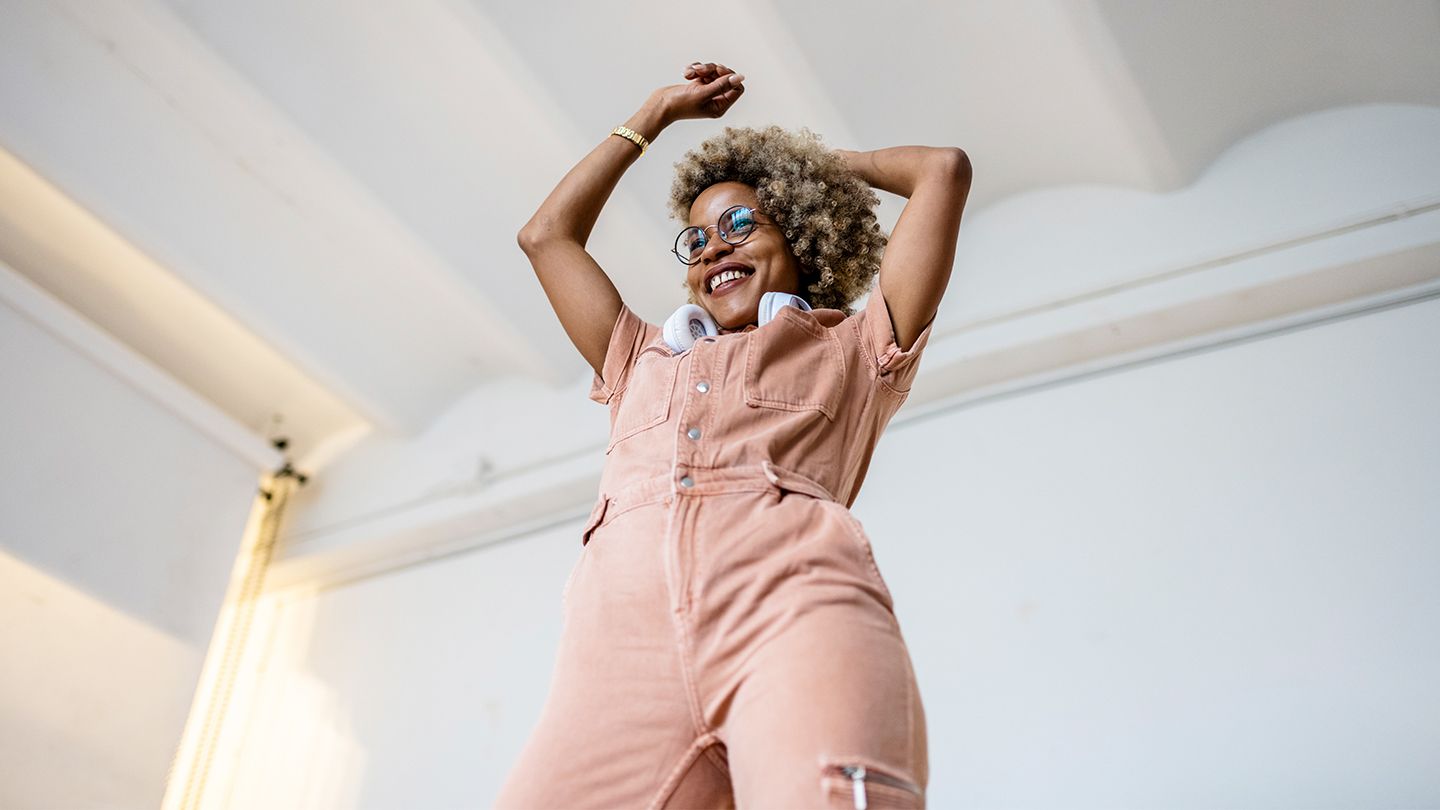
Dancing can be many things: an expression of art, a fun hobby, a representation of culture, and a great form of exercise.
“Dancing is the ultimate workout,” says Julie Granger, a personal trainer and founder and creator of The Studio Paris and Ballerina Body Training. Not only does dancing involve engaging all of your muscles and limbs — it also gets your heart pumping. Plus, dancing can be a whole lot of fun. A workout you can look forward to? Sign us up.
The style of dance you do will influence how intense a workout it is, but pretty much any style of dance can be great exercise. Granger, who is also a former professional ballerina, says to choose a type of dance according to your favorite tunes. You can sign up for a class at your local gym or studio, take one virtually, or hit the town. “No matter which you choose, and even if it is just dancing at the club on Saturday night, you will get benefits,” she says.
So, what are the specific health benefits of busting a move? Here’s the full research-backed list.
1. Dancing Boosts Heart Health
Like other forms of aerobic exercise, dancing is great for improving cardiovascular function. Research explains that because dancing requires you to move in different directions and often speed up or slow down your moves, it’s a great way to keep your heart pumping properly.
But the physical act of dancing isn’t the only reason why it’s good for your heart. Many people who dance also feel a great sense of joy when they let loose, which releases endorphins and dopamine and helps reduce stress. Too much stress can weaken the heart, so dancing some of the stress away can help keep your heart strong.
[1]
2. Dancing Builds Core Strength
Dance requires balance and helps build core strength, which helps promote good posture and prevent muscle injuries and back pain, according to Mayo Clinic.
[2]
Granger adds that this is particularly true of ballet. “In ballet, you train your body to stand still, often on one leg. This helps you train the deep muscles in your body, which you would not work otherwise,” she says. You are also engaging your abs, “which are an essential part to balancing,” she notes.
3. Dancing Promotes Flexibility
In addition to building strength, many forms of dance stretch the limbs of the body, which improves flexibility, says Elizabeth C. Gardner, MD, an orthopedic sports medicine surgeon at Yale Medicine and associate professor at Yale School of Medicine in New Haven, Connecticut. “Both of these (improved strength and flexibility) contribute to improved balance, which can help to avoid falls and reduce the risk of injury in other aspects of life,” she explains.
This is especially true for ballet dancers. “Ballet training involves a great deal of flexibility training. Flexibility means improved mobility, which means that any type of daily activity will be more enjoyable, whether you take yoga or you are trying to reach for the top cabinet in your kitchen,” says Granger.
4. Dancing Can Help With Weight Management
Dancing is also a form of both aerobic and anaerobic exercise, making it a great calorie burner, Dr. Gardner says. “Jumping and twirling movements are great aerobic training, while holding positions of squatting and balance positions can turn on the anaerobic energy system,” she explains. In general, the more up-tempo the dance style, the more calories and energy that you’ll burn.
Depending on the style of dance and your body weight, 30 minutes of dancing can burn between 90 and 252 calories, according to Harvard Health Publishing.
[3]
This type of high-intensity calorie burning can help support weight management if you’re trying to shed pounds. If you want to maximize calorie burn, Granger suggests taking a dance cardio class, designed to blast calories and improve physical fitness.
5. Dancing Is Good for Your Bones
“As a form of weight-bearing activity, unlike a stationary bike or swimming, dancing can help to maintain bone density,” says Gardner. Per the Bone Health & Osteoporosis Foundation, high-impact and weight-bearing exercises, including some forms of dance, help you effectively maintain and even build new bone mass.
[4]
It’s also an effective exercise for older adults who are living with osteoporosis.
[5]
6. Dancing May Help Improve Memory
Dance often requires learning and memorizing moves and routines, which is known as choreography. “There’s actually some very good evidence that social dancing can reduce the risk of cognitive decline as we get older,” says Carolyn Fredericks, MD, a neurologist at Yale School of Medicine.
Research has found that aerobic dancing is good for overall physical health, but it’s also an important tool for enhancing cognitive functioning, improving memory, and increasing balance.
[6]
“We always recommend that older adults seek out cardiovascular exercise and social engagement, and cognitive challenge — social dancing gets all three of these,” Dr. Fredericks says.
7. Dancing Supports Mental Health
Research shows that dance can help decrease anxiety, increase self-esteem, and improve psychological well-being.
[7]
And certain types of dance have even been used as a treatment for depression. Research published in Frontiers in Psychology found that dance movement therapy — defined by the American Dance Therapy Association as the psychotherapeutic use of movement to promote emotional, social, cognitive, and physical integration of the individual, for the purpose of improving health and well-being — was effective in treating depression.
[8]
[9]
8. Dancing Could Reduce Stress
If you’ve had a tough day, have you ever cranked up your favorite tunes and busted a move to blow off some steam? Any type of movement can help bust stress, according to Mayo Clinic, but dancing is a good way to feel more relaxed, move your body, and express yourself creatively — all of which are good for stress management.
[10]
9. Dancing Makes Us Feel Socially Connected
Social connectedness and interaction are a really important part of mental and physical health. Much research shows that feeling lonely or socially isolated can have myriad negative health effects.
[11]
“Dancing is sharing, and when you take class surrounded by other people, you know you all have something in common. You are not here to compete — you are here to enjoy, and there is an amazing feeling that comes with that,” Granger says. “Go take a class, and feel the energy of the room.”
The Takeaway
- Dancing is an excellent form of exercise that can improve cardiovascular health by getting your heart pumping and reducing stress.
- Adding dance to your workout routine can improve flexibility, enhance core strength, and strengthen bones.
- While dancing is great for your physical health, it also offers a ton of benefits mentally, such as reducing stress, improving self-esteem, and decreasing anxiety.
