

Key Takeaways
- Symptoms of Effexor withdrawal begin within a day or two and usually get better within three weeks.
- Withdrawal symptoms can include confusion, changes in appetite, headaches, nausea, and sweating.
- You can prevent withdrawal by taking your medication as prescribed and talking to your doctor before changing your dose.
Effexor (venlafaxine) withdrawal symptoms typically appear within 24 to 48 hours and go away within three weeks, but can last several months. You might feel nauseated, dizzy, short-tempered, confused, restless, and/or distracted during this time.
Effexor withdrawal is a type of antidepressant discontinuation syndrome that can occur when people stop their medication too quickly. For this reason, healthcare providers usually taper the dose gradually, although withdrawal symptoms may still occur.
What Is the Timeline of Effexor Withdrawal?
Everyone’s experience is different, and the severity of symptoms can vary depending on a person’s dose and how long they’ve been taking their medication:
- Early symptoms (24 to 48 hours): The first symptoms of Effexor withdrawal may appear in the first 24 to 48 hours, including flu-like symptoms, anxiety, and agitation.
- Peak symptoms (days 3 to 7): Symptoms of withdrawal usually peak around the end of the first week, often including dizziness and nausea.
- Improvement phase (week 2): During the second week, symptoms often gradually lessen, but some may continue to linger
- Recovery period (week 3 and beyond): The physical symptoms will be mostly gone by the third week. However, psychological symptoms, such as mood swings and irritability, may persist for longer.
Not everyone experiences withdrawal when stopping Effexor. Research suggests that around 33% to 56% of people who take antidepressants experience withdrawal symptoms when they stop taking their medication.
What Does Withdrawal Feel Like?
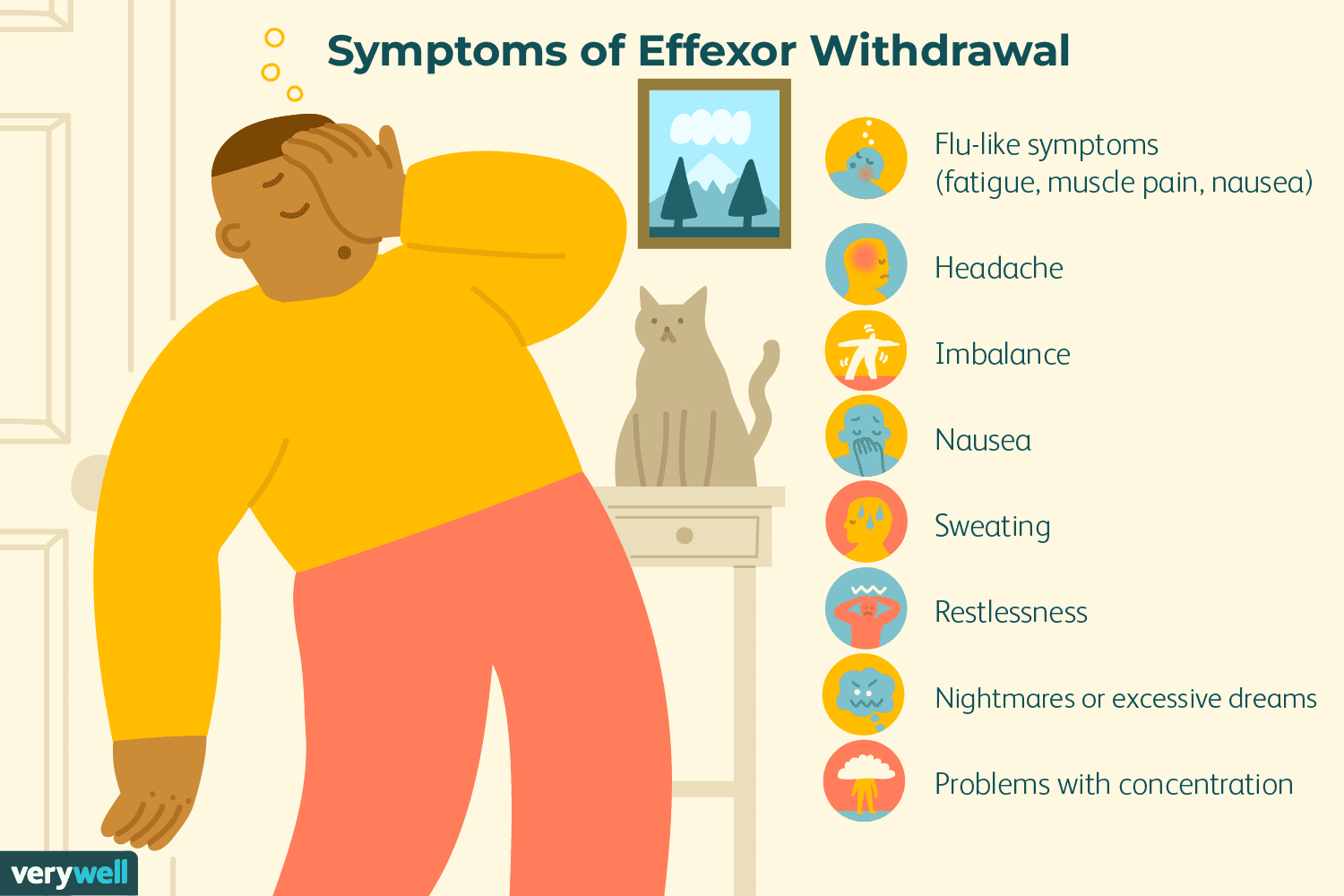
When decreasing or stopping an antidepressant, a neurochemical change takes place in the brain. As the brain readjusts to the new environment, symptoms of withdrawal from Effexor may include:
- Agitation or irritability
- Anxiety
- Changes in appetite
- Confusion
- Dizziness
- Headaches
- Mood changes
- Nausea or vomiting
- Nightmares or other sleep issues
- Paresthesias (a prickling or tingling sensation)
- Sweating
‘Brain Zaps’
Some people report experiencing ‘brain shivers’ or ‘brain zaps’ when they are late taking their prescribed dose of Effexor.
- People often describe these sensations as a very brief, repetitive, electric shock-like feeling that remains confined to the brain or head.
- Others report the sensation spreads out to other parts of the body.
- The sensation can be triggered by moving your eyes and is often accompanied by disorientation, tinnitus (ringing in the ears), vertigo, and/or lightheadedness.
These electric shock-like sensations can cause you to become alarmed or worried, and they may happen frequently enough to disrupt daily life or quality of life. However, no current evidence suggests brain shivers or brain zaps represent any danger.
How to Cope With Effexor Withdrawal Symptoms
Effexor withdrawal symptoms develop quickly, so if you miss a dose, take it as soon as you remember. If it is close to your next scheduled dose, simply skip your missed dose and stick to your schedule.
You can reduce your withdrawal symptoms by getting back on your prescribed dosing schedule as soon as possible.
If you are discontinuing Effexor, there are ways to make Effexor withdrawal more tolerable until the withdrawal symptoms go away. Here are a few steps to consider:
- Team up with your healthcare provider. They are your best ally when it comes to preventing and coping with symptoms of antidepressant withdrawal. Discuss the benefits and risks of stopping Effexor and work together to figure out how (and when) to slowly stop taking the drug.
- Ask about OTC medications. Consult your doctor about any over-the-counter medications that can help ease Effexor withdrawal, such as sleep aids, anti-nausea medications, and pain relievers.
- Consider psychotherapy. According to investigators at Harvard Medical School, engaging in psychotherapy while discontinuing an antidepressant can decrease your risk of having a depression relapse.
- Seek support. Consider asking a close friend or family member for support and let them know what to expect as you work with your physician to wean off the drug.
- Keep up with follow-ups. It’s important to keep in touch with your healthcare provider as you are weaning from the drug, as well as after you’ve stopped altogether. Depending on how you feel, you may need to book ongoing monthly check-ins until discontinuation symptoms have eased and there are no signs of relapse.
- Practice self-care. As you are going through withdrawal, it’s more important than ever to exercise, eat healthfully, get regular sleep, and practice stress management. These acts of self-care can help keep your mood stable as you taper off Effexor.
Important Warnings About Effexor Withdrawal
Some people may experience disorientation, which can be dangerous when driving or operating heavy machinery. And, although rare, stopping Effexor on your own can result in severe and frightening reactions.
If you or someone you love experiences any of the following symptoms, call 911 or seek medical help right away:
If you experience worsening anxiety or depression during withdrawal, and these symptoms last more than a month, it may mean you’re having a relapse and need ongoing mental health treatment. Talk to your care provider if you have any concerns.
How to Manage Effexor Withdrawal in the Long Run
When you’ve decided to stop taking your antidepressant, it might be tempting to toss out your medication. Instead, take your time and work with your physician to gradually decrease your dose.
How you’ll do this will depend on several factors, including:
- How long you’ve been taking the drug
- Your current dose (if you’re on a low dose, you’ll be able to taper off more quickly)
- Past experience with withdrawal symptoms
- Overall health
Sometimes, even if you are slow and deliberate when weaning off an antidepressant, you still may experience symptoms. In these cases, your physician may prescribe Prozac (fluoxetine), which has been found to help ease discontinuation symptoms.
Prozac has a long half-life, which means that its concentration in the body decreases more slowly. As a result, people are better able to slowly taper off of it without experiencing bothersome withdrawal effects.
Additional Resources
In addition to teaming up with your healthcare provider and asking a trusted family member or friend to help you through this period, you may find it helpful to reach out to others who are also going through Effexor withdrawal.
The National Association for Mental Illness (NAMI) and the Anxiety and Depression Association of America (ADAA) both offer online discussion groups where you can connect with others who may share similar experiences. You may also be able to find groups on Facebook, in which members can offer each other tips and support.
Verywell Mind uses only high-quality sources, including peer-reviewed studies, to support the facts within our articles. Read our editorial process to learn more about how we fact-check and keep our content accurate, reliable, and trustworthy.
-
Fava GA, Benasi G, Lucente M, Offidani E, Cosci F, Guidi J. Withdrawal symptoms after serotonin-noradrenaline reuptake inhibitor discontinuation: Systematic review. Psychother Psychosom. 2018;87(4):195-203. doi:10.1159/000491524
-
Gabriel M, Sharma V. Antidepressant discontinuation syndrome. CMAJ. 2017;189(21):E747. doi:10.1503/cmaj.160991
-
Henssler J, Schmidt Y, Schmidt U, Schwarzer G, Bschor T, Baethge C. Incidence of antidepressant discontinuation symptoms: A systematic review and meta-analysis. Lancet Psychiatry. 2024;11(7):526-535. doi:10.1016/S2215-0366(24)00133-0
-
National Library of Medicine. Venlafaxine.
-
Papp A, Onton JA. Brain zaps: An underappreciated symptom of antidepressant discontinuation. Prim Care Companion CNS Disord. 2018;20(6):18m02311. doi:10.4088/PCC.18m02311
-
U.S. Food and Drug Administration. Medication guide: Effexor XR.
-
Harvard Health Publishing. Going off antidepressants.
-
Shapiro B, Cohrs D. Fluoxetine substitution for deprescribing antidepressants: A technical approach. J Psychiatry Neurosci. 2025;50(4):E202-E209. doi:10.1503/jpn.250054
Thanks for your feedback!
What is your feedback?
Helpful
Report an Error
Other
