

Key Takeaways
- Collectivist cultures value the needs of the group over individual desires.
- People in collectivist cultures often define themselves by their relationships and roles.
Collectivist cultures prioritize the needs and goals of the group as a whole over the needs and desires of each individual. In such societies, relationships with other members of the group and the interconnectedness among its people play a central role in each person’s identity.
Collectivism contrasts with individualism, in which personal needs take precedence.
Traits of Collectivist Cultures
In collectivistic cultures, people are considered “good” if they are generous, helpful, dependable, and attentive to the needs of others. This contrasts with individualistic cultures, which often place a greater emphasis on assertiveness and independence.
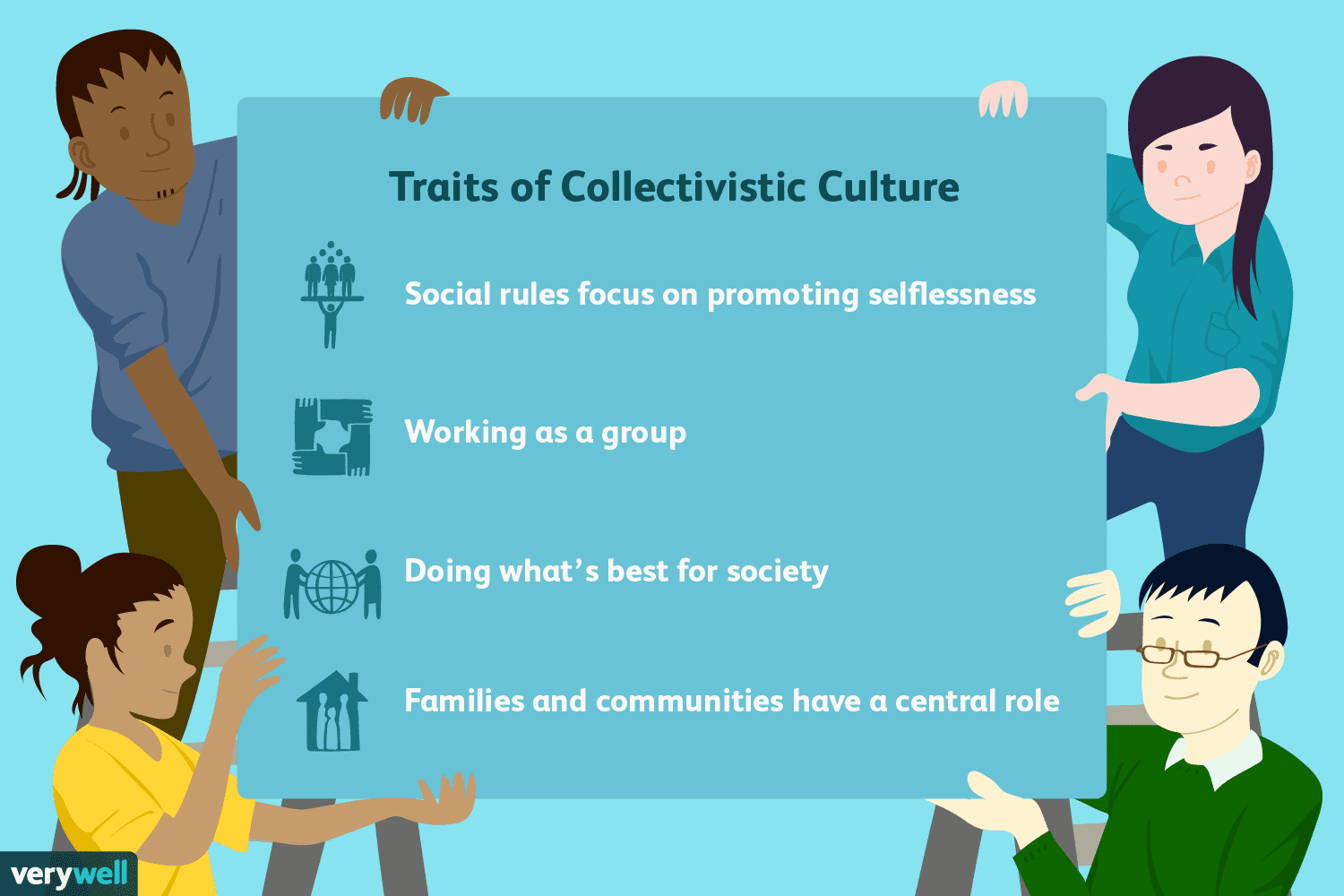
Collectivist cultures generally share these characteristics:
- Individuals define themselves in relation to others (for example, “I am a member of…”).
- Communication is often indirect to avoid potential conflict or embarrassment.
- Group loyalty is encouraged.
- Decisions are based on what is best for the group.
- Compromise is favored when a decision must be made to achieve greater levels of peace.
- Working as part of a group and supporting others are essential.
- Common goals are more important than individual pursuits.
- The rights of families and communities come before those of the individual.
Asian countries such as China, Japan, and South Korea along with countries in South America tend to be more collectivist than others.
Individualism vs. Collectivism
Collectivism stresses the importance of the community and places great value on unity, selflessness, and altruism. Individualism focuses on individual rights and concerns, independence, and personal identity.
These pervasive cultural differences can influence many aspects of society, from the way people shop, dress, and learn to how they conduct business.
For example, workers in a collectivist culture tend to sacrifice their own happiness for the greater good of the group. Those from individualistic cultures, on the other hand, may feel that their own well-being and goals carry greater weight.
The Impact of Collectivism
Collective cultures affect the people within them a few different ways.
Self-Perception
Culture influences self-concept. Although members of individualistic cultures might describe themselves in terms of personality traits and characteristics (e.g., “I am smart, funny, athletic, and kind”), those from collectivist cultures are more likely to describe themselves in terms of their social relationships and roles (e.g., “I am a good parent, sibling, and friend”).
Strong Relationships
Collectivist cultures are associated with low relational mobility, a term that describes the opportunities that individuals in a society have to form relationships with people of their choosing.
Low relational mobility means that relationships are stable, strong, and long-lasting. These relationships are usually formed due to factors such as family and geographical area, rather than personal choice.
In a collectivist culture, building relationships with new people can be difficult, partly because meeting them is, too. Strangers are more likely to remain strangers in a collectivistic culture than in an individualistic culture.
Paradoxically, this means that people in individualistic cultures devote more effort and energy toward actively maintaining close relationships, often through increased self-disclosure and greater intimacy.
Unlike collectivist cultures where stable relationships are expected, relationships in individualistic cultures tend to be more fraught and fragile. People must make a greater effort to maintain these relationships.
Maintaining harmony within interpersonal relationships is of utmost importance in a collectivistic culture. This is likely because these relationships are extremely difficult to change. Failing to keep the peace can mean long-term unhappiness for everyone involved.
Conformity
Cultural differences also influence the motivation to either stand out or fit in with the rest of the group. For instance, one study found that, in a collectivist culture, people submitting an online review are less likely to go against the average rating or express emotions in their review.
Conformity also appears within certain industries. According to research published in the Journal of Economic Growth, descendants of pre-industrial agricultural groups tend to favor collectivist cultures, working in more routine occupations as opposed to driving innovation.
Potential Pitfalls of Collectivism
There are some potential drawbacks of collective cultures.
Social Anxiety
Research shows that collectivistic cultures may foster socially reticent and withdrawn behaviors. In one study, students from Asian cultures (collectivist) displayed higher levels of social anxiety than students from European cultures (individualist).
However, it may not be collectivist values alone that contributed to this. After analyzing the data, the researchers suggested that some of the increase in anxiety could be attributed to Asian American students having greater difficulty in being able to recognize and read emotion.
Less Social Support
People in collectivist cultures tend to be more cautious about sharing their personal problems with their friends. Research shows that they are also cautious when sharing their knowledge within the workplace (even when working in teams), often only doing so if incentivized or if they are highly altruistic.
Instead, people often seek out what is known as implicit social support. This involves spending time with supportive people without actually opening up about or addressing the source of the stress.
Frequently Asked Questions
-
Which of our laws are collectivist?
Labor laws supporting affirmative action or equal opportunity are examples of collectivist laws because they are designed to protect the rights of entire groups. So too are laws regarding vaccinations, healthcare laws, and other forms of public policy.
-
What do collectivist cultures value?
Collective cultures value groups or communities over individuals. Thus, they value generosity over selfishness, harmony over conflict, and meeting the needs of others over meeting the needs of oneself.
-
How can you determine if a country is individualist or collectivist?
If the country’s laws place more focus on protecting the rights of individuals versus groups, it is likely individualist vs. collectivist. Another way to tell the difference is to look at the level of conformity on issues such as fashion and buying preferences, as well as whether members of the community are driven to help others or if everyone must fend for themselves.
-
How is individualism vs. collectivism measured?
One way to measure individualism and collectivism is via the Culture Orientation Scale. This is a 16-point scale that measures the extent to which people see themselves as part of a group or as a fully autonomous being. It also measures their thoughts on whether they believe that each member of the group is equal or if inequality exists.
Verywell Mind uses only high-quality sources, including peer-reviewed studies, to support the facts within our articles. Read our editorial process to learn more about how we fact-check and keep our content accurate, reliable, and trustworthy.
-
Merkin R, Taras V, Steel P. State of the art themes in cross-cultural communication research: A systematic and meta-analytic review. Int J Intercultural Relations. 2014;38:1-23. doi:10.1016/j.ijintrel.2013.10.004
-
LeFebvre R, Franke V. Culture matters: individualism vs. collectivism in conflict decision-making. Societies. 2013;3(1):128-146. doi:10.3390/soc3010128
-
Krassner A, Gartstein M, Park C, Dragan W, Lecannelier F, Putnam S. East-west, collectivist-individualist: A cross-cultural examination of temperament in toddlers from Chile, Poland, South Korea, and the U.S. Eur J Dev Psychol. 2017;14(4):449-464. doi:10.1080/17405629.2016.1236722
-
Lu C, Wan C. Cultural self-awareness as awareness of culture’s influence on the self: Implications for cultural identification and well-being. Pers Soc Psychol Bull. 2018;44(6):823-837. doi:10.1177/0146167217752117
-
Kito M, Yuki M, Thomson R. Relational mobility and close relationships: A socioecological approach to explain cross-cultural differences. Pers Relations. 2017;24(1):114-130. doi:10.1111/pere.12174
-
Hong Y, Huang N, Burtch G, Li C. Culture, conformity and emotional suppression in online reviews. J Assoc Inform Systems. 2016;17(11):737-758. doi:10.17705/1jais.00443
-
Buggle J. Growing collectivism: irrigation, group conformity and technological divergence. J Econ Growth. 2020;25:147-193. doi:10.1007/s10887-020-09178-3
-
Lau A, Wang S, Fung J, Namikoshi M. What happens when you “can’t read the air”? Cultural fit and aptitude by values interactions on social anxiety. J Social Clinic Psychol. 2014;33(10). doi:10.1521/jscp.2014.33.10.853
-
Ma Z, Huang Y, Wu J, Dong W, Qi L. What matters for knowledge sharing in collectivist cultures? Empirical evidence from China. J Knowledg Manage. 2014;18(5):1004-1019. doi:10.1108/JKM-06-2014-0252
-
Yang J, Leu J, Simoni J, Chen W, Shiu C, Zhao H. Please don’t make me ask for help: implicit social support and mental health in Chinese individuals living with HIV. AIDS Behav. 2015;19(8):1501-9. doi:10.1007/s10461-015-1041-y
-
Bogg A. ‘Individualism’ and ‘collectivism’ in collective labour law. Industrial Law J. 2017;46(1):72-108. doi:10.1093/indlaw/dww045
-
Fetzer Institute. Individualism and Collectivism Scale (also known as the Culture Orientation Scale).
Thanks for your feedback!
What is your feedback?
Helpful
Report an Error
Other
