

Key Takeaways
- Prejudice is when you pre-judge someone based on their group without knowing them personally.
- To fight prejudice, recognize when it’s happening and question your thoughts.
- Spending time with different groups and educating yourself can help reduce bias.
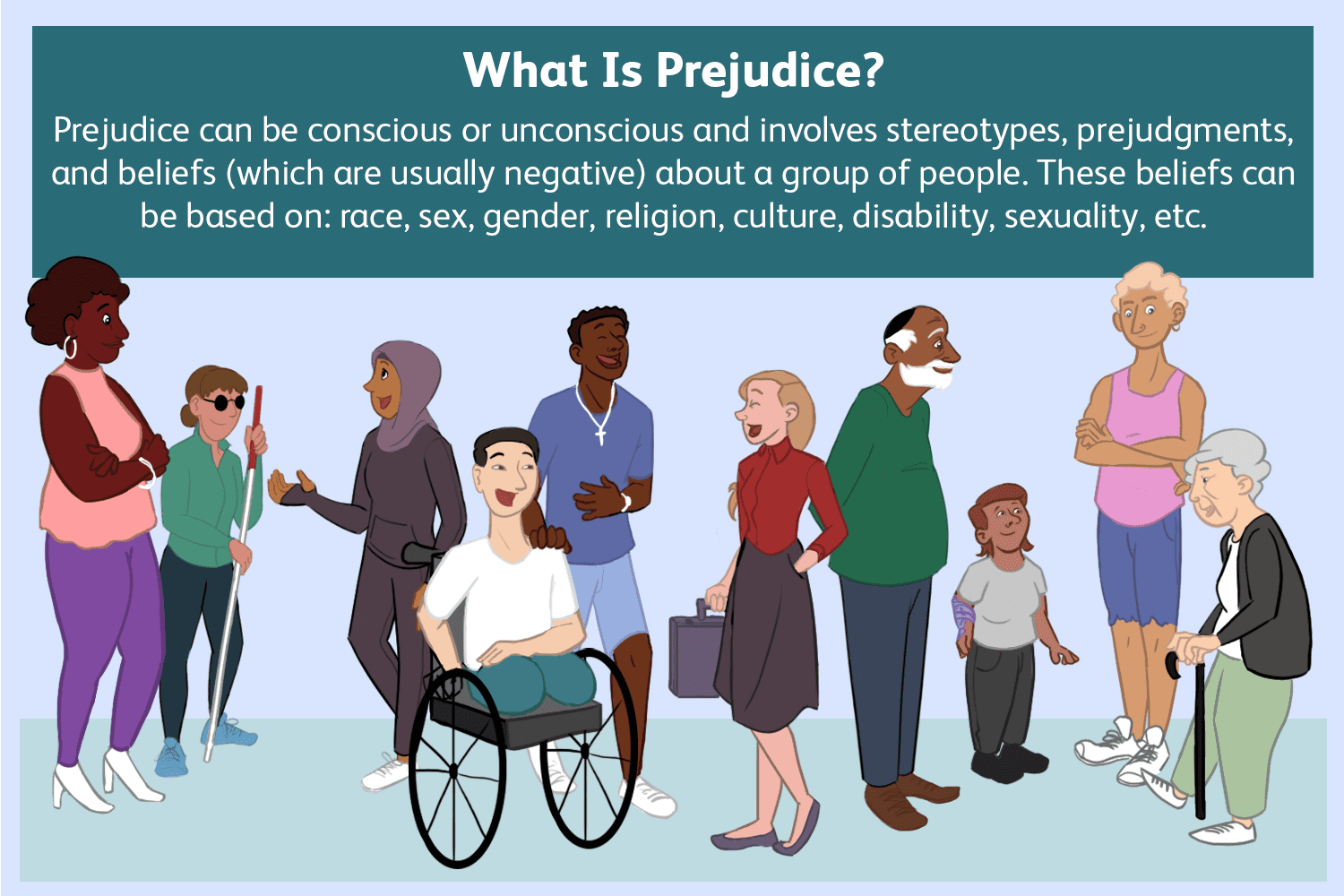
Prejudice is an assumption or an opinion about someone simply based on that person’s membership in a particular group. For example, people can be prejudiced against someone else of a different ethnicity, gender, or religion.
If someone is acting on their prejudices, they are pre-judging (hence the term “prejudice”) someone before even getting to know them on a deeper level. This is an irrational attitude and mindset which does no good for anyone involved.
“Prejudice” comes from the Latin prejudicium (“injustice”) and praeiudicium (“prior judgment”), which referred to judicial examination before trial.
For example, a person might have a lot of preconceived ideas about someone who is Christian, Muslim, or Jewish and will allow those judgments to affect the way they view and treat those people. The same can be true for people who are Black, White, or Asian.
Common features of prejudice include:
- Negative feelings
- Stereotyped beliefs
- A tendency to discriminate against members of a group
In society, we often see prejudices toward a group based on race, sex, religion, culture, and more.
While specific definitions of prejudice given by social scientists often differ, most agree that it involves prejudgments that are usually negative about members of a group.
Types of Prejudice
As mentioned, a prejudiced attitude can be based on a number of factors, including sex, race, age, sexual orientation, nationality, socioeconomic status, and religion. Some of the most well-known types of prejudice include the following:
Prejudice is not the same as discrimination. Whereas prejudice refers to attitudes and beliefs in the abstract, discrimination describes actions that can arise from prejudice.
How Prejudice Negatively Affects All Parties
When people hold prejudicial attitudes toward others, they tend to view everyone who fits into a certain group as being “all the same.” They paint every individual who holds particular characteristics or beliefs with a very broad brush and fail to really look at each person as a unique individual.
This has a very strong influence on how people behave and interact with those who are different from them.
At a basic level, it can stifle a prejudiced person’s ability to learn more about those who are different from themselves. As a result, it can also cause them to miss out on relationships or conversations that have the potential to be deeply fulfilling.
Those on the receiving end of prejudice are particularly impacted, though. Not only can those presuppositions and biases inflict true hurt, but it can even affect their ability to get a “fair shot” in this world.
For example, the ubiquitous prejudice against Black people has translated into higher incarceration rates, fewer job offers, and lower pay.
Another blatant example is the prejudice against Muslims; the rampant anti-Muslim sentiment in the West has led many people to believe that all Muslims are violent and hateful.
Why Prejudice Occurs
There’s no clear answer to why prejudice exists and the reality is that a number of factors come into play. According to psychologist Gordon Allport, prejudice and stereotypes emerge in part as a result of normal human thinking. In order to make sense of the world around us, it’s important to sort information into mental categories.
The human mind must think with the aid of categories. Once formed, categories are the basis for normal prejudgment. We cannot possibly avoid this process. Orderly living depends upon it.
—
GORDON ALLPORT, THE NATURE OF PREJUDICE
In other words, we often depend upon our ability to place people, ideas, and objects into different categories in order to make the world easier to understand.
We are simply inundated with too much information to sort through all of it in a logical, methodical, and rational fashion. Unfortunately, this quick categorization leads to faulty assumptions that have an impact on individuals and the world at large.
Fighting Against Prejudice
While in some cases prejudice is blatant—evolving into outright “-isms”—it can often occur without us even realizing it. Whether deeply ingrained, taught, or implicit bias, it is important to fight the prejudices we have against others.
One of the first ways to do this is to understand and accept that it happens. By being aware of your own natural tendency to be biased (and it’s something we all experience, whether consciously or not), you’ll be able to catch yourself more easily “in the act” and self-correct.
Recognizing and Correcting Your Prejudices
When you realize that you are pre-judging someone else, try asking yourself the following questions:
- Why am I having this thought?
- What proof do I have that my judgment about this particular person or group is correct?
- What don’t I know about this person or group?
- Is it possible that I could be biased?
In addition to looking at the reasons why prejudice occurs, researchers have also explored different ways that prejudice can be reduced or even eliminated. For example, equipping yourself with the skills to be more wholly empathetic to members of another group is one method that has shown considerable success.
For instance, simply imagining yourself in the same “shoes” as the other person can humanize them to you. In that moment, they are no longer just a random member of a group that’s different from your own (one you may not fully understand).
Instead, they become a more complex being in your eyes—someone with a mother and father, a sibling, a friend to others, a co-worker, a romantic partner—someone with unique interests and the ability to love, cry, and feel.
Other techniques that reduce prejudice include:
- Thinking about the fact that others are likely prejudiced against you and sitting with how it feels to be pre-judged based on something as simple as your skin color, religion, sex, or age
- Educating yourself about other groups, which includes learning about common stereotypes against them
- Spending more time with members of other groups
- Having open conversations about the human tendency to practice prejudice
- Advocating for laws and regulations that require fair and equal treatment for all groups of people
Verywell Mind uses only high-quality sources, including peer-reviewed studies, to support the facts within our articles. Read our editorial process to learn more about how we fact-check and keep our content accurate, reliable, and trustworthy.
-
Prejudice. Etymology, origin and meaning of prejudice. Online Etymology Dictionary.
-
Crawford JT, Brandt MJ. Who is prejudiced, and toward whom? The big five traits and generalized prejudice. Pers Soc Psychol Bull. 2019;45(10):1455-1467. doi:10.1177/0146167219832335
-
Rouse L, Booker K, Stermer SP. Prejudice. In: Goldstein S, Naglieri JA, eds. Encyclopedia of Child Behavior and Development. Springer; 2011. doi:10.1007/978-0-387-79061-9_2217
-
Economic Policy Institute. Black-White wage gaps expand with rising wage inequality.
-
Pew Research Center. Many Americans see religious discrimination in U.S. – especially against Muslims.
-
Allport GW. The Nature of Prejudice. Addison-Wesley; 1954.
Thanks for your feedback!
What is your feedback?
Helpful
Report an Error
Other
