

Key Takeaways
- Racing thoughts are fast, uncontrollable thoughts often linked to the manic or hypomanic phase of bipolar disorder.
- Therapy, medication, and deep breathing can all help manage racing thoughts.
- Because racing thoughts can also be a sign of other conditions such as anxiety, OCD, or psychosis, it’s important to talk to a doctor to get an accurate diagnosis.
Racing thoughts involve fast-moving, repetitive, and overwhelming thought patterns. They often involve multiple topics, move quickly from one idea to the next, and seem to come out of nowhere.
Everyone occasionally experiences situations that cause their mind to race. Imagine that feeling amped up several notches and persisting without relief, and you’ll have an idea of what it’s like to experience racing thoughts. This symptom often signals a hypomanic or manic episode in people living with bipolar disorder, although there are other possible causes.
Press Play for Advice On Living With Bipolar Disorder
This episode of The Verywell Mind Podcast, featuring actor Maurice Benard, shares for living with and managing bipolar disorder symptoms. Click below to listen now.
Follow Now: Apple Podcasts / Spotify / Google Podcasts / Amazon Music
Signs of Racing Thoughts
Racing thoughts are more than just thinking fast. Instead, they are a rapid succession of thoughts that cannot be quieted and continue without any sign of restraint. Even when you try to control them, they just keep coming, one after another, with little ability to slow them down.
They can progressively take over a person’s functional consciousness and gallop out of control to a point where daily life can be affected. This symptom can become so severe that it interferes with the ability to sleep.
When talking with someone experiencing racing thoughts, it’s usually readily apparent because they not only speak at a rapid clip but also quickly jump from one topic to another.
This outward manifestation of racing thoughts is called flight of ideas. Thus, racing thoughts and flight of ideas are two sides of the same coin.
Racing thoughts might revolve around rhythms, almost like a broken record without sound. They might include a bar of music, a snippet of a conversation, a sentence in a book, or dialogue from a movie that repeats in one’s mind. Importantly, racing thoughts do not involve hearing voices, a symptom associated with schizophrenia and other types of psychotic disorders.
What Racing Thoughts Feel Like
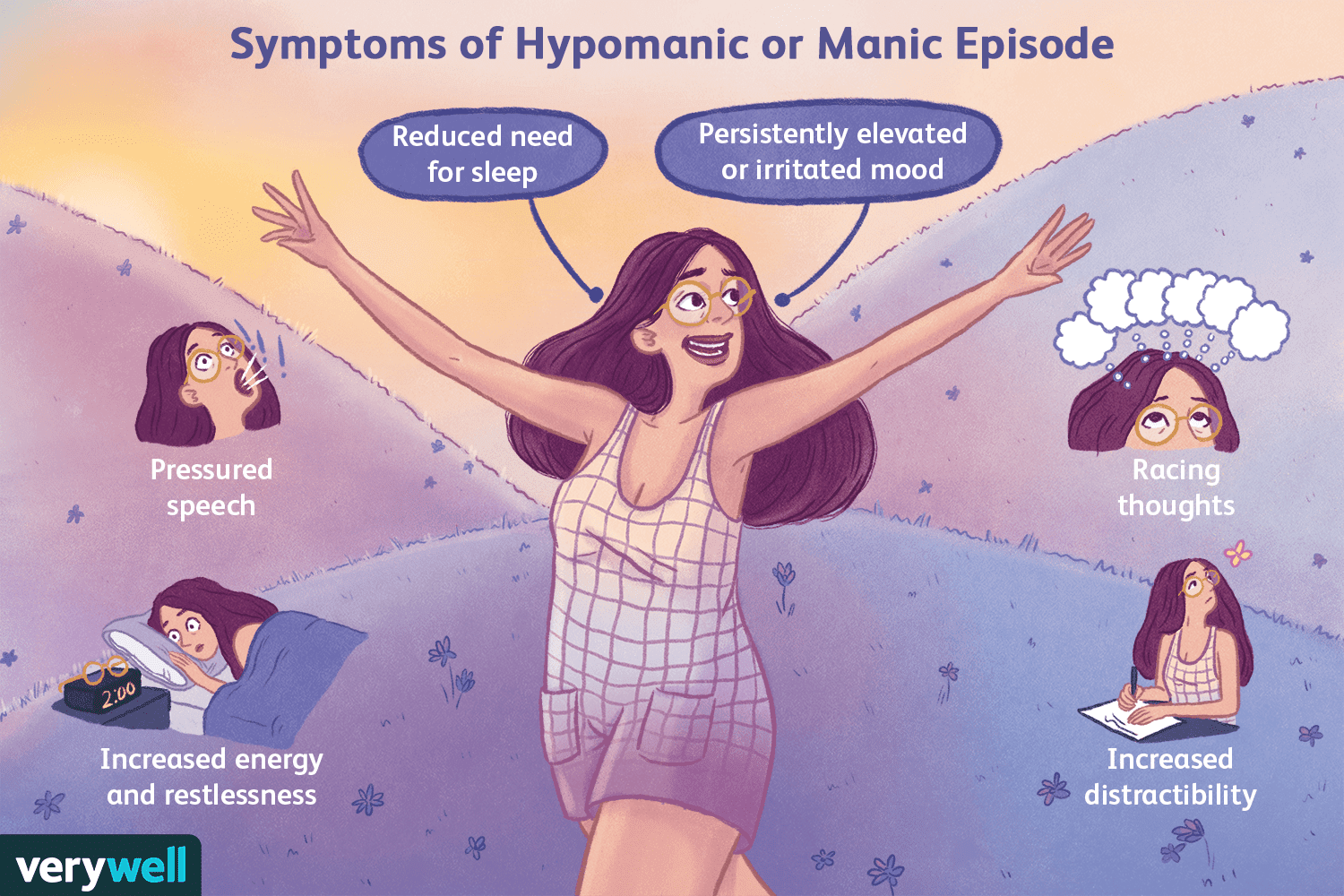
Racing thoughts are often one of the first symptoms to develop when someone with bipolar disorder is entering a hypomanic or manic episode. It can be—but is not always—a debilitating experience.
Some people describe it as having excessive thoughts that move quickly, but with a sense of fluidity and pleasantness. In others, however, the experience can be jarring.
Concentration can become increasingly difficult, and the inability to quiet the relentless onslaught of thoughts can prove unnerving and disruptive. It is not unusual to hear of people who need to play word games for an hour or two just to settle their thoughts enough to sleep.
Racing thoughts and flight of ideas in the context of a hypomanic or manic episode are accompanied by other signs and symptoms that might include:
Pre-Diagnosis
People who experience hypomania—as opposed to full-blown mania—are typically able to maintain their daily functioning and, as such, often go undiagnosed until their first depressive episode occurs. So, racing thoughts and flight of ideas may predate a person being diagnosed with bipolar disorder, typically type II.
Additionally, racing thoughts and flight of ideas that occur without the requisite number of accompanying symptoms to meet the criteria for a diagnosis of hypomania or mania may identify a person at risk for eventually developing bipolar disorder. This is sometimes referred to as a subthreshold bipolar disorder.
Racing thoughts and flight of ideas accompanied by an elevated or irritable mood appear to increase an individual’s risk for eventually developing full-blown bipolar disorder.
What Causes of Racing Thoughts?
Bipolar disorder is one potential cause, but racing thoughts and flight of ideas can occur with conditions including major depression and anxiety disorders. That’s why talking to a doctor or mental health professional about what you are experiencing is so important. They can evaluate your symptoms and help determine the cause.
Common causes of racing thoughts include:
While racing thoughts can be a symptom of a mental disorder, they are not specific to a particular illness. The accompanying signs, symptoms, mood, and behaviors help distinguish the various possible causes of this symptom.
Talk with your doctor if you experience racing thoughts, especially if they interfere with your ability to work, sleep, concentrate, or interact with others. Once the cause of your symptoms is identified, you can receive appropriate treatment.
Treatment for Racing Thoughts
The treatment for racing thoughts depends on the underlying condition causing them. In many cases, recommended treatments may include therapy and medications.
Therapy
For racing thoughts that occur in bipolar disorder, therapy can help people learn to identify changes in mood and behavior. By learning how to identify things that might trigger manic or hypomanic episodes, people can better manage their condition.
Cognitive-behavioral therapy (CBT) is a type of therapy that helps people understand and manage their thoughts. In CBT, people learn to identify their thoughts and develop new strategies to change or regulate them.
Other types of therapy that may help treat bipolar disorder include dialectical behavior therapy (DBT) and family therapy.
Medications
Medications may also be helpful. The specific type of medication that your doctor prescribes will depend on your diagnosis but may include:
- Anti-anxiety medications
- Antidepressants
- Antipsychotics
- Mood stabilizers
If your racing thoughts are related to bipolar disorder, antipsychotics, such as Abilify (aripiprazole), Risperdal (risperidone, and Seroquel (quetiapine), or mood stabilizers, like Depakote (divalproex sodium) and Tegretol (carbamazepine), may be prescribed.
How to Cope With Racing Thoughts
In addition to seeking help from a mental health professional, there are also strategies you can use on your own to help manage racing thoughts. Some steps you can take include:
- Practice deep breathing: Deep breathing can help induce a relaxation response and calm feelings of stress and anxiety.
- Utilize mindfulness: Racing thoughts are often centered on worries about the future. Practicing mindfulness by focusing on the present moment can help calm these worrying thoughts.
- Distract yourself: When your mind is racing, try to distract yourself with something else. For example, you might try cooking a new recipe, listening to music, painting a picture or watching a movie.
- Get active: Exercise has many mental health benefits, including combatting feelings of anxiety and depression.
You might need to experiment with several strategies to determine what works best. Talk to a doctor or mental health professional if you still struggle to manage your thoughts after trying some self-help techniques.
Verywell Mind uses only high-quality sources, including peer-reviewed studies, to support the facts within our articles. Read our editorial process to learn more about how we fact-check and keep our content accurate, reliable, and trustworthy.
-
Homish GG, Marshall D, Dubovsky SL, Leonard K. Predictors of later bipolar disorder in patients with subthreshold symptoms. J Affect Disord. 2013;144(1-2):129-33. doi:10.1016/j.jad.2012.06.020
-
American Psychiatric Association. What are bipolar disorders?
-
National Institute of Mental Health. Bipolar disorder.
-
Correll CU, Hauser M, Penzner JB, et al. Type and duration of subsyndromal symptoms in youth with bipolar I disorder prior to their first manic episode. Bipolar Disord. 2014;16(5):478-92. doi:10.1111/bdi.12194
-
Camacho M, Almeida S, Moura AR, et al. Hypomania symptoms across psychiatric disorders: Screening use of the Hypomania Check-List 32 at admission to an outpatient psychiatry clinic. Front Psychiatry. 2018;9:527. doi:10.3389/fpsyt.2018.00527
-
Curtiss JE, Levine DS, Ander I, Baker AW. Cognitive-behavioral treatments for anxiety and stress-related disorders. Focus (Am Psychiatr Publ). 2021;19(2):184-189. doi:10.1176/appi.focus.20200045
-
Ma X, Yue ZQ, Gong ZQ, et al. The effect of diaphragmatic breathing on attention, negative affect and stress in healthy adults. Front Psychol. 2017;8:874. doi:10.3389/fpsyg.2017.00874
-
Aylett E, Small N, Bower P. Exercise in the treatment of clinical anxiety in general practice – a systematic review and meta-analysis. BMC Health Serv Res. 2018;18(1):559. doi:10.1186/s12913-018-3313-5
Thanks for your feedback!
What is your feedback?
Helpful
Report an Error
Other
