

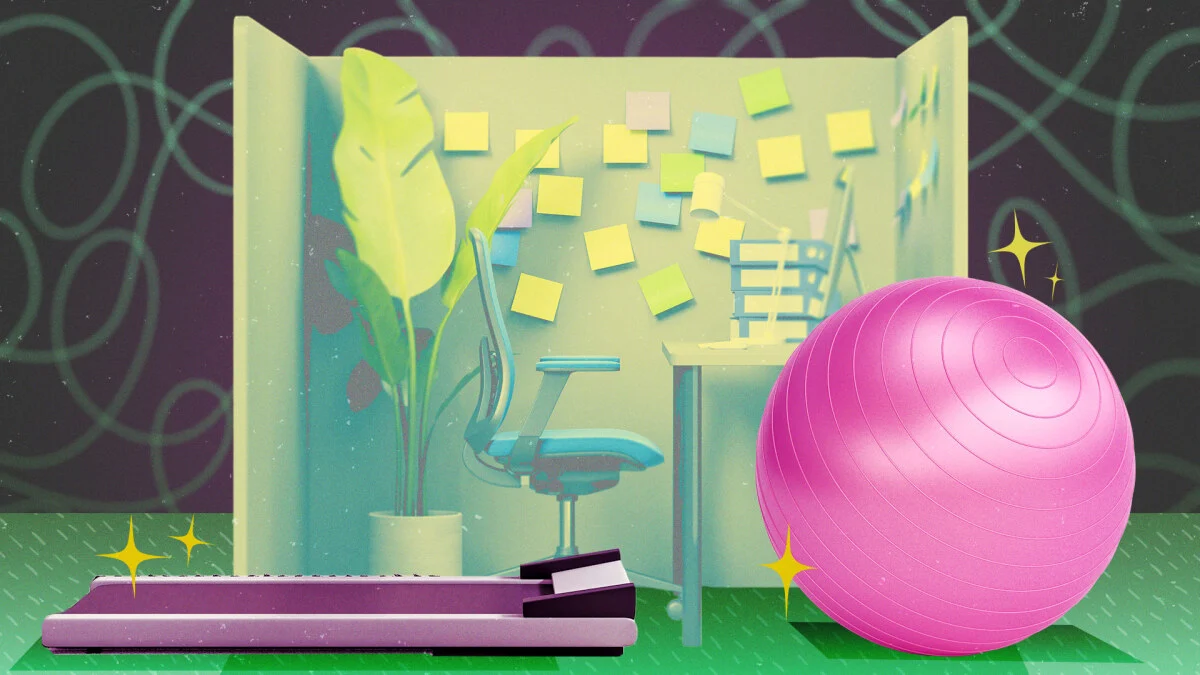
To me, the under-desk treadmill is the ultimate symbol of productivity culture (read: late-stage capitalism). And I’m exactly the type to buy into the under-desk treadmill appeal. Why shouldn’t I want to walk while I work, burn calories during calls, and transform my sedentary office prisons into a wellness wonderland—all without sacrificing a single billable hour? (Never mind that I don’t work in an office or bill my hours.) Office fitness is the perfect hack for our optimization-obsessed culture, promising that we can have it all: career success and physical health, no trade-offs required.
But when I see an under-desk treadmill, I also remember when we all swore that replacing our desk chairs with yoga balls would change our lives. Or that a standing desk, or a balance board, or some kind of pedaling contraption would do the same. In other words, nothing ever changes. I’m not denying that there’s a problem with fully sedentary work days; it’s just that no one gadget ever seems to be the solution. And the problem isn’t that we lack willpower or that the products are inherently flawed. The problem is that we’re buying solutions to the wrong problem.
The allure of multitasking your way to health
I’m not immune to the fantasy either. When you’re drowning in deadlines and meetings bleed into evenings, the idea that you could somehow merge your workout with your workday feels like a lifeline. Why carve out an hour for the gym when you could just walk while answering emails? It’s efficient! It’s smart! It’s…probably not going to work the way you hope.
“I think these products can and do work for some people, but there’s an important caveat: there’s no replacement for actually getting away from your desk for a mental and physical break,” says Jen Fisher, formerly the chief wellbeing officer at Deloitte. “There’s a real irony here—these products aim to solve one problem (sedentary behavior) but reinforce another (never truly disconnecting from work).”
Therein lies the paradox: We’re trying to optimize ourselves into working more, not better. An under-desk treadmill might give you movement, sure, but it keeps you tethered to your screen, always available, always productive.
You might think that if anyone could make office fitness gadgets work, it would be Google—a company famous for its wellness perks and campus amenities. But even there, this pattern persists. “I love the treadmill desks that we have available whenever I’ve used them,” says Shosh Brodman, a senior Google Workspace program manager with over 13 years at the company. “But I think I’ve used it maybe less than five times.” Brodman’s experience with an under-desk pedaling device was similar: initial excitement followed by abandonment.
She says that despite access to gyms, treadmill desks, and a culture that supports movement, the fundamental problem remains: the structure of modern work doesn’t actually allow for these interventions. The one thing that did work for her? Step-tracking contests that encouraged actual breaks and movement, creating social motivation to escape the desk entirely. Compared to an under-desk treadmill, a real lunch walk gives you something far more valuable: a little mental space, entirely separate from work.
Fitness gadgets become another source of anxiety
The fitness gadget industrial complex has convinced us that the path to wellness is paved with data, tracking, and technology. But for many people, these tools become yet another thing to feel bad about.
“When it specifically comes to products that people use to mitigate their sedentary lifestyle, gadgets are never the answer,” says Melissa Painter, founder of Breakthru, an app that guides users through two-minute movement breaks. “Especially not gadgets that cause us inadvertently to outsource our body’s intelligence to a piece of tech. The minute we’re staring at data in the face of what we’ve ‘done wrong,’ the more likely we’re going to put it in a drawer and step away.”
This points to a pattern many of us recognize: the sleep tracker that made us more anxious about sleep, the step counter that turned movement into a guilt-inducing scorecard. Tools are only useful if they nudge us toward feeling better, rather than becoming another metric of inadequacy.
The absurdity becomes clear when we consider what actually helps us think and solve problems. “The reason going for a walk helps you solve a problem is because you’re moving and untethered,” Painter says. “The space and time away from your screen is an invitation for your mind to wander just enough so that instinctual solutions can emerge. Walking on a treadmill is not going to have the same impact. It’s like trying to do the wrong kinds of thinking at once.”
Breaking free from productivity culture
Here’s what makes our gadget obsession even more frustrating: We already know what works, but we just don’t want to hear it, because it requires actually stepping away from work. “It’s very American to think we don’t need breaks,” Painter says. Trapped in non-stop productivity culture, we fall prey to this idea that “wellness” requires an enormous amount of time and money. We live in a culture that treats rest as laziness and breaks as luxuries.
Fisher says that the type of work matters: “For passive tasks—listening to a meeting, reading documents—these tools might genuinely help. But I worry about the cultural message when we’re optimizing to work more rather than building in real breaks that actually support our wellbeing.” If these gadgets work in addition to actual breaks, great. But if you’re thinking “now I can skip my lunch walk because I have a treadmill desk,” that’s where we’ve gone wrong.
Fitness gadgets around the office allow us to maintain this idea that we can always be productive without any downtime. As if our bodies are just machines that need the right accessories to run indefinitely. We’d rather invest in expensive gadgets that let us keep working than accept that you might need to actually stop and rest. As a result, most of us end the workday feeling overwhelmed, fatigued, nowhere near the end of our to-do lists, and nowhere close to wanting to go to the gym.
The problem isn’t the under-desk treadmill itself, but the slippery slope of non-stop-optimization it represents. So, what’s the solution?
How to actually prioritize your wellness at work
The irony is that the effective solutions are free and simple—they just require us to challenge the “always on” culture we’ve normalized.
What people need instead are genuinely brief interventions that help them feel better and reconnect with their bodies. Getting up to see the sun. Watering a plant. Taking a walking meeting. These aren’t fancy, and they don’t require a $1,200 piece of equipment, but they do require something that feels even more expensive in our work culture: permission to stop working, even briefly.
There’s no need to swear off all office fitness products. Standing desks with decent ergonomics have real value for shifting body position throughout the day. If you genuinely use that balance board or under-desk elliptical regularly for passive tasks, and it’s in addition to real breaks, keep at it.
But for most of us, the better investment isn’t another gadget—it’s the harder work of time management and cultural change:
-
Set actual boundaries around breaks. Block time for a real lunch away from your desk. Schedule walking meetings. Stand up and stretch between Zoom calls. These sound obvious because they are, but we skip them because we’ve internalized the message that real breaks are indulgent.
-
Question the productivity narrative. Just like your doctor has been telling you for years: more movement throughout your day, across your lifetime, improves thinking, mood, focus, and attention span. If you still want to think in terms of productivity, consider that taking breaks isn’t sacrificing productivity, but actually promoting it.
-
Start absurdly small. You don’t need a $1,500 treadmill desk. You need to get up once an hour and walk to the window. Water a plant, step outside for a coffee, or try to touch your toes.
The bottom line
The fitness gadget industry thrives on our desire to optimize, to find the one weird trick that lets us have it all. But the actual hack is much less sexy: we need to accept that human bodies require breaks, that our brains need space to wander, and that no piece of equipment will let us cheat these fundamental needs.
The treadmill desk isn’t evil. It’s just a symptom of our broader refusal to accept that rest is productive, and that being fully present for our work sometimes means being fully absent from our screens.
So before you click “buy” on that under-desk elliptical, ask yourself: Am I solving my sedentariness problem, or am I buying permission to never truly step away from work? Because if it’s the latter, you already know where it’s going to end up—right next to that dusty yoga ball in the corner.
