

Key Takeaways
- Social workers help vulnerable people with a wide range of issues, from finding secure housing, applying for community services, and providing mental health treatment.
- To become a social worker, a Bachelor’s degree is the minimum requirement, and most states require a license.
- Social work careers are expected to grow 7% from 2022 to 2032, faster than the average for all jobs.
A social worker is a mental health professional who works to improve the lives of vulnerable populations. They work with individuals and communities to overcome challenges and effect social change.
Social work is an exciting career area that is highly related to psychology. Are you looking for a career that is rewarding yet challenging? Do you want to contribute to society by helping people overcome difficulties and improve their lives? Social work fits this description, which is why many psychology undergraduates opt to pursue it.
While many individuals who work in this field start by earning an undergraduate degree in social work before moving on to graduate school, some psychology majors opt to switch to a social work master’s program after earning their degrees.
What Is a Social Worker?
So what exactly is a social worker? These mental health professionals help people with a broad range of issues, including psychological, financial, health, relationship, and substance abuse problems. Learn more about what social workers do, the educational requirements, and the projected job outlook for the field.
Fast Facts
- Social workers held approximately 728,600 jobs in 2022, according to the Bureau of Labor Statistics.
- Most jobs in the field require a Master’s degree in Social Work.
- Social workers are employed in various settings, including hospitals, mental health clinics, schools, nonprofit agencies, and government offices.
What Does a Social Worker Do?
The field of social work utilizes social theories to understand human problems, to help improve people’s lives, and to improve society as a whole.
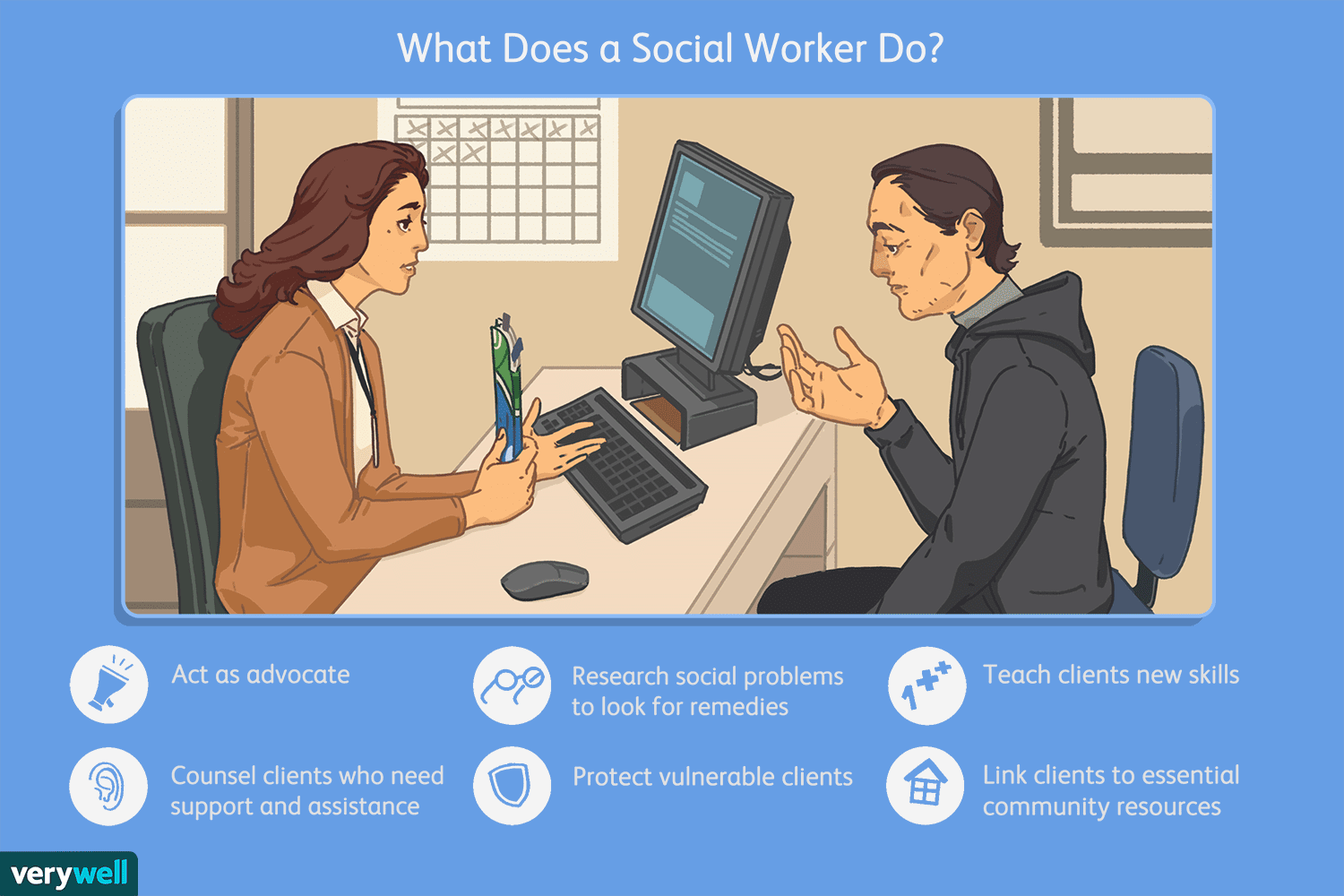
Social workers:
- Act as advocates for their clients
- Promote social welfare
- Educate clients and teach them new skills
- Link clients to essential resources within the community
- Protect vulnerable clients and ensure that their best interests are observed
- Counsel clients who need support and assistance
- Research social problems to look for remedies
- Advocate for social justice
Many who work in this field specialize in particular areas, such as helping children, assisting those with life-threatening problems, or aiding people in overcoming addictions.
Who Social Workers Help
Social workers work with a wide range of people, including:
- Kids and teens
- People with mental health conditions
- Disabled people
- Unhoused people
- Veterans
- Victims of trauma or violence
- Couples and families
- Older adults
- LGBTQIA+ people
- People with substance use problems
- Students
- Immigrants and refugees
- People with medical issues or chronic illnesses
Where Are Social Workers Employed?
According to the U.S. Bureau of Labor Statistics, about half of all social workers are employed as child, family, and school social workers, a trend projected to continue through 2032.
Areas where social workers often work include:
- Individual and family services: 17%
- Ambulatory healthcare services: 14%
- Local government, excluding education and hospitals: 14%
- State government, excluding education and hospitals: 13%
- Hospitals; state, local, and private: 10%
Professionals in government positions might conduct child welfare assessments, help individuals in need of public assistance, and work with people who have come into contact with the criminal justice system.
Salary Information
Salaries can vary based on various factors, including geographic location, educational background, and specialty area.
The U.S. Department of Labor reports that the median annual wage for social workers as of 2022 was $55,350. The lowest 10% made less than $36,600, and the highest 10% made more than $87,300.
According to the National Association of Social Workers, those just starting out in their career with an undergraduate degree in social work earn a mean income of $31,327 per year. Those with a Master’s degree typically average a mean income of $44,418.
The U.S. Department of Labor reports the following median yearly earnings for different specialty areas in social work:
- Child, family, and school social workers: $50,820
- Mental health and substance abuse social workers: $51,240
- Healthcare social workers: $60,280
How to Become a Social Worker
In order to become a social worker, a Bachelor of Social Work (BSW) degree is the minimum requirement. However, some individuals with psychology, sociology, and education degrees are able to find entry-level jobs in social work.
If you are interested in providing therapy services, then a Master of Social Work (MSW) degree is required. Are you interested in teaching at the university level or conducting research? Then you will need to earn a doctorate degree in social work (DSW).
Requirements vary by state, but most states require social workers to be licensed, registered, or certified in their field. For example, becoming a licensed clinical social worker (LCSW) generally requires taking an exam and completing at least two years of supervised clinical experience.
Social Worker Specialty Areas
Social workers often opt to specialize in a specific area. Some of these include:
Medical and Public Health Social Workers
Those specializing in medical or public health social work offer psychosocial services to individuals, families, and groups affected by acute, chronic, and terminal illnesses. These services might involve:
- Providing psychological counseling
- Connecting clients with resources in the community
- Helping families who are caring for a sick loved one
Child, Family, and School Social Workers
Child, family, and school social workers work with children and families. Some work in school settings to help children with academic, social, and emotional issues. Others may work with foster children, help arrange adoptions, and assist single parents.
Some specific tasks they may perform include:
- Helping families access housing
- Connecting families with services such as childcare, benefits, or food stamps
- Intervening when children are experiencing abuse or neglect
- Assisting with arranging foster care or adoptions
Mental Health and Substance Abuse Social Workers
Mental health and substance abuse social workers assess and treat individuals suffering from mental health problems or addiction and substance abuse issues. Social workers in this specialty area may provide:
Levels of Social Work
Social work is also categorized into different levels of practice:
- Micro social work involves working directly with individuals, families, or couples.
- Mezzo social work involves working with larger groups of people, often by supervising other social workers or administering services.
- Macro social work involves working with communities and organizations to develop and administer programs and policies.
Job Outlook for Social Workers
The U.S. Bureau of Labor Statistics projects that social work careers will grow 7% from 2022 to 2032, much faster than the average for all occupations. While employment opportunities in urban areas are predicted to be more competitive, the Department of Labor suggests that job demand will also be good in rural locations.
What This Means For You
A career as a social worker can be rewarding, but it’s important to consider your needs, educational requirements, and job outlook before you decide if it is the right choice for you. Consider talking to a practicing social worker to learn more, or talk to your academic advisor to learn more about your options. If you’re unsure whether this career path is right for you, a psychology careers self-test can help you get a better idea.
Thanks for your feedback!
What is your feedback?
Helpful
Report an Error
Other
