

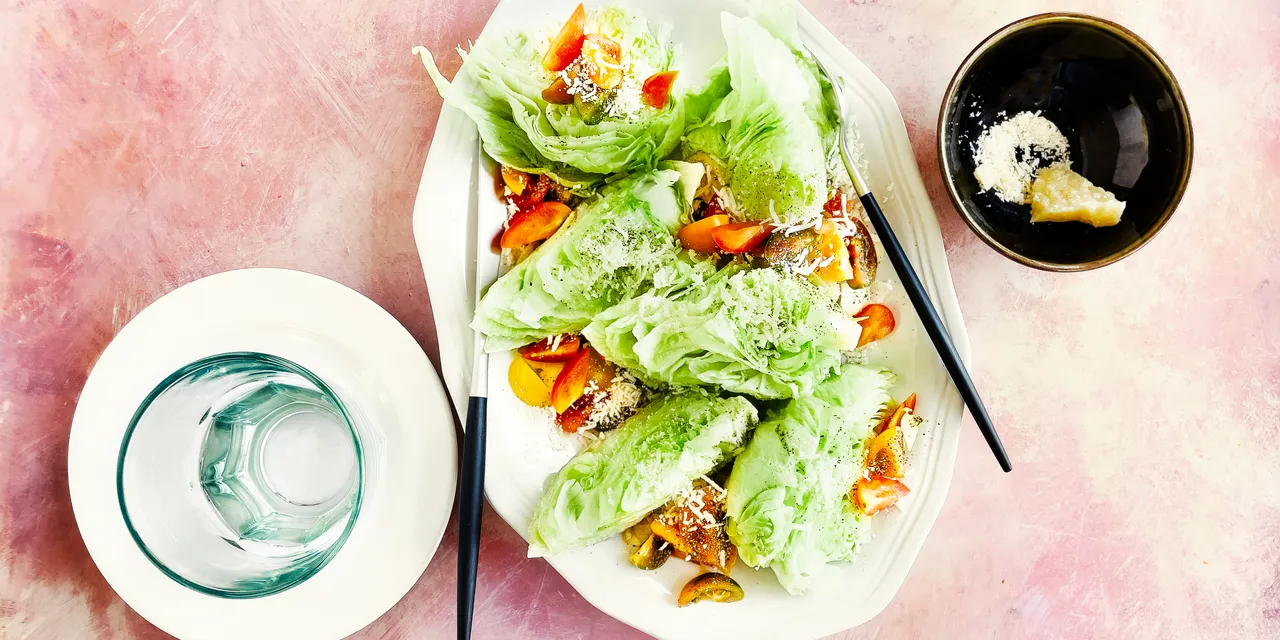
It’s well documented that making a satisfying salad is no easy feat. Between nailing the balance of protein, fiber, fat, and carbs, and making it all taste good in the process, there’s a lot that can go wrong between prepping and plating.
One part that shouldn’t be difficult? Picking a leafy green that will form the base of your dish. The problem is, even that decision can feel impossible when the consensus has long been against the most affordable and reliable option: iceberg lettuce.
The refrain that iceberg lettuce has “no nutrients” is one we hear all the time, but does it hold up as well as said vegetable does to a heavy dressing? Not really, according to registered dietitians. We chatted with them to find out why they think it’s time to bring back the old standby and why the anti-iceberg lettuce wave was flawed from the start.
Why did folks turn on iceberg lettuce?
There are a few reasons why what was once the go-to for salads fell out of favor, and almost all of them have to do with cultural and nutritional perceptions that aren’t really supported by science, Cara Harbstreet, MS, RD, LD, of Street Smart Nutrition, tells SELF.
Iceberg lettuce hate started when love for kale and other dark, leafy greens took off, she says. “When stacked next to dark leafy greens, the nutrition in iceberg lettuce seems to pale in comparison.” And it’s true that iceberg lettuce has fewer nutrients than those trendier alternatives, but that doesn’t mean it can’t be worthwhile in the right context (more on that in a bit).
Diet culture has also had a heavy hand in perpetuating the idea that the veggie is a low- or no-calorie food. This was seen as a benefit for a time, but as the desire for heartier fare grew, so too did the idea that the only real benefit to eating iceberg lettuce was its lack of calories, she explains.
Where iceberg lettuce gets the most use has similarly impacted its image, Wendy Lopez, MS, RD, CDCES, co-founder and COO of Diabetes Digital, tells SELF. “[It’s] commonly associated with fast food, diners, school lunches, and lower-cost meals, and when a food is linked to low-income communities, people often make unfair assumptions about its value,” she explains. It’s no coincidence that the anti-iceberg lettuce sentiment is heavily influenced by the types of people who are less likely or will never need to eat at those types of establishments.
