

Key Takeaways
- People with chaotic early relationships might feel comfort in unstable love-hate relationships because it feels familiar.
- Feeling unworthy or unlovable can lead someone to accept chaotic relationships as the norm.
- To navigate a love-hate relationship, set boundaries and be more aware of your emotions.
If it feels like your relationship has a lot of ups and downs and you hate your partner as much as you love them, you may be in a love-hate relationship.
People in love-hate relationships experience intense emotions and tend to vacillate between one end of the love-hate spectrum to the other extreme, says Sabrina Romanoff, PsyD, a clinical psychologist and professor at Yeshiva University.
Romanoff says that these relationships feel like rollercoasters, as there is both excitement and exhaustion, and couples must navigate the more negative aspects of these relationships like aggression and frustration to reap the benefits like passion and thrill.
This article explores the causes and impact of love-hate relationships, as well as some strategies that can help you navigate them.
How a Love-Hate Relationship Can Happen
Romanoff outlines the causes of love-hate relationships below and explains how these relationships can impact your mental health.
Having Volatile Relationships in Early Life
People who have chaotic or volatile relationships in their early years tend to find solace in the unstable nature of love-hate relationships because they are familiar and they may conceptualize conflict as a way to express love.
For these people, conflict is a way to gauge their partner’s interest in them through their perseverance to seek resolution. The closeness that is experienced after the resolution following a rupture in the relationship can feel more intimate than not having one at all.
In turn, stable and even-keeled relationships might feel boring, or they might quickly feel doubtful about how the other person feels about them.
The problem with love-hate relationships is the belief that the pain and tension they bring relate to closeness in relationships. What these folks often don’t realize is that these relationships are not the norm and that there are other possibilities.
However, past experience has taught them that this is the only option. They don’t realize that there are people who will consider their feelings, who will be courteous to their preferences, and who will communicate openly and effectively.
Additionally, the good in these relationships or how the couple works well together will be magnified relative to the bad, so many couples have a skewed perception of how the relationship is and is not working for them because they are constantly navigating extremes.
These people must learn to let go of what they gain from conflict by looking at the long-term effects and sustainability of these patterns.
Feeling Unworthy of Love
People who find themselves in love-hate relationships might have predisposing vulnerabilities such as feeling unworthy or unlovable. Chaotic relationships might reinforce these beliefs they have about themselves, and they might not think they are deserving of more.
Therefore, these relationships reinforce their most negative or critical self-thoughts. They also provide a false sense of being loved and might cause them to think their relationship is more meaningful because of the struggle and conflict they endured for it.
The truth is, just because you don’t have chronic and daily struggles in your relationship, doesn’t mean it’s not valuable. In fact, it’s the opposite, but it requires faith in the relationship to believe in it, without the daily proof of what you are sacrificing for the relationship.
Navigating Love-Hate Relationships
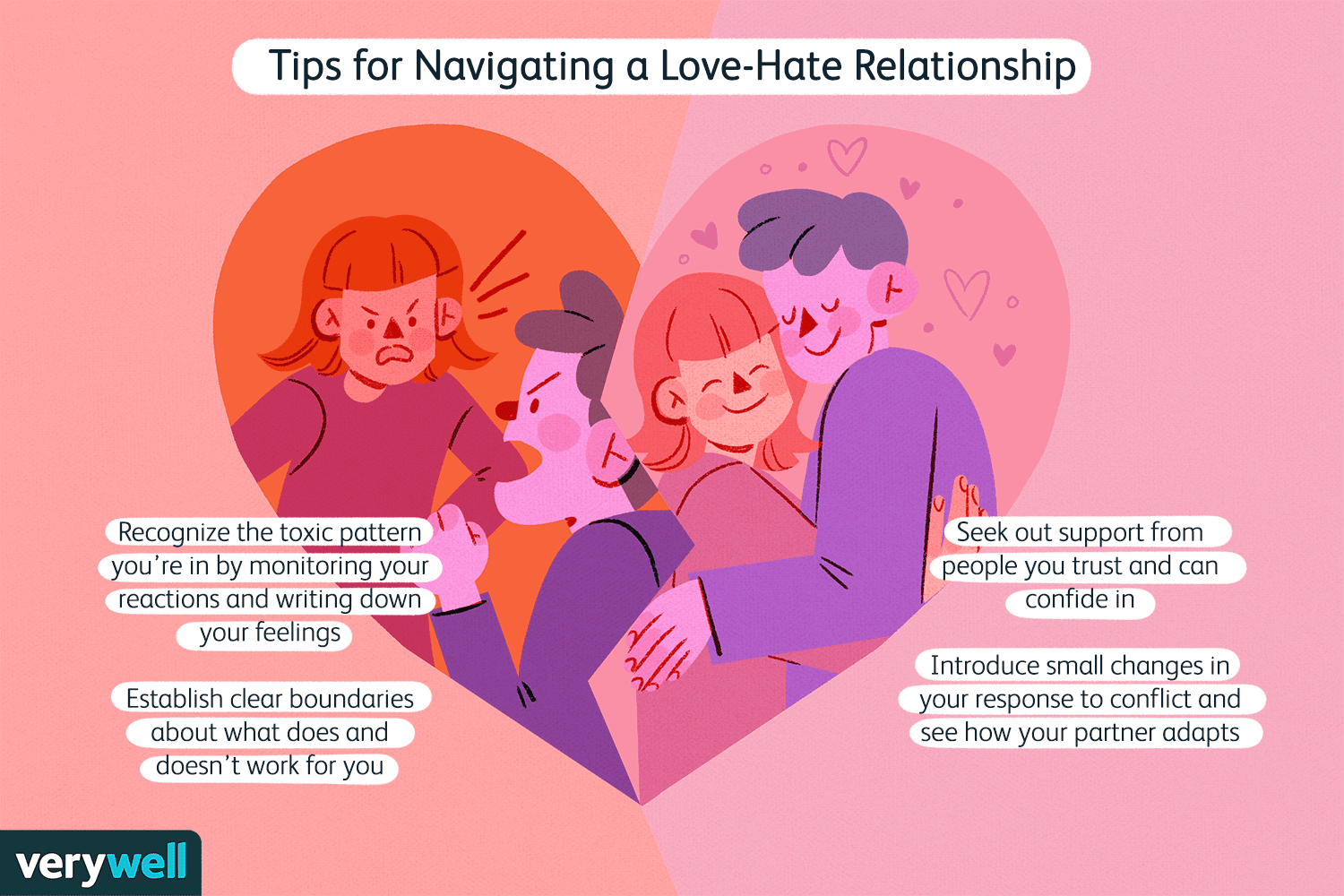
Below are some steps that can help you navigate a love-hate relationship.
Sabrina Romanoff, PsyD
If you find yourself in these types of relationships, you need to shift your perspective by demanding more for yourself and recognizing how you are contributing to the things no longer serving you.
— Sabrina Romanoff, PsyD
- Be more aware of your emotions: Become more active and learn about the toxic cycle of your relationship instead of passively accepting it. Begin to label your emotions and reactions to your partner’s behavior. Start to factor yourself into these patterns by writing out your feelings and emotions. Once you take the time to process how you’re feeling, you will begin to get perspective and will see new solutions to your problems you did not previously consider.
- Set boundaries: Take inventory on exactly what is not working for you so you can determine action steps to take when they occur in the future. Take back your power by setting limits in your relationships and aspects you are no longer willing to tolerate.
- Reach out for help: People in these relationships tend to be isolated and lack social support from family and friends who can validate their experiences and help them manage problems. Likely, you don’t have a clear perspective and your position in the relationship is causing you to be biased in your approach to managing it.
- Decide how you want to proceed: You don’t necessarily need to end the relationship or break up, but you do have control over how you participate in the relationship. Recognize the role you play in the undesirable aspects of the relationship and begin to introduce small changes or variations in the way you respond to conflict and notice how your partner either does or does not change in reaction.
“You must decide if you are able to live with the lows of these relationships and if you would genuinely remain in them out of choice and not just because of a lack of options,” says Romanoff.
Thanks for your feedback!
What is your feedback?
Helpful
Report an Error
Other
