

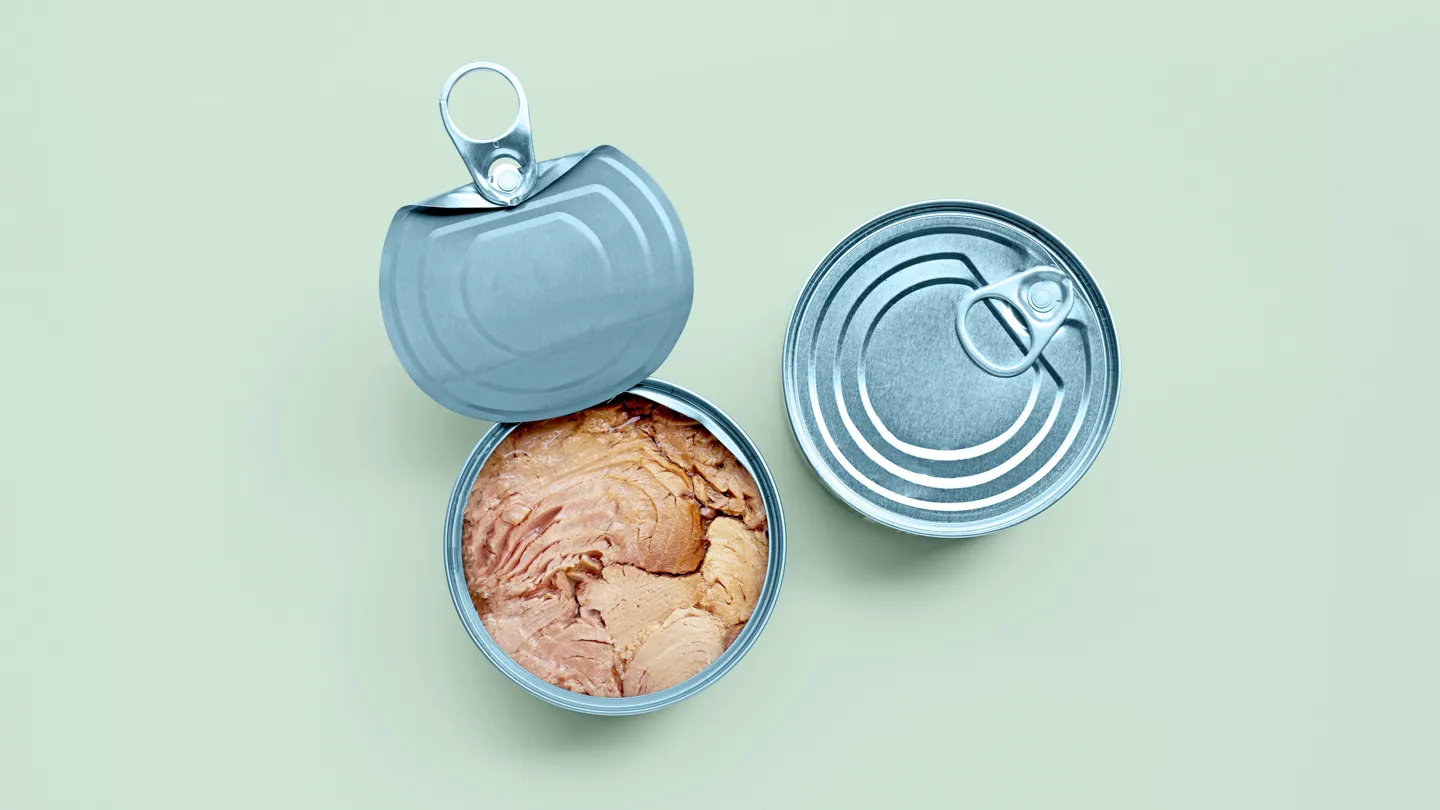
Canned tuna is a healthy and convenient alternative to fresh fish, providing the same low-calorie source of protein, essential nutrients, and heart-friendly omega-3 fatty acids. That’s likely why canned tuna is the second-most-popular seafood product in the U.S. after shrimp, according to the Office of Sustainable Fisheries.
The U.S. Department of Agriculture recommends that you include fish in your diet, but it’s vital to know which types of tuna are safest and how much is safe to eat. Due to the risk of mercury poisoning, eating tuna every day would exceed the U.S. Food and Drug Administration’s (FDA) recommended safe limit. How much depends on the type of tuna you eat. Canned light tuna contains the least amount of mercury, and the FDA suggests limiting yourself to no more than 12 ounces (oz) a week, or no more than three 5-oz cans.
What’s in Canned Tuna?
Tuna are members of the Scombridae family and are commercially fished worldwide, both in tropical and subtropical seas. Among the many species, canned tuna comes mostly from two types.
- Skipjack This relatively small fish is the most abundant and widely fished tuna. About 70 percent of the canned tuna in the U.S. is skipjack. It’s often called chunk light or flaked tuna, and producers can it in water, brine, or oil.
- Albacore This is larger than skipjack. Its pale meat has a delicate, mild taste. Producers often sell albacore as white tuna. The most recent data suggests that around 20 percent of the canned tuna consumed in the U.S. is albacore, although this is now 10 years old. More recent tuna consumption habits may be different.
What About Mercury Content?
All fish contain some mercury. Being aware of which species have the highest levels can help you reduce your risk of mercury poisoning.
Mercury occurs naturally in the environment — such as from volcanic activity — but industrial pollution can also contribute to mercury in the air, according to a study published in 2023. Mercury builds up in rivers and streams and ultimately ends up in the oceans around the world, where it becomes methylmercury.
This can build up in fish flesh over time after they absorb it from the water and from food. The amount of mercury in a fish depends on several factors, including where they live, the quality of what they eat, and the characteristics of the species. Generally, the older, larger, and heavier a fish is, the more mercury it’s likely to contain.
In an effort to help consumers reduce mercury exposure while still achieving the health benefits of eating fish, the FDA devised a chart listing fish species as “best choices,” “good choices,” and “choices to avoid” based on their mercury content.
In the study released in 2023, tuna contained the highest mercury content of any of the fish studied. However, the FDA chart showed that different types of tuna have varying levels of mercury. Each category has specific recommendations for safe consumption, including for children and pregnant people.
How Much Canned Light Tuna Can You Eat a Week?
According to the FDA, canned light tuna, made primarily from skipjack, is recognized as a low-mercury fish and is designated a “best choice.”
The FDA recommends eating 2 to 3 servings a week, or about 8 to 12 ounces. That includes people of childbearing age and pregnant individuals.
An adult serving of fish is the amount that fits in the palm of your hand, or about 4 ounces. Therefore, the recommendation would make eating two to three 5-ounce cans of light tuna a week safe for adults.
How Much Canned White Tuna?
Because albacore, or white tuna, typically contains three times more mercury than canned light tuna, the FDA has included it in the “good choices” category. That means the recommendation is one serving per week or 4 ounces for adults — about one 5-ounce can of white tuna per week.
How Much Is Safe for Children?
Feeding your child protein-rich, light canned tuna supports growth and development. The FDA recommends serving fish to your children one to two times per week, using a variety of fish. But the portion size must be appropriate for the child’s age and total calorie needs.
Serving size for children varies by age:
Age (years)
Serving Size
2 to 3
1 oz
4 to 7
2 oz
8 to 10
3 oz
11+
4 oz
How Is the Amount Calculated?
The FDA’s recommendation for the safe amount of fish to consume is intended as a general guideline based on the average weight of the American population. If you’re an adult who weighs less than the average (165 pounds), you may want to go for smaller portions or limit your intake to two servings of fish a week instead of three.
If you want a more accurate indication of how much tuna you can safely eat per week, take a look at the tuna calculator created by the Environmental Working Group. It allows you to enter your weight, age, gender, and whether you have a heart condition.
Based on that information, you can get suggestions for the type and amount of fish you can safely eat, along with the mercury content and sustainability information.
What’s the Standard for Safety?
The FDA and Environmental Protection Agency (EPA) regulate mercury content standards for consumable fish to support public safety. They established the following:
- A safe threshold for mercury content in fish is 0.15 parts per million or less
- Moderate to high levels range from 0.16 to 0.46 parts per million
- Any fish with mercury concentration over 0.46 parts per million is not considered safe for consumption
The level of mercury in a can of tuna may vary somewhat, depending on the age of the fish, its size, and where it was caught. The EPA and FDA determine averages for each fish species, which form the basis for regulations and recommendations on safe amounts to eat.
The average mercury concentration of canned light tuna is 0.13 parts per million, and canned albacore chunk white tuna is 0.35 parts per million, according to the EPA.
Tuna in Oil or Water?
Tuna packed in water contains fewer calories and less fat, which can be helpful if you’re trying to maintain your weight.
For comparison, one can of white tuna in oil, drained, contains 331 calories and 14.4 grams of fat. A can of white tuna packed in water, drained, contains 220 calories and 5.1 grams of fat.
A can of light tuna packed in oil has 339 calories and 14 grams of total fat, while a can packed in water contains 191 calories and 1.4 grams of fat.
