

Key Takeaways
- Freud believed personality develops through five psychosexual stages, each focused on a specific erogenous zone.
- Early childhood experiences play a critical role in shaping personality and can have lasting effects throughout life.
- If conflicts during a psychosexual stage are not resolved, individuals may become fixated and develop related personality traits.
Freud’s five psychosexual stages of development describe how personality forms during childhood. According to Freud, experiences at each stage shape adult personality, and unresolved conflicts can influence behavior later in life.
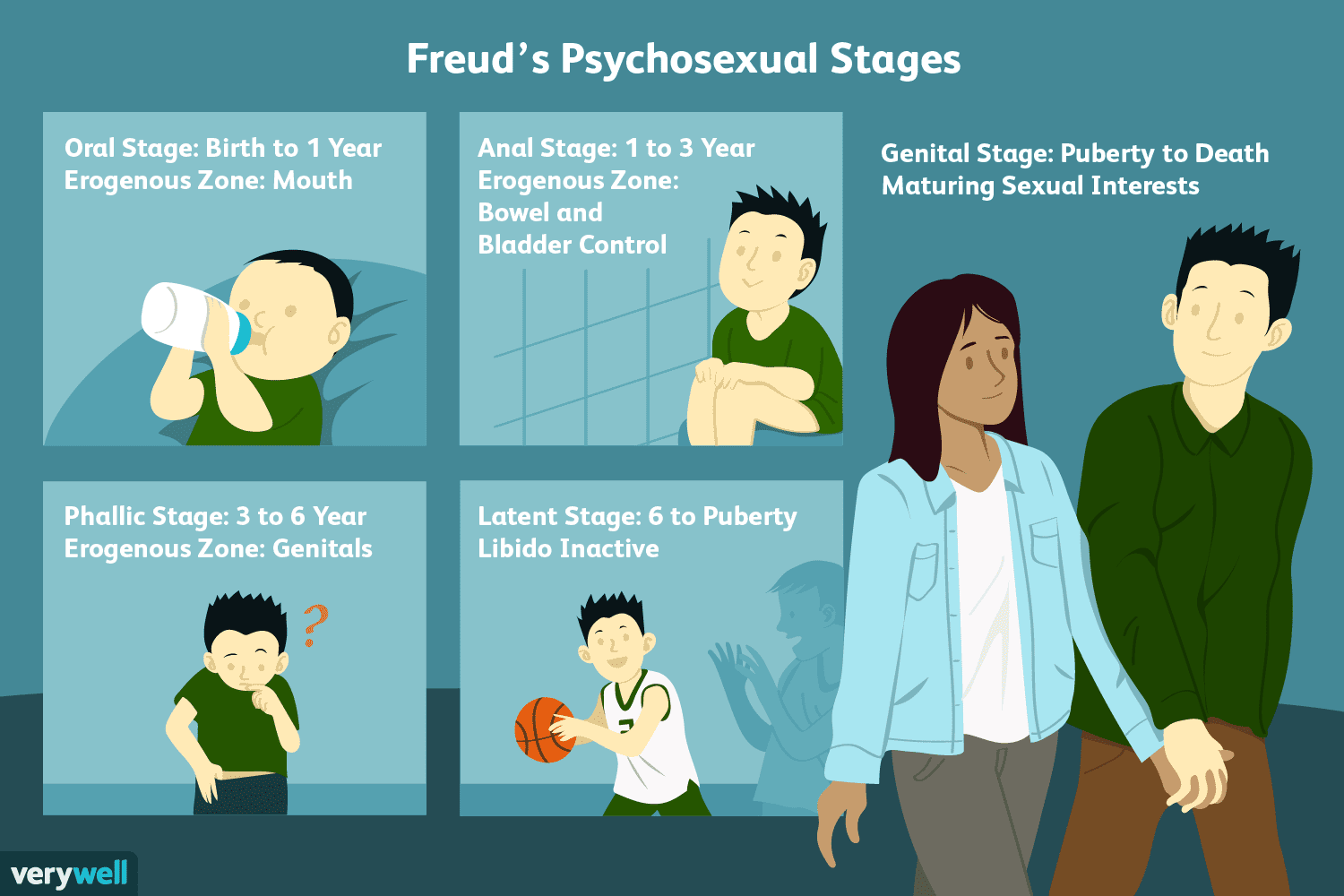
Each stage centers on a conflict between instinctual drives and societal expectations. Freud believed that libidinal energy, the driving force behind behavior, focuses on a different region of the body at each stage and influences psychological development.
Illustration by Joshua Seong, Verywell
Freud’s 5 Stages
Freud believed that personality developed through a series of childhood stages in which the id’s pleasure-seeking energies become focused on certain erogenous areas. An erogenous zone is a region of the body that is particularly sensitive to stimulation.
During the five psychosexual stages, the erogenous zone associated with each stage serves as a source of pleasure.
- The oral stage (from birth to 1)
- The anal stage (from 1 to 3)
- The phallic stage (from 3 to 6)
- The latent period (from 6 to puberty)
- The genital stage (puberty to death)
Psychosexual energy, or the libido, was described as the driving force behind behavior.
Psychoanalytic theory suggests that personality is mostly established by the age of five. Early experiences play a large role in personality development and continue to influence behavior later in life.
Psychosexual Conflicts
Each stage of development is marked by conflicts that can help build growth or stifle development, depending upon how they are resolved. If these psychosexual stages are completed successfully, a healthy personality is the result.
If certain issues are not resolved at the appropriate stage, fixations can occur. A fixation is a persistent focus on an earlier psychosexual stage.
Until this conflict is resolved, the individual will remain “stuck” in this stage. A person who is fixated at the oral stage, for example, may be over-dependent on others and may seek oral stimulation through smoking, drinking, or eating.
Does Freud’s Theory Hold Up Today?
Freud’s theory is still considered controversial today, but imagine how audacious it seemed during the late 1800s and early 1900s. There have been a number of observations and criticisms of Freud’s psychosexual theory on a number of grounds, including scientific and feminist critiques.
Criticisms of the Psychosexual Stages of Development
- The theory is focused almost entirely on men’s development, with little mention of women’s psychosexual development.
- His theories are difficult to test scientifically. Concepts such as the libido are impossible to measure and, therefore, cannot be tested. The research conducted tends to discredit Freud’s theory.
- Future predictions are too vague. How can we know that a current behavior was caused specifically by a childhood experience? The time between the cause and the effect is too long to infer a relationship between the two variables.
- Freud’s theory is based on case studies and not empirical research. Freud also based his theory on the recollections of his adult patients, rather than on direct observation and study of children.
One important thing to note is that contemporary psychoanalytic theories of personality development have incorporated and emphasized ideas about internalized relationships and interactions and the complex ways in which we maintain our sense of self into the models that began with Freud.
Excludes LGBTQ+ Development
Another criticism of the psychosexual stages is that the theory focuses primarily on heterosexual development and largely ignores LGBTQ+ development.
So how exactly did Freud explain the development of sexual preferences?
Freud’s theory suggested that heterosexual preferences represent the “normal” outcome of development and suggested that non-heterosexual preferences represented a deviation from this process.
Freud’s own viewpoints on homosexuality varied, at times expressing biological explanations and at other times social or psychological explanations for sexual preferences.
Unlike many thinkers of his time, Freud was unconvinced that homosexuality represented a pathology. He also believed that attempts to alter a person’s sexuality were usually futile and often harmful.
In a famous 1935 letter to a mother who had written him to ask that he treat her gay son, Freud wrote that while he believed being gay was not socially advantageous, it was certainly not a vice or something to be ashamed of. Freud wrote, “…it cannot be classified as an illness; we consider it to be a variation of the sexual function, produced by a certain arrest of sexual development.”
While Freud’s theory implied that being gay was a deviation from his views of normal psychosexual development, contemporary psychologists believe that sexual orientation is primarily influenced by biological factors.
Influence on Psychology
While few people are strong proponents of Freud’s theory of psychosexual development today, his work made important contributions to our understanding of human development. Perhaps his most important and enduring contribution was the idea that unconscious influences could have a powerful impact on human behavior.
Freud’s theory also stressed the importance of early experiences in development. While experts continue to debate the relative contributions of early versus later experiences, developmental experts recognize that the events of early life play a critical role in the developmental process and can have lasting effects throughout life.
