

Key Takeaways
- Aromantic people do not experience romantic attraction and do not seek romantic relationships.
- Aromantic individuals can still have deep, meaningful relationships with friends and family.
- Aromantic and asexual are different; some aromantic people may desire sexual experiences.
Why do some people swoon over romantic books, movies, and love songs while others wonder what all the fuss is about? It can be hard to ignore how love stories are often portrayed as the ultimate goal, but for some people, that’s not the case. While we all respond differently, having no interest in romance is sometimes a sign that a person is aromantic.
A person who is aromantic experiences little to no romantic attraction to persons of any gender and also lacks interest in having romantic relationships. Romantic attraction refers to a desire to have emotional contact and interaction with a partner, while the definition of a romantic relationship can vary depending on the individual.
Aromanticism is the opposite of alloromanticism, which is a desire to experience a romantic relationship.
Aromanticism is sometimes known by the abbreviated form “aro.” In the LGBTQIA+ lexicon, the “A” represents aromantic, asexual, and agender. Although the exact prevalence of aromanticism is not known, one study suggests that around 1% of people identify as asexual, and around 25% of these are also aromantic. Romantic attraction is just one part of the broader spectrum of human connection.
Below, learn more about what it means to be aromantic, how it shows up in everyday life, and why understanding your identity can be so crucial in a seemingly romance-obsessed world.
What Are Signs of Being Aromantic?
While romantic attraction is often presented as a universal experience, that just isn’t the case for everyone. Unfortunately, this tendency to think that *everyone* feels the same about romance can make aromantic people feel invisible or broken when they don’t relate.
Everyone’s experience is unique, so feelings about romance and relationships can vary greatly among aromantic people. Some may have different desires and expectations for physical and emotional intimacy. There is no standardized definition of what constitutes romance, so one person’s definition may differ from someone else’s.
Some signs that you might be aromantic include:
- You don’t experience feelings of romantic attraction.
- You feel that you do not need a romantic relationship to feel complete or fulfilled.
- You don’t experience “crushes” or being “in love” with someone else.
- You have a hard time relating to romantic stories.
Aromanticism represents a spectrum, which means that people experience little to no romantic attraction. While many do not ever have these feelings, some may identify as aromantic and still experience some degree of romantic attraction depending on the individual and the situation.
Can Aromantics Still Fall in Love?
Aromantic people can experience love. Being aromantic doesn’t mean that you don’t feel or experience love. You may experience strong feelings of love for family and friends. And research suggests that aromantic people often still desire sex. People who identify as aro can also want relationships. While they may not experience romantic feelings, they can still have deep, meaningful, and lasting connections with others.
Aromanticism vs. Asexuality
Some aromantic people are asexual, but the two are not synonymous. Asexuality involves a lack of sexual interest or attraction. Some asexual people may not desire sex but can still want romance. And aromantic people may desire sex but not romance.
There is little research available on aromanticism, and the distinctions between romantic and sexual orientation are not fully understood. People sometimes have difficulty distinguishing between romantic and sexual attraction because they are often so closely intertwined, making studying the topic more difficult.
Aromantic Spectrum
Both asexuality and aromanticism are part of what is known as the asexual spectrum identities. While many aromantic people are also asexual, people with various sexual identities may also describe themselves as aromantic. For example, a person may describe themselves as an aromantic bisexual, an aromantic lesbian, or an aromantic gay man.
Other identities on the aromantic spectrum include:
- Grayromantic or graysexual: These terms refer to individuals who fall somewhere in the middle of aromantic and romantic and asexual and sexual. They may experience some romantic or sexual feelings but only under certain conditions.
- Demiromantic or demisexual: These terms refer to people who only experience romantic or sexual feelings with another person after forming an emotional bond.
- Lithromantic or akoiromantic: These terms refer to people who may feel romantic feelings toward other people but do not wish for those feelings to be returned. If those feelings are reciprocated, the attraction fades.
- Recipromantic or reciprosexual: These terms refer to individuals who only experience a romantic or sexual attraction if they know that the other person also feels the same way.
Can Aromantics Have a Relationship?
Aromantic people can and do have committed, fulfilling relationships. However, these relationships may look a little different than the traditional ‘romantic partner’ model.
Such partnerships may involve being in an exclusive relationship, living together, showing affection, and having sex. Aromantic people may get married, have children, and raise families.
- Motivations beyond romance, such as a desire for family or children, are some reasons why people might choose to pursue a relationship.
- Aromantic people may pursue relationships to give or receive affection and care. A lack of romantic or sexual interest does not mean that a person does not want intimacy, commitment, or emotional support.
- They may develop relationships based on shared interests, mutual respect, or emotional closeness. However, such relationships may be based on a more familiar or platonic sense of love rather than a romantic one.
What Is Aromantic Dating?
Some aromantic people may enter what is referred to as a queer-platonic partnership or QPP. These partnerships are platonic in nature but have the same degree of commitment as a romantic partnership, including cohabiting and making decisions together.
Challenges Facing Aromantic People
Societal expectations can create challenges for people who identify as aromantic. There is a tremendous amount of societal pressure on people to find a partner, commit, and have children.
People who don’t desire that are often pressured to settle down, get married, and have kids anyway. Those who don’t are often made to feel that there is something wrong with them or that they are missing out.
Romantic content in popular media can also sometimes present challenges for those who are aro. While some aromatic people might enjoy romance-centered movies, books, and TV programming, others may feel indifferent or even repulsed by such depictions.
Amatonormativity
For some people, realizing that they are aromantic comes with a sense of relief. It gives a label to something they’ve always felt, but never been able to explain. Others, however, may struggle with internalized pressure to “want” romance, even if they don’t personally resonate with those feelings.
That internalized pressure to feel like a person *should* want romance has been called amatonormativity. Amatonormativity is a term coined to describe society’s expectations concerning romance. It has been used to describe the pressure to find and prioritize romance, marriage, and monogamy.
Some researchers have suggested that amatonormativity creates a social stigma surrounding being single and can pressure people into entering or staying in unhealthy relationships.
How to Support Someone Who Is Aromantic
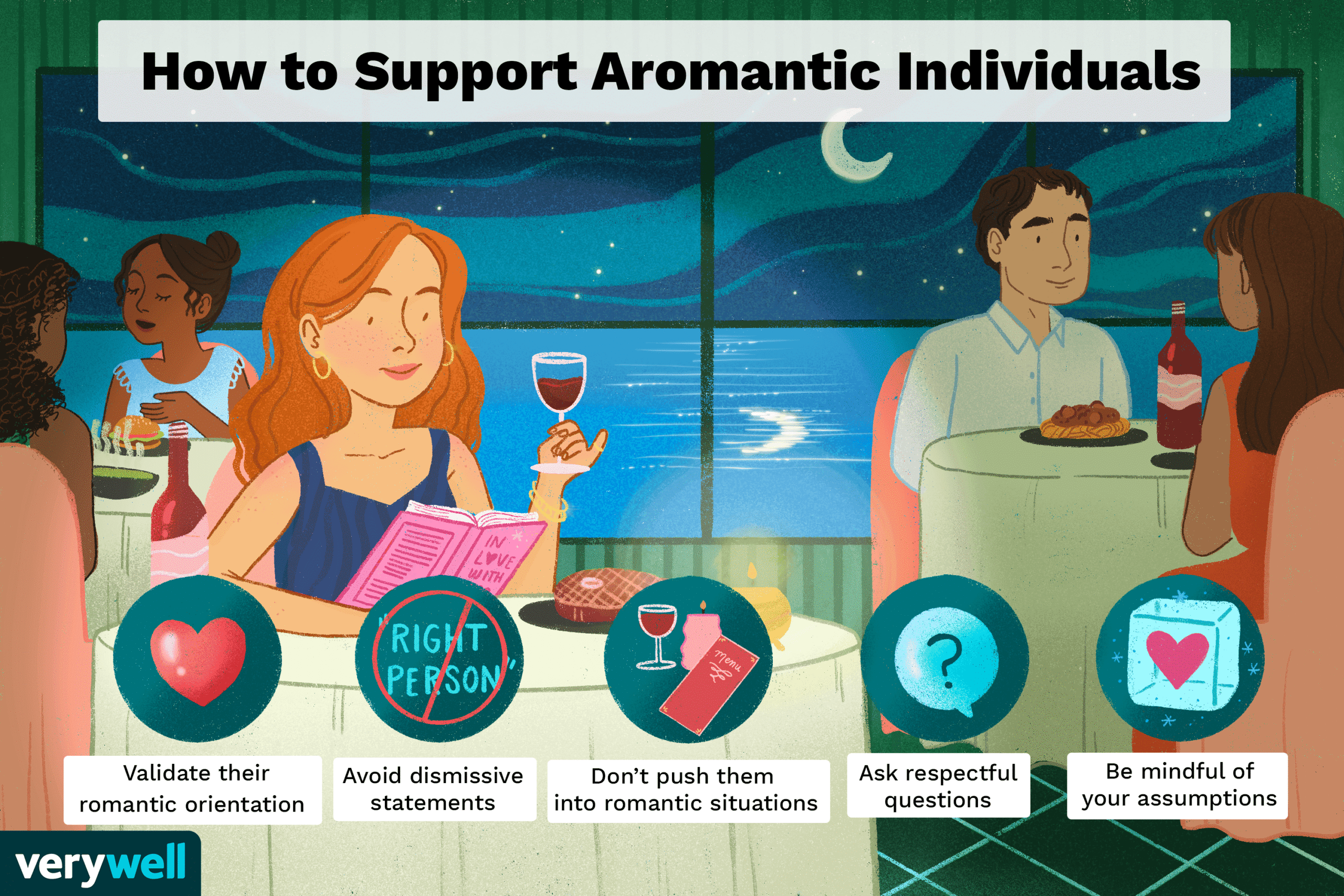
If you have a friend or loved one who is aromantic, there are things that you can do to be a supportive friend and ally:
- Respect their romantic orientation: You might not fully understand all of the aspects of aromantic behavior, but you should show respect for their feelings. Listen to what they have to say and ask what you can do to accommodate their needs and show your support.
- Don’t be dismissive: Remember that people understand themselves and their own feelings better than you ever can. Don’t dismiss what they feel or insist that they’ll change how they feel. Don’t try to push people into romantic situations they are not interested in.
- Don’t make assumptions: Avoid common misconceptions about aromantic people, such as the idea that they are cold or haven’t met the right person. Be respectful if you have questions, and be aware that the individual may not want to share. Ask if it is okay for you to ask questions and learn more about them.
Caring for Yourself
Aromantic people often face stigma and misconceptions about their romantic orientation. Others sometimes think they are not loving or that they will eventually change and develop romantic relationships. Dealing with these myths can sometimes make people feel isolated or pressured to conform to other people’s expectations.
Get Help Now
We’ve tried, tested, and written unbiased reviews of the best online therapy programs including Talkspace, Betterhelp, and Regain. Find out which option is the best for you.
While you might not want romantic relationships, having social support is important for your mental health and well-being. Focus on cultivating strong relationships with other people outside of romantic contexts. It is important to remember that other forms of love are not any less important than romantic love.
If you are seeking support for issues with coming out, relationships, bullying, self-harm, and more, contact the LGBT National Hotline at 1-888-843-4564 for one-to-one peer support.
For more mental health resources, see our National Helpline Database.
Verywell Mind uses only high-quality sources, including peer-reviewed studies, to support the facts within our articles. Read our editorial process to learn more about how we fact-check and keep our content accurate, reliable, and trustworthy.
-
Antonsen AN, Zdaniuk B, Yule M, Brotto LA. Ace and aro: Understanding differences in romantic attractions among persons identifying as asexual. Arch Sex Behav. 2020;49(5):1615-1630. doi:10.1007/s10508-019-01600-1
-
Fowler JA, Mendis M, Crook A, Chavez-Baldini U, Baca T, Dean JA. Exploring aromanticism through an online qualitative investigation with the aromantic community: “Freeing, alienating, and utterly fantastic”. Int J Sex Health. 2024;36(1):126-143. doi:10.1080/19317611.2024.2311158
-
Fischer NL, Seidman S. Introducing the New Sexuality Studies. Routledge; 2016.
-
Bogaert AF. Understanding Asexuality. Rowman & Littlefield Publishers, Inc; 2012.
-
GLAAD. Explore the spectrum: guide to finding your ace community.
-
Miller SJ, ed. Glossary of terms: defining a common queer language. Teaching, Affirming, and Recognizing Trans and Gender Creative Youth. London: Palgrave Macmillan; 2016. doi:10.1057/978-1-137-56766-6
-
AUREA. A beginner’s guide to being an aromantic ally.
Thanks for your feedback!
What is your feedback?
Helpful
Report an Error
Other
