

- Aim to eat every 3-4 hours and include protein and fiber in meals and snacks to support steady energy.
- Adjust meal and snack timing based on your work schedule, workouts and hunger cues.
- Meal planning, small frequent meals and regular exercise can support better energy levels.
Most of us are familiar with the dreaded afternoon slump. You start the day with a pep in your step, but then the all-too-common midafternoon lag has you wishing you could curl up under your desk for a quick nap. It’s completely normal for your energy levels to go up and down throughout the day. However, if midday fatigue is getting in the way of your life, it might be time to take stock of your diet.
While other factors, such as sleep quality and stress management, influence your energy levels, diet plays a crucial role. Food is literally energy for your body, so if you often feel like you’re running on fumes, you may need to adjust not just what you’re eating, but also when you’re eating. We asked dietitians how often you should eat to maintain steady energy, and for tips on how to make a meal plan that works for your schedule.
How Often You Should Eat
“Everyone’s body and lifestyle are unique, and thus optimal meal timing for each individual is too,” says Elizabeth Harris, M.S., RDN. That’s why you can’t exclusively use the clock to determine when you should be eating. Instead, Harris suggests that a good rule of thumb is to plan for a meal or snack, or at least to check in on hunger levels, about every three to four hours. If you’re wondering how to apply that to your own day-to-day life, here are a few examples of how to plan your meals and snacks according to your schedule.
A Typical 9-to-5 Workday
Whether you’re working from home or commuting to the office, finding an eating schedule that fits your busy daily routine is important for keeping you energized. “The most important guideline is to avoid skipping your first meal of the day—whenever your ‘morning’ begins,” says Jessica Clancy-Strawn, M.A., RDN. “This meal breaks your overnight fast and helps support energy, metabolism and appetite control.” To properly fuel your day, start with a breakfast that is rich in protein and fiber, like these apple & peanut butter overnight oats or this anti-inflammatory breakfast bowl.
Unplanned meetings, last-minute coverage and other work emergencies can throw off your eating schedule, so it’s always good to be prepared by keeping a few energy-boosting snack options like this trail mix stocked at work.
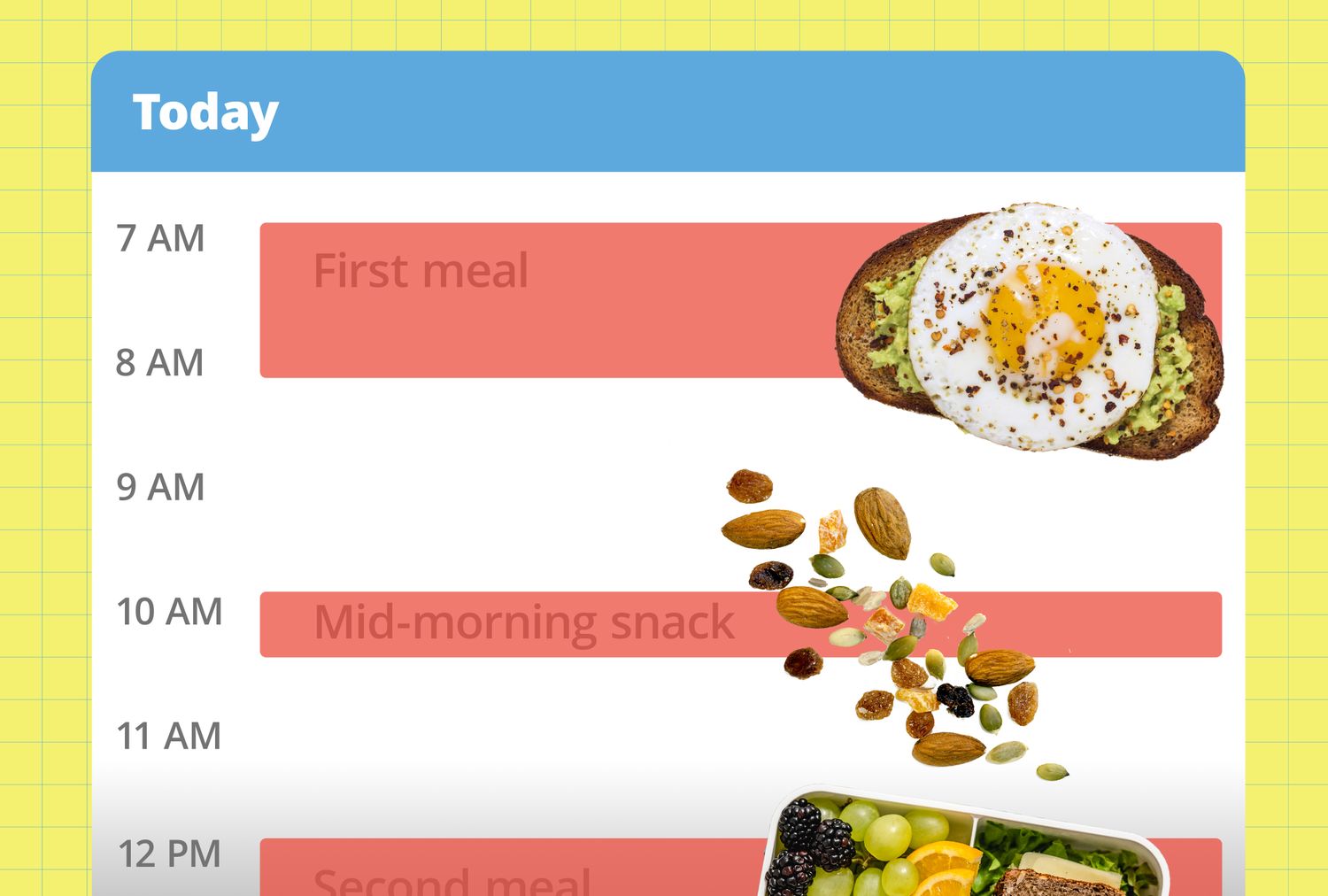
Curious what a workday eating schedule might look like? Here’s an example:
- 7-8 a.m. First meal
- 10 a.m. Midmorning snack
- 12-1 p.m. Second meal
- 3 p.m. Midafternoon snack
- 6-7 p.m. Third meal
For Workout Days
If you have a workout planned, you’ll want to make some adjustments to your meal schedule to make sure you’re properly fueled for optimal performance, while also preventing an energy crash later in the day. For early morning exercise, you’ll want to try and squeeze in a quick pre-workout snack that’s mostly simple carbs, like half a banana or a slice of toast with jam. Afterward, make sure you’re eating a balanced meal, then continue spacing meals every three to four hours. If you work out in the evening, use that midafternoon snack to your advantage, choosing something with a source of carbs and some protein, like whole-wheat toast with nut butter.
Here’s what your meal timing might look like for an early workout day:
- 6:30 a.m. Pre-workout snack
- 8 a.m. First meal
- 10 a.m. Midmorning snack
- 12-1 p.m. Second meal
- 3-4 p.m. Midafternoon snack
- 6-7 p.m. Third meal
Here’s what your meal timing might look like for an evening workout day:
- 7-8 a.m. First meal
- 10 a.m. Midmorning snack
- 12-1 p.m. Second meal
- 3-4 p.m. Midafternoon snack
- 6 p.m. Pre-workout snack
- 8 p.m. Third meal
Nighttime Shift Workers
For those who work an overnight shift, it can be extra challenging to maintain steady energy levels, since you have to work against your body’s natural internal clock. The same general advice to eat something every three to four hours still applies, but the time of day you’re eating meals will differ. One thing to keep in mind is that being tired makes it more difficult to make healthy choices, so it’s important to prepare your meals and snacks in advance rather than relying on in-the-moment choices. Not sure what to pack? Try options that reheat well, like this one-pot creamy chicken & mushroom pasta or black bean-quinoa bowl.
For a night shift from 11 p.m. to 7 a.m., try the following eating pattern:
- 5 p.m. First meal
- 8-10 p.m. Second meal
- 12-2 a.m. First snack
- 4-6 a.m. Third meal
- 7-8 a.m. Second snack
When You Eat Impacts Digestion
Your body’s internal clock, also known as the circadian rhythm, dictates more than just your sleep-wake cycle. Clancy-Strawn explains that your body processes nutrients differently depending on the time of day, which is all thanks to the circadian rhythm. Research suggests that your body may actually be more efficient at burning calories, controlling blood glucose and digesting food earlier in the day. Therefore, it may be advantageous to choose bigger meals earlier in the day for better energy.
Another factor to consider is how much protein you are consuming. Not only does protein slow down digestion to help maintain energy levels for longer, but spreading your protein intake throughout the day can optimize your absorption of amino acids. Protein also keeps you feeling full by stimulating the release of satiety hormones while simultaneously decreasing the levels of the hunger hormone called ghrelin.
How Often You Eat Impacts Hunger
Our bodies thrive on routine, and that applies to eating meals on a schedule. “When you eat at the same times each day, your body adjusts and begins sending hunger cues on that schedule. Over time, this becomes a habit—a routine that supports your metabolism, helps regulate portion sizes and allows you to make more intentional food choices rather than reacting to extreme hunger,” says Clancy-Strawn. She adds that those consistent meals also help keep your blood sugar levels stable. “When blood sugar stays steady, you’re less likely to experience energy crashes, overeating or cravings that can lead to weight gain,” adds Clancy-Strawn.
Hunger may also be an indicator that you need to make some adjustments to your meal schedule. “If you struggle with afternoon cravings or nighttime grazing or overeating, that may be your body’s way of signaling you that you’re not eating enough earlier in the day,” says Harris. “Instead of focusing on more willpower, try to eat regular, consistent meals throughout the day balanced with protein, complex carbs and healthy fats,” she adds.
Other Tips for Planning Meals to Optimize Your Energy Levels
Here are a few other helpful tips for optimizing your meal schedule for steady energy levels all day long.
- Plan ahead. Make it easier to stick to your eating schedule by prepping one or two meals and stocking your pantry with healthy snacks that you can grab on the go. Not sure what to make? Check out some of our healthy meal-prep recipes.
- Use your freezer. Eating the same meal five days in a row might not be appealing, and leftovers only stay good in the refrigerator for a few days. To avoid meal-prep fatigue, try freezing meals to have on hand for when you need them. Be sure to use airtight containers, and try recipes that freeze well, like soups and sauces.
- More small, frequent meals. Feeling tired after you eat, also known as postprandial somnolence, can happen after eating a large meal. These “food comas” happen for a few reasons, partly because it requires quite a bit of energy to digest a larger amount of food. Having smaller, more frequent meals during the day can help you avoid that post-meal fatigue.
- Move your body. Regular exercise has been shown to improve energy levels, so try to find a form of movement that you enjoy doing consistently. This could be as simple as a brisk walk on your lunch break or an at-home workout to start your day.
Our Expert Take
Life gets busy, and keeping yourself adequately fueled ensures that you have the energy to tackle your never-ending to-do list. But what you eat isn’t the only factor that plays a role in your energy levels; when you eat can also contribute to fatigue. If you’re struggling with lagging energy levels at key times of the day, our experts suggest you focus on eating something every three to four hours and prioritizing higher protein and fiber options. The result? Steady energy levels that can carry you through everything that the day throws your way!
