

Key Takeaways
- Both nature (genetics) and nurture (environment) play a role in shaping who we are, and their interaction is often the most influential factor in a person’s development.
- Mental health can be influenced by both genetic factors, such as brain chemical imbalances, and environmental factors, like traumatic experiences.
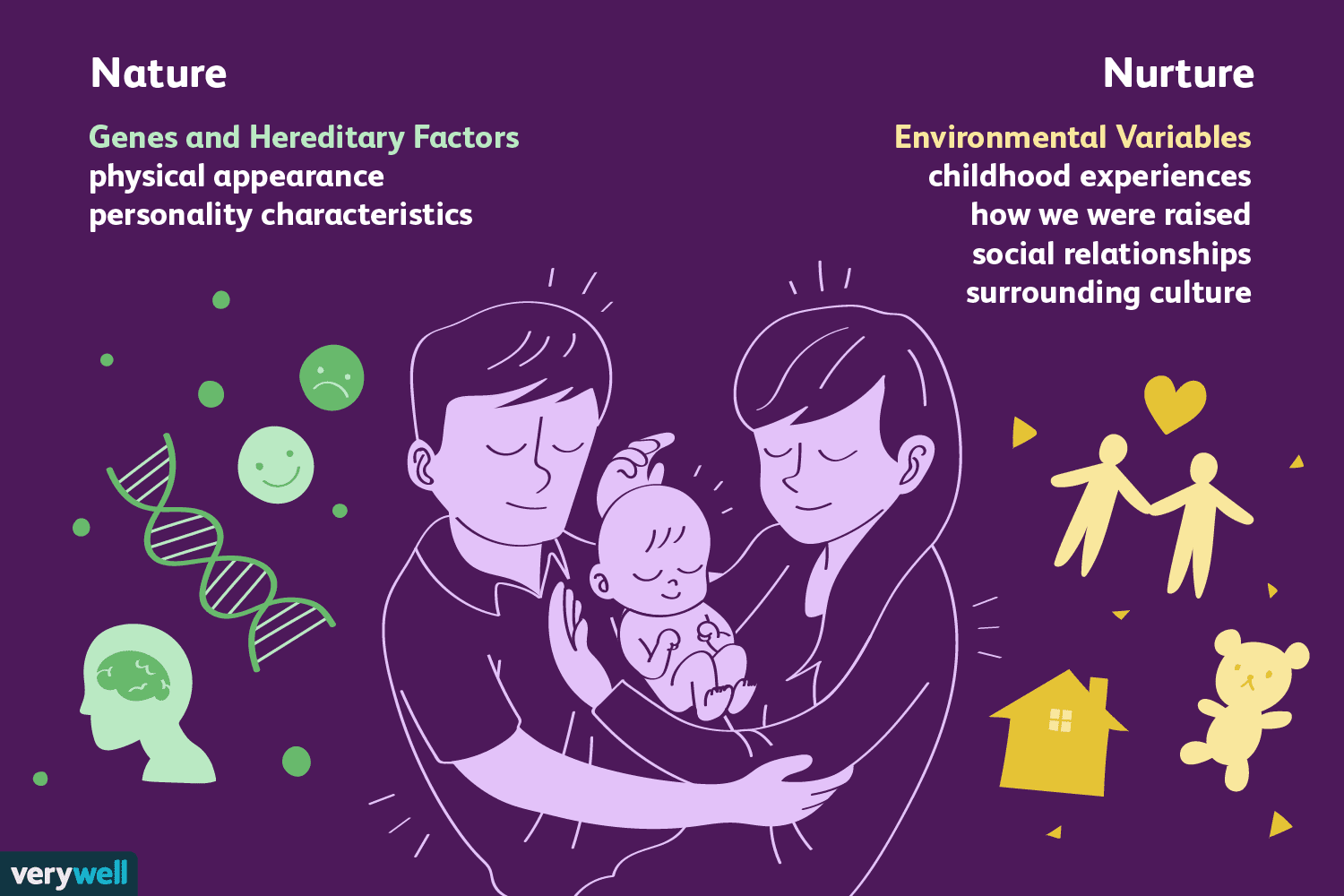
The nature vs. nurture debate in psychology centers on whether genetics, environmental factors, or a combination of both are responsible for all of our unique behaviors, traits, and quirks. Nature refers to how genetics influence an individual’s personality, whereas nurture refers to how an individual’s environment (including relationships and experiences) shapes their development. Both play a role in who we are, and the interaction between the two is often the most influential.
Illustration by Joshua Seong. © Verywell, 2018.
What Nature vs. Nurture Means
What exactly do we mean when we talk about nature and nurture? To better understand the nature vs. nurture argument, it helps to know what each term means.
- Nature refers largely to our genetics. It includes the genes we are born with and other hereditary factors that can shape how our personality develops from childhood through adulthood.
- Nurture encompasses the environmental factors that impact who we are. This includes our early childhood experiences, the way we were raised, our social relationships, and the surrounding culture.
A few biologically determined characteristics include genetic diseases, eye color, hair color, and skin color. Other characteristics are tied to environmental influences, such as how a person behaves, which can be influenced by parenting styles and learned experiences.
For example, one child might learn through observation and reinforcement to say please and thank you. Another child might learn to behave aggressively by observing older children engage in violent behavior on the playground.
How Nature and Nurture Interact
Which is stronger: nature or nurture?
Many researchers consider the interaction between heredity and environment—nature with nurture as opposed to nature versus nurture—to be the most important influencing factor of all.
- Bidirectional: Nature and nurture interact in a bidirectional manner. For example, a child’s temperament can influence how their parents raise them. This can affect how characteristics are expressed.
- Epigenetics: This newer field of study aims to explain how the environment impacts the ways genes are expressed.
For example, perfect pitch is the ability to detect the pitch of a musical tone without any reference. Researchers have found that this ability tends to run in families and might be tied to a single gene. However, they’ve also discovered that possessing the gene isn’t enough; musical training during early childhood is needed for this inherited ability to manifest.
Height is another example of a trait influenced by an interaction between nature and nurture. A child might inherit the genes for height. However, if they grow up in a deprived environment where proper nourishment isn’t available, they might never reach the height they could have if they’d grown up in a healthier environment.
Some characteristics are biologically determined, such as eye color, hair color, and skin color. Other things, like life expectancy and height, have a strong biological component but are also influenced by environmental factors and lifestyle.
Why Nature vs. Nurture Has Been Such a Big Debate
The nature vs. nurture debate centers on the contributions of genetics and environmental factors to human development.
- Some philosophers, such as Plato and Descartes, argued that certain traits are inborn or occur naturally, independent of environmental influences. They believed that all of our characteristics and behaviors are the result of evolution, suggesting that genetic traits are passed down from parents to their children and that these traits influence the individual differences that make each person unique.
- Other well-known thinkers, such as John Locke, believed in the doctrine of tabula rasa, which holds that the mind is a blank slate. According to this notion, everything that we are is determined by our experiences. Behaviorism is a good example of a theory rooted in this belief, as behaviorists hold that all behavior results from conditioning. Theorists such as John B. Watson believed that people could be trained to do and become anything, regardless of their genetic background.
People with extreme views are called nativists and empiricists. Nativists hold that most behaviors and characteristics are the result of inheritance. Empiricists hold that most behaviors and characteristics result from learning.
Examples of Nature vs. Nurture in Action
One example of when the nature-versus-nurture debate arises is when a person achieves high academic success. Did they do so because they are genetically predisposed to elevated levels of intelligence, or is their success a result of an enriched environment?
The nature-versus-nurture debate can also be applied to why a person behaves in a certain way. If a man abuses his wife and kids, for instance, is it because he was born with violent tendencies, or is violence something he learned by observing others in his life when growing up?
In Psychology
Throughout the history of psychology, the nature vs. nurture debate has continued to stir controversy. Eugenics, for example, was a movement heavily influenced by the nativist approach.
Francis Galton coined the terms ‘nature versus nurture’ and ‘eugenics’ and believed that intelligence resulted from genetics. Galton also felt that intelligent individuals should be encouraged to marry and have many children, while less intelligent individuals should be discouraged from reproducing. Galton’s scientific racism contributed to the spread of harmful stereotypes and was used to justify discriminatory policies and practices.
The value placed on nature vs. nurture can even vary across different branches of psychology, with some taking a more one-sided approach. For example
- In biopsychology, researchers conduct studies exploring how neurotransmitters influence behavior, emphasizing the role of nature.
- In social psychology, on the other hand, researchers might conduct studies examining how external factors, such as peer pressure and social media, influence behavior, underscoring the importance of nurture.
- Behaviorism is another branch that focuses on the impact of the environment on behavior.
In Child Development
Some psychological theories of child development emphasize nature, while others emphasize nurture.
- Nativist approaches to child development: An example is Chomsky’s concept of a language acquisition device (LAD). According to this theory, all children are born with an instinctive mental capacity that allows them to both learn and produce language.
- Empiricist approaches to development: An example is Albert Bandura’s social learning theory. This theory says that people learn by observing the behavior of others. In his famous Bobo doll experiment, Bandura demonstrated that children could learn aggressive behaviors simply by observing another person acting aggressively.
In Personality Development
There is also debate over whether nature or nurture plays a greater role in personality development. The answer to this question varies depending on which personality development theory you use.
- According to behavioral theories, our personality results from interactions with our environment, while biological theories suggest that personality is largely inherited.
- Then there are psychodynamic theories of personality that emphasize the impact of both.
In Mental Illness Development
Nature and nurture also contribute to mental health.
- Some causes of mental illness fall on the nature side of the debate, including changes to or imbalances with chemicals in the brain. Genetics can also contribute to mental illness, increasing one’s risk of a certain disorder or disease. Mental disorders with some type of genetic component include autism, attention-deficit hyperactivity disorder (ADHD), bipolar disorder, major depression, and schizophrenia.
- Other explanations for mental illness are environmental. This includes being exposed to environmental toxins, such as drugs or alcohol, while still in utero. Certain life experiences can also influence mental illness development, such as witnessing a traumatic event, leading to the development of post-traumatic stress disorder (PTSD).
In Mental Health Therapy
Different types of mental health treatment can also rely more heavily on either nature or nurture in their treatment approach.
- One of the goals of many types of therapy is to uncover any life experiences that may have contributed to mental illness development (nurture).
- However, genetics (nature) can also play a role in treatment. For instance, research indicates that a person’s genetic makeup can impact how their body responds to antidepressants. Considering this is important for getting that person the help they need.
Twin Studies
Researchers often use twin studies to examine the relative contributions of nature and nurture to different aspects of human psychology and health. In such studies, research looks at both identical and fraternal twins. Identical twins have the exact same set of genes. On the other hand, fraternal twins share about half, much like other full genetic siblings. In some cases, researchers also look at twins raised together vs. those raised apart. Doing so allows them to look more closely at how genetic and environmental variables contribute to differences between twins.
How Psychologists View Nature and Nurture Today
Most experts recognize that neither nature nor nurture is stronger than the other. Instead, both factors play a critical role in who we are and who we become.
Nature and nurture interact with each other in important ways all throughout our lifespan.
As a result, many in this field are interested in seeing how genes modulate environmental influences and vice versa. At the same time, this debate of nature vs. nurture still rages on in some areas, such as in the origins of sexual orientation and influences on intelligence.
While a few people take the extreme nativist or radical empiricist approach, the reality is that there is no simple way to disentangle the multitude of forces shaping personality and human development. Instead, these influences include genetic factors, environmental factors, and how each intermingles with the other.
While the nature-nurture debate is often presented as suggesting that traits are caused by either genetics or environment, it’s important to remember that it’s much more complex than that. The idea that it’s either one or the other is outdated.
Today, experts recognize that not only do *both* nature and nurture play a role, but it is also often the unique interaction of the two that is responsible for how certain characteristics or behaviors are expressed.
Verywell Mind uses only high-quality sources, including peer-reviewed studies, to support the facts within our articles. Read our editorial process to learn more about how we fact-check and keep our content accurate, reliable, and trustworthy.
-
Gustavson DE, Coleman PL, Wang Y, et al. Exploring the genetics of rhythmic perception and musical engagement in the Vanderbilt Online Musicality Study. Ann N Y Acad Sci. 2023;1521(1):140-154. doi:10.1111/nyas.14964
-
Jelenkovic A, Sund R, Yokoyama Y, et al. Genetic and environmental influences on human height from infancy through adulthood at different levels of parental education. Sci Rep. 2020;10(1):7974. doi:10.1038/s41598-020-64883-8
-
Wang JJ, Feigenson L. Is empiricism innate? Preference for nurture over nature in people’s beliefs about the origins of human knowledge. Open Mind (Camb). 2019;3:89-100. doi:10.1162/opmi_a_00028
-
National Human Genome Research Institute. Eugenics and scientific racism.
-
Wright RO. Nature versus nurture—on the origins of a specious argument. Exposome. 2022;2(1):osac005. doi:10.1093/exposome/osac005
-
Sun X, Nancekivell SE, Shah P, Gelman SA. How essentialist reasoning about language acquisition relates to educational myths and policy endorsements. Cogn Res Princ Implic. 2023;8(1):27. doi:10.1186/s41235-023-00481-2
-
Peedicayil J. Genome-environment interactions and psychiatric disorders. Biomedicines. 2023;11(4):1209. doi:10.3390/biomedicines11041209
-
National Institutes of Health. Common genetic factors found in 5 mental disorders.
-
Pain O, Hodgson K, Trubetskoy V, et al. Identifying the common genetic basis of antidepressant response. Biol Psychiatry Global Open Sci. 2022;2(2):115-126. doi:10.1016/j.bpsgos.2021.07.008
-
McAdams TA, Cheesman R, Ahmadzadeh YI. Annual Research Review: Towards a deeper understanding of nature and nurture: combining family-based quasi-experimental methods with genomic data. J Child Psychol Psychiatry. 2023;64(4):693-707. doi:10.1111/jcpp.13720
Thanks for your feedback!
What is your feedback?
Helpful
Report an Error
Other
