

Key Takeaways
- Priming can make you remember things faster by linking related ideas in your brain.
- Your brain uses priming to decide what you hear in situations where sound is not clear.
- Teachers can use priming to help students understand new information better.
In psychology, priming is a technique in which the introduction of one stimulus influences how people respond to a subsequent stimulus. Priming works by activating an association or representation in memory just before another stimulus or task is introduced.
This phenomenon occurs without our conscious awareness, yet it can have a major impact on numerous aspects of our everyday lives.
What Is Priming?
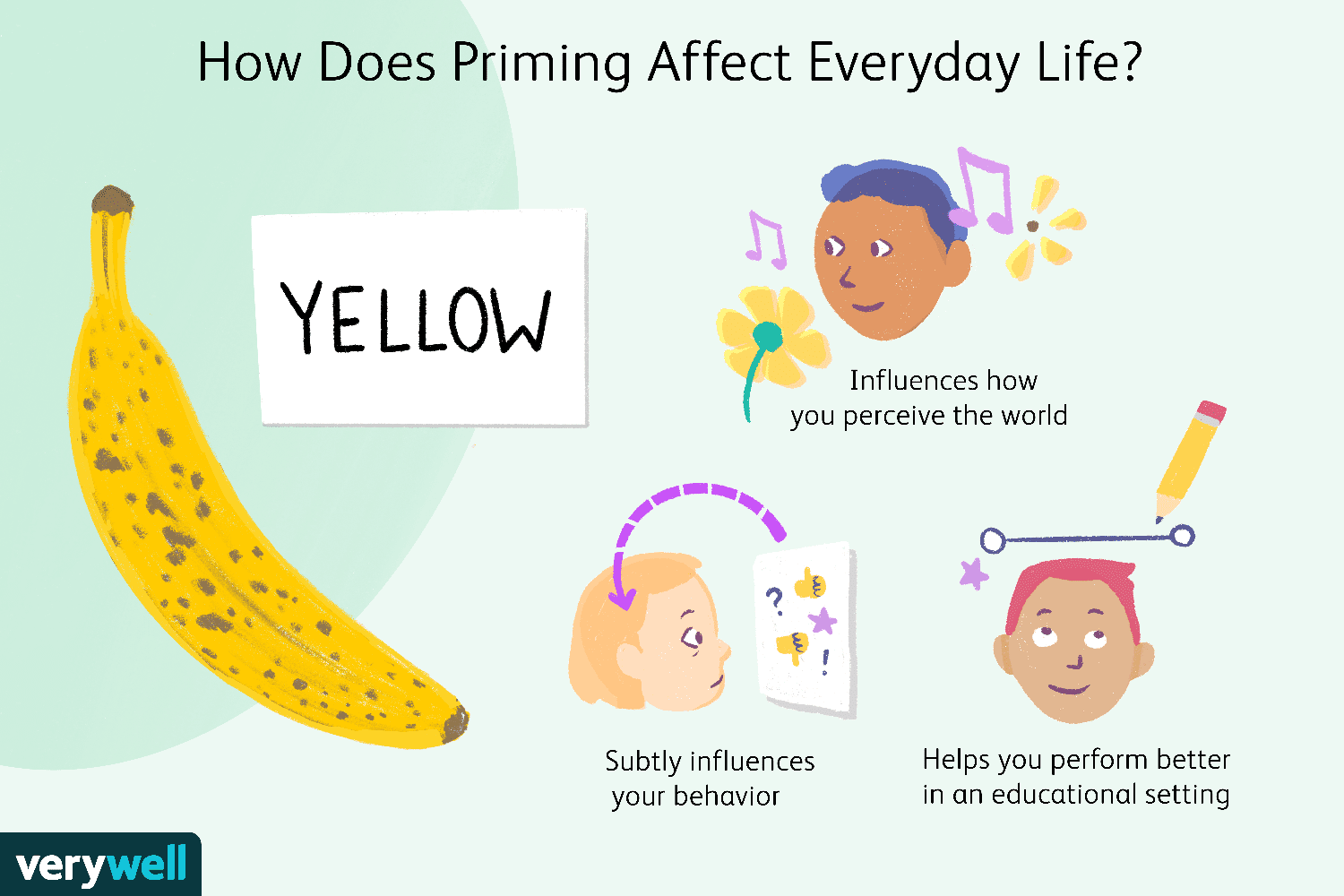
There are many examples of how priming works. For instance, if someone hears the word “yellow,” they might respond more quickly to the word “banana” than to an unrelated word like “television.” This faster response happens because “yellow” and “banana” are more closely linked in memory.
Priming can work with stimuli that are related in a variety of ways. For example, priming effects can occur with perceptually, linguistically, or conceptually related stimuli. Priming can have promising real-world applications as a learning and study aid as well.
Priming is named as such to evoke the imagery of a water well being primed. Once the well has been primed, water can then be subsequently produced whenever it is turned on. Once the information has been primed in memory, it can be retrieved into awareness more readily.
Types of Priming in Psychology
Psychology identifies several types of priming, each with a specific process and distinct effects.
Positive and Negative Priming
Positive and negative priming refer to how priming affects processing speed. Positive priming accelerates processing and memory retrieval, while negative priming slows it.
Semantic Priming
Semantic priming involves words that are associated in a logical or linguistic way. The earlier example of responding to the word “banana” more rapidly after being primed with the word “yellow” is an example of semantic priming.
Associative Priming
Associative priming uses two stimuli that are typically linked. For example, “cat” and “mouse” are often connected in memory, so seeing one word can prime faster responses to the other.
Repetition Priming
Repetition priming occurs when a stimulus and response are repeatedly paired. Because of this, subjects become more likely to respond in a certain way more quickly each time the stimulus appears.
Perceptual Priming
Perceptual priming involves stimuli that have similar forms. For example, the word “goat” will evoke a faster response when it is preceded by the word “boat” because the two words are perceptually similar.
Conceptual Priming
Conceptual priming involves a stimulus and response that are conceptually related. Words such as “seat” and “chair” are likely to show priming effects because they are in the same conceptual category.
Masked Priming
Masked priming involves part of the initial stimulus being obscured in some way, such as with hash marks. Even though the entire stimulus is not visible, it still evokes a response.
The Priming Process
Psychologists believe that units (or schemas) of information are stored in long-term memory. The activation of these schemas can either be increased or decreased in a variety of ways.
- When the activation of certain units of information is increased, these memories become easier to access.
- When activation is decreased, the information becomes less likely to be retrieved from memory.
Priming suggests that certain schemas tend to be activated in unison. By activating some units of information, related or connected units also become active.
So, why would it be useful for related schemas to become activated and more accessible? In many instances, drawing related information into memory more quickly might help people respond faster when the need arises.
For example, schemas related to rainstorms and slick roads may be linked closely in memory. When you see it raining, memories of possible slick road conditions may also come to mind.
Because your mind has been primed to think of this information, you might be better able to think quickly and react rapidly when encountering a dangerous, wet stretch of road on your drive home from work.
Priming Affects Perceptions
The 2018 Yanny/Laurel viral phenomenon is one example of how priming can influence how you perceive information. An ambiguous sound sample was uploaded by an online user with a poll asking what people heard.
Some people distinctly heard “Yanny,” while others clearly heard “Laurel.” Some people even reported being able to switch back and forth between the words they heard.
Due to the aural ambiguity, psychologists suggest that people rely on priming effects to help determine what they are likelier to hear.
Research suggests that we do not hear by analyzing the frequencies of the noises that enter our ears and then determining the words that these frequencies form.
Instead, we utilize what is known as top-down processing. Our brains first recognize some sounds like speech. Then, our brains utilize context cues to interpret the meaning of these speech sounds.
Why You Mishear Song Lyrics
This can help explain why people often misinterpret song lyrics. When the sound is ambiguous, your brain fills in the missing information as best it can. Priming effects can then come into play. If you are primed to interpret a lyric in a particular way, you will be more likely to hear it in a certain way based upon that priming.
When it comes to hearing either Yanny or Laurel, just being aware of the nature of the viral audio clip primes you to hear it as one or the other. The fact that people who heard the clip were already expecting to hear either Yanny or Laurel primed them to hear either of those two words rather than some other word.
In this case, factors related to sound quality and hearing ability also played a role. Younger people with less age-related hearing damage were more likely to hear “Yanny” because their ears are better able to detect higher frequency sounds. Those who heard Laurel tended to only hear lower-frequency sounds.
Priming Affects Behavior
In one study, researchers implicitly primed participants with words commonly associated with stereotypes about elderly people. Upon leaving the testing booth, people who had been primed with words related to older adults were more likely to walk more slowly than participants who had not been primed.
A study published in the journal Aging and Mental Health found that priming participants with negative aging stereotypes resulted in more negative effects on behaviors and self-rated evaluations. Priming participants with these negative aging stereotypes led to increased feelings of loneliness and an increased frequency of help-seeking.
In other words, bringing to mind stereotypes about elderly people being lonely and helpless actually led to people feeling lonelier and acting more helpless.
Researchers suggest that being exposed to such age-related stereotypes may lead to increased dependency and lower self-evaluations of ability and functioning in older people.
A third study, also in Aging and Memory, primed adults 55 and older with negative or positive messages about aging. They then asked participants to recall a list of 30 words. Adults who had been primed with negative messages had worse memory performance than those who received positive messages.
Priming Affects Learning
Teachers and educators can also utilize priming as a learning tool. Some students perform better when they know what they can expect. Tackling new material can sometimes be intimidating, but priming students by presenting information before a lesson is given can help.
Priming is often used as an educational intervention for students with certain learning disabilities. New material is presented before it is taught, allowing the student to become comfortable with it.
For example, students might be allowed to “preview” the books or materials that are going to be used as part of a lesson. Because they are already familiar with the information and materials, they may be better able to pay attention during the actual lesson.
What This Means For You
While priming occurs outside of conscious awareness, this psychological phenomenon can play an essential role in your daily life. From influencing how you interpret information to your behavior, priming can affect your perceptions, emotions, and actions.
Being aware of it can help you better recognize when it is happening. It can also help you look for ways to use it to your advantage, like previewing something to become familiar with it before you try to learn it.
