

Key Takeaways
- Correlational studies help researchers see if a relationship exists between two or more variables.
- Correlational studies can’t prove cause-and-effect, only that a relationship exists.
- Naturalistic observation is a type of correlational research that studies variables in their natural setting without interference.
A correlational study is a research design that examines the relationships between two or more variables. It is non-experimental, meaning the experimenter does not manipulate or control any variables.
The goal of correlational research is often to look for relationships, describe these relationships, and then make predictions. Such research can also often be a jumping-off point for future experimental research.
Verywell / Brianna Gilmartin
Characteristics of Correlational Studies
Correlational studies are commonly used in psychology and fields like medicine when researchers need preliminary information or cannot conduct experiments.
This method helps researchers determine if a relationship exists between two or more variables, even though they cannot control these variables.
Although correlational research can show a relationship between variables, it cannot prove that one variable causes changes in another. In other words, these studies do not establish cause-and-effect relationships.
When you encounter research that refers to a “link” or an “association” between two things, they are most likely talking about a correlational study.
What Do Positive, Negative, and Zero Correlations Mean?
Correlation refers to a relationship between two variables, which can be strong or weak, positive or negative, or sometimes nonexistent.
A correlation study can reveal three outcomes:
- Positive correlation: When both variables increase or decrease together, indicated by a correlation coefficient close to +1.00.
- Negative correlation: When one variable increases as the other decreases, indicated by a coefficient close to -1.00.
- No correlation: When there is no relationship between the variables, indicated by a coefficient of 0.
Researchers measure these variables and use statistical analysis to determine the relationship’s existence, strength, and direction. However, correlational studies do not prove that one variable causes changes in another.
How Psychologists Use Correlational Research
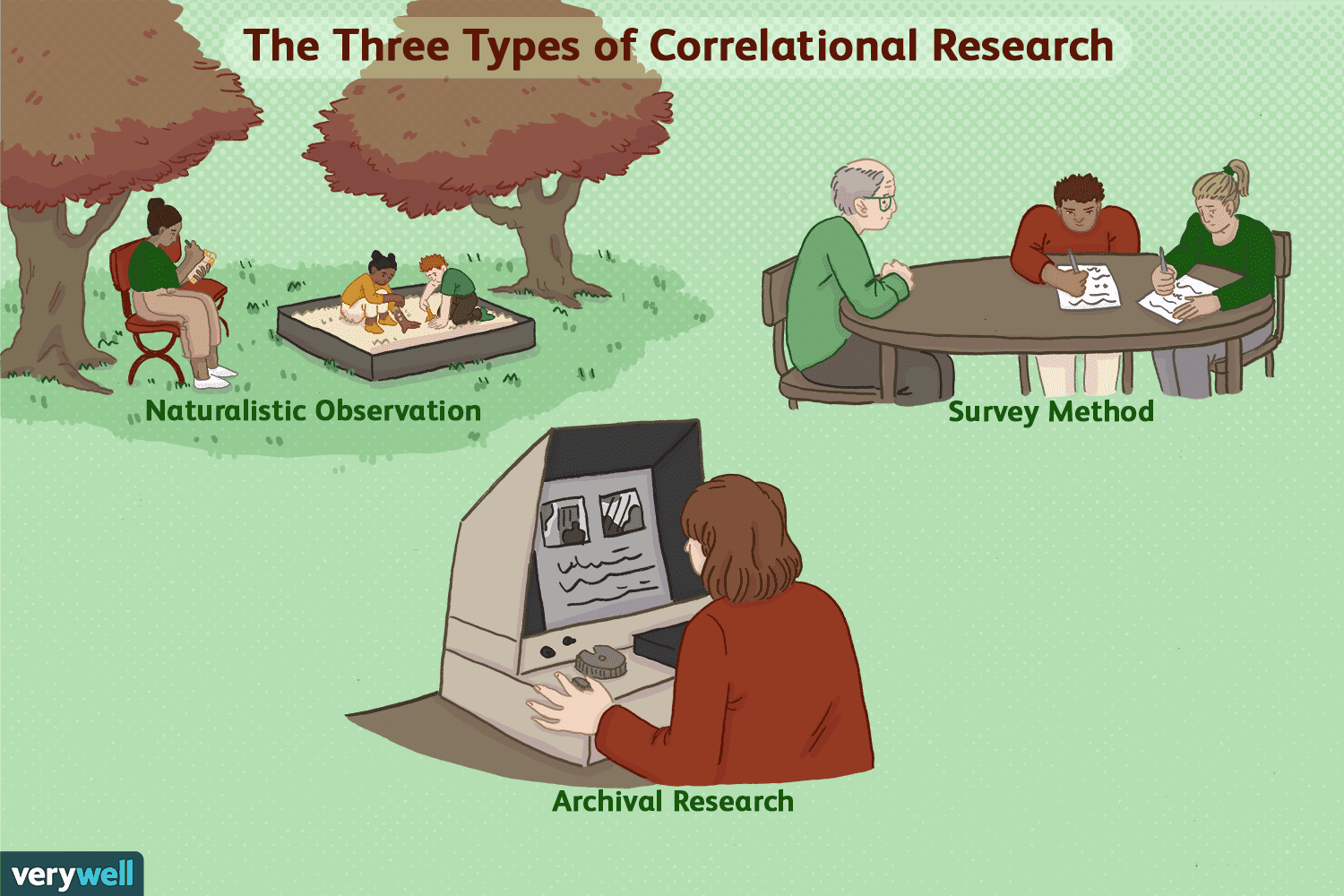
There are three types of correlational research: naturalistic observation, the survey method, and archival research. Each type has its own purpose, as well as its pros and cons.
Naturalistic Observation
The naturalistic observation method involves observing and recording variables of interest in a natural setting without interference or manipulation.
Advantages
-
Can inspire ideas for further research
-
Option if lab experiment not available
-
Variables are viewed in natural setting
Disadvantages
-
Can be time-consuming and expensive
-
Extraneous variables can’t be controlled
-
No scientific control of variables
-
Subjects might behave differently if aware of being observed
This method is well-suited to studies where researchers want to see how variables behave in their natural setting or state. Inspiration can then be drawn from the observations to inform future avenues of research.
In some cases, it might be the only method available to researchers; for example, if lab experimentation would be precluded by access, resources, or ethics. Naturalistic observation is preferable to not being able to conduct research at all, but the method can be costly and usually takes a lot of time.
Naturalistic observation poses challenges as researchers cannot control or influence variables, including external ones.
This method doesn’t guarantee reliable data, as observations might be biased. Subjects may behave differently if they know they’re being watched, skewing results.
Researchers must also be mindful of their own biases, which can affect how they observe and interpret behaviors.
Surveys
Surveys and questionnaires are some of the most common methods used for psychological research. The survey method involves having a random sample of participants complete a survey, test, or questionnaire related to the variables of interest. Random sampling is vital to the generalizability of a survey’s results.
Disadvantages
-
Results can be affected by poor survey questions
-
Results can be affected by unrepresentative sample
-
Outcomes can be affected by participants
If researchers need to gather a large amount of data in a short period of time, a survey is likely to be the fastest, easiest, and cheapest option.
It’s also a flexible method because it lets researchers create data-gathering tools that will help ensure they get the information they need (survey responses) from all the sources they want to use (a random sample of participants taking the survey).
Survey data might be cost-efficient and easy to obtain, but it has its downsides. For one, the data is not always reliable, particularly if the survey questions are poorly written or the overall design or delivery is weak. Specific faults, such as unrepresented or underrepresented samples, also affect the data.
The use of surveys relies on participants to provide useful data. Researchers need to be aware of the specific factors related to the people taking the survey that will affect its outcome.
For example, some people might struggle to understand the questions. A person might answer a particular way to try to please the researchers or to try to control how the researchers perceive them (such as trying to make themselves “look better”).
Sometimes, respondents might not even realize that their answers are incorrect or misleading because of mistaken memories.
Archival Research
Many areas of psychological research benefit from analyzing studies that were conducted long ago by other researchers, as well as reviewing historical records and case studies.
Using records, databases, and libraries that are publicly accessible or accessible through their institution can help researchers who might not have a lot of money to support their research efforts.
Free and low-cost resources are available to researchers at all levels through academic institutions, museums, and data repositories around the world.
Another potential benefit is that these sources often provide an enormous amount of data that was collected over a very long period of time, which can give researchers a way to view trends, relationships, and outcomes related to their research.
While the inability to change variables can be a disadvantage of some methods, it can be a benefit of archival research. That said, using historical records or information that was collected a long time ago also presents challenges.
- Missing information: For one, important information might be missing or incomplete, and some aspects of older studies might not be useful to researchers in a modern context.
- Unreliable information: A primary issue with archival research is reliability. When reviewing old research, little information might be available about who conducted it, how the study was designed, who participated in it, and how data were collected and interpreted.
- Ethical problems: Researchers can also face ethical quandaries—for example, should modern researchers use data from studies that were conducted unethically or with questionable ethics?
How Correlational Studies Differ From Experiments
The difference between a correlational study and an experimental study involves the manipulation of variables.
Correlational Studies
-
No manipulation of variables
-
Used to detect the presence and strength of relationships between variables
-
Can show positive, negative, or zero correlation
-
Good for identifying patterns and making predictions
Experiments
-
Variables are systematically controlled and varied
-
Used to determine cause-and-effect relationships between variables
-
Can show if changes in one variable lead to changes in another
-
Good for determining causal relationships
If the study involves the systematic manipulation of a variable’s levels, it is an experimental study. If researchers are measuring what is already present without actually changing the variables, then it is a correlational study.
Correlation Doesn’t Equal Causation
You’ve probably heard the phrase, “correlation does not equal causation.” This means that while correlational research can suggest that there is a relationship between two variables, it cannot prove that one variable will change another.
For example, researchers might perform a correlational study that suggests a relationship between academic success and self-esteem. However, the study cannot show that academic success changes a person’s self-esteem.
To determine why the relationship exists, researchers would need to consider and experiment with other variables, such as the subject’s social relationships, cognitive abilities, personality, and socioeconomic status.
Verywell Mind uses only high-quality sources, including peer-reviewed studies, to support the facts within our articles. Read our editorial process to learn more about how we fact-check and keep our content accurate, reliable, and trustworthy.
-
Curtis EA, Comiskey C, Dempsey O. Importance and use of correlational research. Nurse Researcher. 2016;23(6):20-25. doi:10.7748/nr.2016.e1382
-
Heath W. Psychology Research Methods. Cambridge University Press; 2018:134-156.
-
Schneider FW. Applied Social Psychology. 2nd ed. SAGE; 2012:50-53.
-
Zaniletti I, Larson DR, Lewallen DG, Berry DJ, Maradit Kremers H. How to distinguish correlation from causation in orthopaedic research. J Arthroplasty. 2023;38(4):634-637. doi:10.1016/j.arth.2022.11.019
Additional Reading
-
Akoglu H. User’s guide to correlation coefficients. Turk J Emerg Med. 2018;18(3):91-93. doi:10.1016/j.tjem.2018.08.001
-
Price PC. Research Methods in Psychology. California State University.
Thanks for your feedback!
What is your feedback?
Helpful
Report an Error
Other
