

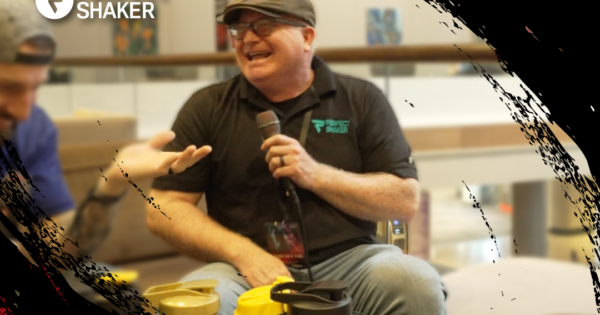
Darren Thompson, co-founder of PerfectShaker, joins Ben and Spencer at the 2026 Arnold Sports Festival to break down shaker bottle manufacturing, DC/Marvel licensing, laser etching, and the future of custom shakers on Episode #209 of the PricePlow Podcast.
Most supplement users have owned a shaker bottle, but very few have thought much about what separates a good one from a bad one. Episode #209 of the PricePlow Podcast changes that.
Recorded live at the 2026 Arnold Sports Festival, Ben Kane and Spencer Lynn sit down with Darren Thompson, co-founder of PerfectShaker. This episode pulls back the curtain on one of the supplement industry’s most overlooked categories.
Darren and business partner Mark started PerfectShaker in 2009, and over 15-plus years have built it into a full-service custom shaker brand used by Bucked Up, Redcon1, and hundreds of others. From injection molding in China, Hungary, and the USA to DC and Marvel licensing deals, to laser-etched stainless steel and a forthcoming aluminum shaker built for the RTD era, this conversation goes places most supplement media doesn’t.
The episode also covers trade show drayage, COVID survival, the Action Rod patent, and why a shaker bottle with your name on it psychologically hits differently than one without.
0:00 – Introductions
- Subscribe to the PricePlow Podcast on Your Favorite Service (RSS)
- Video: Inside PerfectShaker – Supply Chains, Superheroes, and Custom Shaker Innovation
- Detailed Show Notes: Darren Thompson of PerfectShaker at the 2026 Arnold Sports Festival
- 0:00 – Introductions
- 7:15 – The PerfectShaker Origin Story
- 9:00 – Licensing Superheroes: A Six-Figure Bet on DC and Marvel
- 10:45 – The Action Rod and Customer-Led Innovation
- 12:30 – Injection Molding 101: How Shaker Bottles Are Made
- 16:00 – Quality, Durability, and Owning Mistakes
- 17:30 – Printing Methods and Color Science
- 19:30 – Manufacturing Locations: China, the USA, and Hungary
- 22:00 – Sustainability: Ocean Plastic and Material Innovation
- 24:30 – Trade Show Hustle and the Drayage Racket
- 27:00 – COVID, Bucked Up, and Small Business Survival
- 32:45 – Custom Metal Shakers and the PricePlow Partnership
- 35:00 – Laser Etching, Powder Coating, and Water Dipping
- 37:00 – Personalization at Scale
- 39:30 – All-In on Stainless Steel: MOQs, Risk, and Pre-Selling
- 41:00 – Breakthrough Moments and Why the Industry Matters
- 45:30 – Sports and Entertainment Licensing
- 49:00 – The PricePlow Origin Story and Bevlab
- 57:30 – Creating Content and Handling Online Criticism
- 1:01:30 – What’s Next: Aluminum Shakers and the RTD Convergence
- 1:04:15 – The $1.2B Shaker Bottle Market and the RTD Future
- 1:07:30 – Closing Thoughts
- Where to Follow and Learn More
- Subscribe to the PricePlow Podcast on Your Favorite Service (RSS)
- All PricePlow Articles Mentioning Perfect Shaker
Ben and Spencer welcome Darren Thompson, co-founder of PerfectShaker, recorded live at the 2026 Arnold Sports Festival. Spencer opens with one of the industry’s favorite Darren stories: specifically told not to attend a summer conference, Darren showed up the day before it started anyway, fedora on and a rucksack of custom-branded shakers across his back. Spencer spotted him from 100 yards down an empty expo hall.
Darren describes PerfectShaker as being in “the spoon business”: not glamorous up front, but essential. He and business partner Mark focus on branded shaker cups that help supplement companies express their identity to customers. At Expo West alone, the PerfectShaker team assembled 180 custom one-offs, each already bearing a brand’s logo before the team ever walked up to their booth, turning a cold sales call into a gift.
7:15 – The PerfectShaker Origin Story
Darren traces the company back to 2009, when he and Mark were attending the Olympia and brainstorming ways to collaborate. They wandered onto the show floor and started talking to two gentlemen named Eric and Jeff — not realizing at the time they were speaking to the president and CEO of Europa Sports, one of the largest sports nutrition distributors in the country. Those 15 minutes of mentorship set everything in motion.
PerfectShaker launched in 2010. For a while, Darren jokes, it was “the redheaded stepchild” of his Canadian distribution business. But it kept growing, and the company started collecting licensing partnerships and building the supply chain relationships that would eventually make it a go-to custom shaker partner for the supplement industry.
9:00 – Licensing Superheroes: A Six-Figure Bet on DC and Marvel
The turning point came in 2013 when Darren was emceeing a bodybuilding show for the Alberta Bodybuilding Association (ABBA), a role he held for 10 years. Looking out at the stage, he noticed 10 of 17 competitors had Batman or Superman tattoos. The insight hit immediately: put that on a shaker cup.
What followed was three years of grinding, a 6-figure minimum guarantee up front, and an 18% ongoing royalty on all sales. Licensing fees were funded by mortgaging homes and borrowing from family while both wives asked “what are you doing?” The risk paid off. When DC and Marvel branded shakers launched at the Toronto Pro Show and the Arnold Sports Festival, people were literally throwing $20 bills at the booth. They sold out in the first 90 days, and PerfectShaker was on the map.
10:45 – The Action Rod and Customer-Led Innovation
PerfectShaker’s patented Action Rod is one of the brand’s signature features. Instead of a loose mixing ball rattling around (and occasionally getting lost or left in a previous bottle), the rod keeps everything attached and in place. As Darren puts it: “In rod we trust, so you never lose your balls.”
Beyond the patent, a customer request sparked another key evolution. A large retailer noted that their existing shaker supplier could only print on one side of the bottle. PerfectShaker could print on both. The retailer put an inventory SKU on one side and a marketing message on the other, effectively cutting their per-unit cost in half. Spencer calls this “literal white space”. Darren calls it listening to your customers, which he returns to as the single most reliable source of product innovation throughout the conversation.
12:30 – Injection Molding 101: How Shaker Bottles Are Made
Few people think about what actually happens before a shaker bottle reaches a shelf. Darren explains injection molding from scratch: a metal mold, roughly table-sized and weighing several hundred pounds, gets injected with hot plastic pellets in a 30-second cycle. The mold opens. A finished part drops out. Repeat.
Each PerfectShaker bottle has four plastic components and one surgical stainless steel part. A single mold in the US runs roughly $250,000. In China or Europe, the same mold costs $25,000 to $30,000 and produces about a million shots before it needs replacing. PerfectShaker’s Chinese manufacturing partner, the same partner for 17 years, runs 72 500-ton injection molding machines using BPA-free, phthalate-free plastic. The licensing agreements PerfectShaker holds also require annual social accountability audits at all factories.
16:00 – Quality, Durability, and Owning Mistakes
Plastic grammage, meaning the weight of plastic used per part, drives durability. Thicker plastic costs more but survives the drops that shatter cheaper alternatives. Darren recalls the early-era shakers that people threw out rather than cleaned because the plastic was thin enough that cleaning wasn’t worth the effort.
PerfectShaker isn’t immune to quality failures. Darren tells the story of a full production run for Redcon1 where bottles would “vaporize” on impact. His response: ship replacement bottles immediately, own the mistake without making excuses, and use the failure to improve systems. Redcon1 has been a customer ever since. Making shakers across three different manufacturing climates (China, USA, Hungary) also requires constant calibration, similar to how McDonald’s had to reformulate their fries as they expanded globally. Consistent results across geographies don’t happen automatically.
17:30 – Printing Methods and Color Science
Sublimation (heat transfer printing) and screen printing produce different results, and the durability comparison is counterintuitive. Sublimated prints on PerfectShaker bottles are rated for around 50 dishwasher cycles. Screen-printed bottles can survive up to 500. The trade-off is in setup costs and minimum order quantities: sublimation enables one-offs at low MOQs, while screen printing needs roughly 5,000 units to justify the setup cost.
Color accuracy matters enormously. PerfectShaker invested roughly $12,000 in a Pantone (PMS) color catalog with actual physical plastic chips for every color option. Colors on a screen render differently than colors in molded plastic. When a brand is ordering tens of thousands of units, they need to see and approve the real thing before the run starts, not a digital approximation. CMYK and PMS matching are both options depending on the project, and getting the details right is part of what PerfectShaker’s team handles for each client.
19:30 – Manufacturing Locations: China, the USA, and Hungary
PerfectShaker manufactures in three locations depending on customer needs and cost sensitivity. Chinese production remains most cost-effective for runs over 5,000 units, but COVID exposed the fragility of that supply chain. Shipping a 40-foot container (roughly 32,000 plastic shakers) went from $4,000 to $6,000 pre-COVID all the way to $28,000 at the peak. Costs have since come back to $8,000 to $10,000.
US manufacturing carries a 30% to 50% price premium but offers 4-to-6-week turnarounds and appeals to brands that want “Made in USA” on the label. Hungary serves European production needs with comparable quality standards. Canada, where Darren is based, is no longer viable for warehousing (warehouse rent runs $18 per square foot there versus $6 per square foot across the border in upstate New York), so inventory is staged stateside where it can reach US brands faster.
22:00 – Sustainability: Ocean Plastic and Material Innovation
Darren worked with Oceanworks, a company that collects ocean plastic, breaks it down into reusable pellets, and supplies it as a manufacturing input. The cost premium for ocean-recycled material was just $0.25 per bottle. Most customers passed on it anyway, citing price sensitivity. The sustainability-leaning brands that might have embraced it have since shifted toward stainless steel and glass as their preferred premium tier.
The conversation turns forward-looking. Stainless steel now anchors the premium category, driven by consumers who want something that feels collectible rather than disposable. Darren also floats copper, noting emerging science around drinking from copper vessels, though the cost per unit would push well above $280. The progression from disposable plastic to ocean-recycled pellets to laser-etched stainless tracks closely with how supplement consumers have raised their standards over time, and PerfectShaker has tried to stay ahead of each shift.
24:30 – Trade Show Hustle and the Drayage Racket
Spencer recounts the story of Darren showing up at a conference specifically told not to attend, delivering custom shakers anyway from inside a rucksack. That hustle is the short version. The longer version involves what it costs to play by the rules at trade shows: Darren paid $800 at Expo West to move a single pallet approximately 15 feet from a loading dock to his booth. Ben’s characterization of the union-enforced drayage system is “organized crime,” and Darren doesn’t push back.
His workaround is now LinkedIn-famous: surfing a luggage cart loaded with shaker bottles down a street in downtown Denver (technically illegal, he admits) rather than paying union rates to roll it across a convention floor. At SupplySide Global, Spencer’s team commandeered a cart and carried boxes by hand to avoid the same fees. The culture of “ask forgiveness instead of permission” runs deep among independent brands that can’t absorb $15,000 freight bills.
27:00 – COVID, Bucked Up, and Small Business Survival
COVID nearly ended PerfectShaker. Customers went bankrupt. Shipping costs exploded. Darren describes facing real choices between paying freight bills and making payroll. His candid answer when Spencer praises the frugal LinkedIn posts: “I’m not just trying to save money. We’re just trying to stay afloat.”
The company credits Bucked Up and the Gardner family (Ryan, Jeff, and Dan) with keeping them in business through the worst of it. PerfectShaker and Bucked Up first crossed paths at the Olympia in 2016, when both companies were running 10×10 booths. That early relationship grew into one that sustained PerfectShaker when the supply chain collapsed around them. Darren was also at the Arnold this year with his 16-year-old son Reed working the booth, trying to pass down the same scrappy work ethic he learned sleeping in a van between retailer visits during the early years.
32:45 – Custom Metal Shakers and the PricePlow Partnership
As part of the 2026 partnership between PricePlow and PerfectShaker, every podcast guest receives a custom laser-etched stainless steel shaker engraved with both their brand and the PricePlow logo. Spencer holds up a recent example: one made for Red Knot Capital’s Nate Frazier, an earlier 2026 guest (Episode #201 with Gym Snack). Spencer’s own PricePlow shaker now sits on his kitchen counter, more decorative than functional.
When PerfectShaker made a custom piece for VMI Sports for Episode #205, Tom from VMI reportedly told Spencer it was going straight onto his trophy shelf. Darren notes this is the psychological hook of personalization: when you see a group photo, you look for yourself first. A shaker with your name on it activates the same reflex. The metal bottle’s weight and durability make it feel more like an award than an accessory, which is exactly what Darren wants guests to experience.
35:00 – Laser Etching, Powder Coating, and Water Dipping
Getting laser etching right came with a costly lesson: Darren spent $13,000 on a fiber laser that burned straight through the metal instead of cleanly removing the powder coating. The correct tool for metal is a CO2 laser, which runs closer to $100,000 for a professional setup. He eventually partnered with Radian Laser Systems to get the process dialed in.
The finished stainless steel product starts as a powder-coated bottle in any color the client chooses. The CO2 laser then etches away the coating to reveal the natural metal underneath. For more elaborate customization, PerfectShaker recently added water dipping technology, originally used for motorcycle helmets. It allows full-coverage hydrographic patterns (camo, textured finishes, layered effects) that can then receive laser etching on top. The Arnold VIP shakers this year featured a full 360-degree Arnold collectible wrap across 5,000 units, with the Arnold UK partnership receiving similar treatment.
37:00 – Personalization at Scale
Modern laser etching machines enable a capability that most people don’t expect at scale: individual names. PerfectShaker can load a spreadsheet of 10,000 names, attach it to a production run, and engrave a unique name on each bottle as it passes through. The machine prints a new name automatically on every cycle. Ben sent 12 PricePlow-branded shakers to his team, each personalized for one person, and the reaction was noticeably different than receiving a generic branded bottle.
Darren frames this as the real weight of the business. When a company hands PerfectShaker their logo to put on a bottle, they’re trusting him with something they’ve built. His job isn’t to manufacture a cup; it’s to represent that brand well to every person who picks up the bottle. “When you can put somebody’s name on it, you know it becomes something they’re going to cherish,” he says. That’s the philosophy behind every batch, whether it’s 100 one-offs or a 40-foot container.
39:30 – All-In on Stainless Steel: MOQs, Risk, and Pre-Selling
A standard 40-foot container of stainless steel units holds roughly 17,000 bottles, each requiring significant capital up front. Darren describes the 2025-2026 period as PerfectShaker’s all-in moment: every spare dollar went into laser-etching equipment or stainless steel inventory. There’s no hedging.
The lesson on pre-selling comes from an outside story: a seminar speaker who invested nearly $500,000 in molds and marketing for a novelty football shaped like a pig (the “when pigs fly” concept) without preselling a single unit. Darren uses that story as a standing reminder to go to the market first. PerfectShaker validates demand before placing large orders, finances purchase orders through factoring arrangements when needed, and cycles credit lines to keep operations running. It’s not elegant. But it works, and it protects the brand from being the person with the unsold pig footballs.
41:00 – Breakthrough Moments and Why the Industry Matters
Two moments stand out as PerfectShaker milestones. The first was landing a full container-level order from a single brand, which signaled a new level of customer trust and scale. The second was the Batman, Superman, Wonder Woman, and Hulk launch at the Arnold, where people were handing over $20 bills without waiting for a sales pitch.
A woman posted on Instagram that she hadn’t wanted to go to the gym that morning, but “couldn’t let Wonder Woman down.” Her shaker sat on the bench as a small daily commitment device. Darren also shares a more personal thread: his father had a triple bypass at 42 and died of a heart attack at 72. The supplement industry, for Darren, means being around people who help each other make better choices. That connection between a branded shaker and someone’s health decision is the deeper story he’s in this to tell.
45:30 – Sports and Entertainment Licensing
Superhero licensing opened the door to other deals. PerfectShaker has worked with Major League Baseball (MLB) and, Darren’s personal favorite, WWE. Getting to the WWE headquarters in Connecticut to sign the Hulk Hogan licensing deal was a genuine life moment. His grandmother, who had suffered a stroke and could communicate only the word “wrestling”, had loved the sport. Darren paused the signing to honor her presence in the room.
New licensees get taken to a private archive of every piece of WWE merchandise produced over the past 30 years and invited to take one item home. Darren chose something tied to the Ultimate Warrior, a figure he describes as genuinely speaking to kids about believing in themselves and taking care of their bodies. The specific item remains undisclosed. Expect a LinkedIn post.
49:00 – The PricePlow Origin Story and Bevlab
Darren turns the tables and asks where PricePlow came from. Ben explains that founder Mike started it in Hermosa Beach, CA around 2008 as a price comparison site for supplements, having come up with the idea while playing water polo at Ohio State in the early 2000s. When e-commerce commoditized comparison shopping, Mike pivoted to content and investigative journalism, publishing pieces that exposed amino spiking and proprietary blend abuses in ways that built real audience trust.
Ben joined from NutraBio, where he’d been feeding Mike stories for years, and introduced the retainer model that turned PricePlow from a lifestyle business into a content operation. Spencer manages operations. The newest chapter is Bevlab, led by Cody, which takes an entertainment-first approach to the energy drink space. Cody’s White Monster review hit over a million views. While PricePlow goes deep and technical, Bevlab goes wide and shareable, pulling mainstream consumers into the funnel.
57:30 – Creating Content and Handling Online Criticism
Ben shares something he’s rarely said publicly: there are days he doesn’t want to be on camera. Content, like shaker bottle manufacturing, requires consistency on the hard days. Spencer notes that Ben filmed three to four videos per day during the pre-Arnold push, and even a 90-second clip can take an hour to produce when you factor in scripting and getting mentally ready for it.
The group also addresses online criticism. Joe Rogan says don’t read the comments, but at PricePlow’s scale, comment engagement is still algorithmically valuable enough that ignoring it isn’t smart. The team distinguishes between purely inflammatory comments (push back briefly or ignore) and comments where someone is genuinely mistaken or curious (engage, educate, share data). The goal is always to leave someone better informed than before they clicked. Bad-faith engagement is still engagement, and the algorithm doesn’t care about the intent.
1:01:30 – What’s Next: Aluminum Shakers and the RTD Convergence
Darren teases a major product in development: an aluminum shaker bottle, built in partnership with the PricePlow and Bevlab teams. Aluminum is infinitely recyclable, unlike plastic, and the product concept positions PerfectShaker at the intersection of two growing markets.
RTD (ready-to-drink) energy drinks have captured consumer attention at the sub-$5 impulse-buy tier, pulling spending away from $70 tubs of powder. Darren expects the cycle to eventually turn back to cost-per-serving math. For now, the aluminum shaker is designed to serve both the RTD consumer and the gym-goer mixing their own pre-workout. PerfectShaker is all-in on stainless steel at the moment, but the aluminum project is where the brand is pointed next. Darren is actively looking for functional beverage consultants to help bring it to life.
1:04:15 – The $1.2B Shaker Bottle Market and the RTD Future
The numbers support the optimism. The global shaker bottle market is approximately $1.2 billion and projected to grow 6% to 7% annually over the next five years. Darren argues that energy drinks haven’t hurt shaker bottle sales — they’ve pulled new consumers into the health ecosystem, which benefits the whole category. GHOST Energy is the clearest example: a consumer buys a can at a gas station, discovers the brand, explores protein powder and pre-workout, and eventually needs a shaker.
The conversation ends with functional ingredient alternatives to caffeine. Spencer points to paraxanthine (enfinity by TSI Group), Cognizin, MitoPrime from NNB Nutrition, and goBHB from Ketone Labs as ingredients already reshaping the energy drink formula. As the RTD market matures and consumers become sensitive to stim overload, there’s real opportunity for brands that can deliver mental and physical performance without relying entirely on caffeine.
1:07:30 – Closing Thoughts
Darren wraps up reflecting on PerfectShaker’s Arnold booth tagline: “Make America Shake Again”. It made people smile, whether they bought anything or not. His core values are service, integrity, and results. He credits those values with why the PricePlow partnership makes sense on both sides.
One moment earns a laugh: early in the business, PerfectShaker printed “voted #1 shaker cup in Canada” on the back of business cards. The vote count was exactly two (Mark and Darren). Ben’s humorous response: “the FTC would like to talk to you about that claim”. Anyone interested in how supplement industry regulatory compliance actually works will find that conversation covered in depth in our Episode #100 with Dan Fabricant of the Natural Products Association. This was only Darren’s second podcast ever, and he rocked it.
It’s only fitting that the company sponsoring the PricePlow Podcast in 2026 is also the subject of one of our most in-depth niche episodes. A huge thank-you to Darren for joining us at the Arnold and opening up on every corner of the business, from the early van-life days to the stainless steel all-in bet he’s running right now. If you’ve ever wanted a custom shaker bottle for your brand or your own gym shelf, head over to PerfectShaker.com and see what the team can do.
Subscribe to the PricePlow Podcast on any platform, sign up for Perfect Shaker news and alerts on PricePlow, and leave us a review on iTunes and Spotify!
