

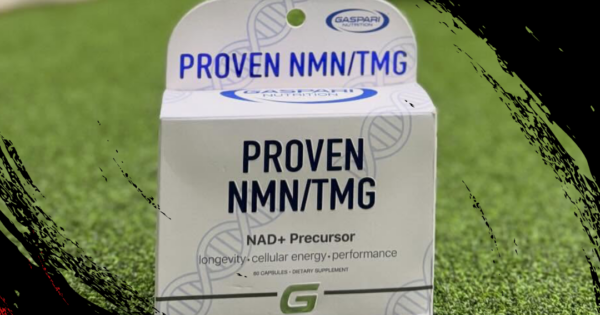
Gaspari Nutrition is back with a product built for the long game.
NMN is legally confirmed as a dietary supplement again, and Gaspari Nutrition timed this perfectly. Proven NMN/TMG delivers a full NAD+ and methylation support stack in two capsules.
Proven NMN/TMG is the brand’s entry into the cellular energy and longevity category, and it arrives at exactly the right moment: NMN has just been fully cleared as a dietary supplement after an absurd years-long (and wholly unnecessary) regulatory battle with the FDA. Gaspari’s formula makes a strong case for why a bare-bones NMN capsule isn’t enough once you see what Rich and his team have put together here.
The backstory: NMN has been sold as a dietary supplement since the early 2010s, having at least one GRAS self-affirmation since 2018, and a valid New Dietary Ingredient Notification on file in May 2022. But in late 2022, the FDA attempted to remove NMN from the supplement market entirely — a legally questionable move given that there was no safety or adulteration basis. The Natural Products Association challenged that position, and in September 2025 the FDA reversed course completely,[1] confirming NMN is not excluded from the dietary supplement definition (which it shouldn’t have been in the first place).
If you’ve been following the saga in our NMN and FDA coverage,[1] this is the resolution the industry was waiting for. Gaspari’s timing is picture perfect.
What separates Proven NMN/TMG from the crowd is what’s in it alongside the NMN. Most brands ship 300mg to 500mg of NMN and call it done. Gaspari added TMG (trimethylglycine) to address a real formulation gap: NMN supplementation can deplete methyl donors, and TMG replenishes them, keeping methylation pathways running efficiently. Add 125mg trans-resveratrol for antioxidant and longevity pathway support, layer in active methylated B-vitamins (B2, B6, folate, and B12), and you’ve got a formula that actually accounts for how these pathways interact.
The packaging is a callback worth noting too. Gaspari shipped Proven NMN/TMG in blister packs inside a box, a format the brand used during its golden era with some of its most iconic products. For longtime Gaspari fans who still love PlasmaJet, it’s a familiar touch.
NMN (Beta-Nicotinamide Mononucleotide) – 500mg
Beta-nicotinamide mononucleotide is a naturally occurring nucleotide found in small amounts in cinnamon, milk, broccoli, edamame, avocado, and tomatoes. However, it’s in amounts so modest that food alone likely wouldn’t meaningfully raise NAD+ levels in the body, although the body seems to have a specific transporter for it,[2] which means it’s incredibly important. That’s where supplementation enters the picture.
NAD+ (nicotinamide adenine dinucleotide) is a coenzyme required for energy metabolism, DNA repair, liver detoxification, and the activation of sirtuin proteins and PARP enzymes that regulate cellular maintenance. The problem: NAD+ concentrations in tissues including skin, blood, liver, muscle, and brain decline measurably with age, and that decline is associated with reduced mitochondrial efficiency, impaired DNA repair capacity, and broader shifts in cellular function.[3] NMN is the immediate precursor to NAD+ via the salvage pathway (the cell’s primary route for synthesizing and recycling NAD+) and its availability is considered rate-limiting in that biosynthetic process.[4] As such, you can consider it a quality form of vitamin B3, and it won’t make you flush like niacin (nicotinic acid) will.
What the Clinical Research Shows
The human trial record on NMN has grown considerably over the past several years, with consistent findings on two fronts: NAD+ elevation and safety.
After it received letter of non-objection as a legal dietary supplement ingredient, the FDA has gone back on its word and claimed that NMN is not an ingredient. What’s the full story here, and will the dietary supplement industry fight back?
A randomized, multicenter, double-blind, dose-dependent trial in 80 healthy middle-aged adults found that blood NAD+ concentrations rose significantly at both day 30 and day 60 across all NMN doses (300mg, 600mg, and 900mg daily), with the highest concentrations observed in the 600mg and 900mg groups. Six-minute walking distance improved significantly in all NMN groups versus placebo, and biological age as measured by a validated assessment tool remained stable in NMN-treated participants while it increased in the placebo group over the 60-day trial. No safety issues were identified across all doses.[5]
In a placebo-controlled, randomized, double-blind trial at the University of Tokyo, 250mg/day NMN for 12 weeks in healthy men aged 65 and older significantly elevated NAD+ and NAD+-related metabolites in whole blood as measured by LC-MS/MS analysis. Researchers also observed nominally significant improvements in gait speed and left grip strength in the NMN group.[6] In a separate six-week double-blind trial in recreational runners, NMN at 600mg and 1200mg/day significantly increased oxygen uptake, ventilatory threshold, and aerobic capacity versus placebo, with the researchers attributing the improvement to enhanced oxygen utilization in skeletal muscle.[7]
For metabolic function, a 10-week randomized controlled trial by Washington University researchers found that 250mg/day NMN increased insulin-stimulated glucose disposal and skeletal muscle insulin signaling in postmenopausal prediabetic women (as measured by phosphorylation of AKT and mTOR), while placebo produced no change.[4]
The Methylation Connection
An important downstream consideration is one reason this formula doesn’t stop at NMN: the salvage pathway that NMN feeds is SAMe (S-adenosylmethionine)-dependent, and sustained NAD+ biosynthesis increases demand on methyl donor pools. Without support, that can elevate homocysteine as a byproduct. The TMG, folate, and methylcobalamin in this formula collectively address that downstream pressure, keeping the methylation cycle functional while NMN drives NAD+ biosynthesis upstream. Resveratrol layers in an additional angle, acting as a SIRT1 activator that works on the same NAD+-dependent pathway NMN supports.
Dosing Context
The 500mg dose in Proven NMN/TMG sits at the upper end of doses studied in human trials, which have ranged from 250mg to 900mg/day. The clinical data from Yi et al. (2022) found peak physical performance benefits at 600mg/day, and NMN has demonstrated a consistent safety profile across all doses evaluated to date — no serious adverse events have been reported in published human trials.[3]
This is a phenomenal ingredient, and the FDA did the entire world a massive disservice by illegally attempting to give it to big pharma for 3 years. Thank you to the NPA for saving it, as it is truly a dietary supplement ingredient through literally every lens of the law.
Trimethylglycine (TMG) (as Betaine Anhydrous) – 500mg
Trimethylglycine (TMG, also called betaine anhydrous) is a compound found in beets, spinach, and whole grains that works through two mechanisms: as an osmolyte that helps cells manage osmotic stress, and as a methyl donor that contributes methyl groups directly to the methylation cycle, converting homocysteine to methionine via betaine-homocysteine methyltransferase (BHMT).[8]
The methyl donor role is what earns TMG its spot here. As mentioned above, NMN supplementation drives NAD+ biosynthesis through the salvage pathway, a process that consumes SAMe (S-adenosylmethionine) and elevates homocysteine as a byproduct. TMG provides a direct, independent route to clear it: oral TMG lowers plasma homocysteine in a dose-dependent fashion.[9][10]
At 500mg, this dose is calibrated for methylation support rather than the 2.5g range studied in athletic performance contexts. With folate and methylcobalamin also feeding the methionine synthase pathway, TMG contributes a second, BHMT-dependent route for homocysteine clearance, keeping the methylation cycle running as NMN does its work upstream.
Trans-Resveratrol – 125mg
Trans-resveratrol (3,5,4′-trihydroxy-trans-stilbene) is a polyphenolic stilbene found in grape skins, berries, and peanuts. It’s best known as one of the compounds behind the “French Paradox” observation, and it earns its place in this formula through a specific mechanism: activation of SIRT1, the NAD+-dependent sirtuin at the center of this product’s longevity rationale.[11]
SIRT1 is a histone deacetylase that requires NAD+ as a cofactor, which is exactly what NMN is designed to support upstream. Resveratrol was originally identified in 2003 as the most potent small-molecule activator of yeast SIRT1 in a search for calorie restriction mimetics.[11] In middle-aged mice on a high-calorie diet, resveratrol improved insulin sensitivity, increased mitochondrial number, and supported motor function.[12]
Over 244 clinical trials have evaluated resveratrol’s safety and effects in humans, with clinical data showing activity across metabolic, cardiovascular, and neurological health markers.[13] The trans-isomer specifically used here is the more bioavailable and biologically active form, making the designation on this label meaningful.
At 125mg, this dose fits comfortably within ranges used in clinical research and pairs logically with the NMN here: NMN raises NAD+ availability, and resveratrol targets the SIRT1 pathway that depends on it. The two ingredients aren’t redundant — they work at different points along the same axis.
Riboflavin (as Riboflavin-5-Phosphate) – 5mg
Riboflavin-5-phosphate (R5P) is the bioavailable, coenzyme-active form of vitamin B2, bypassing the conversion step required by standard riboflavin. Inside cells, riboflavin is converted to its two functional coenzyme forms: flavin mononucleotide (FMN) and flavin adenine dinucleotide (FAD).[14] FAD is an essential component of both Complex I and Complex II of the mitochondrial respiratory chain, making riboflavin a direct participant in cellular energy production.[14]
Riboflavin also contributes directly to this formula’s methylation support layer. MTHFR (methylenetetrahydrofolate reductase), the FAD-dependent enzyme that generates 5-methyltetrahydrofolate for homocysteine remethylation, requires adequate riboflavin status to function efficiently.[15] This connects riboflavin directly to the folate and methylcobalamin already present here, supporting the same methylation cycle that NMN supplementation places additional demand on.
On the antioxidant side, FAD is the cofactor for glutathione reductase (GR), the enzyme that regenerates reduced glutathione from its oxidized form. Riboflavin deficiency reduces GR activity and depletes tissue glutathione, impairing the cell’s primary peroxide-clearing system.[16] At 5mg, the dose is well above the adult RDA of ~1.3mg, consistent with the supplemental range used to support these functional pathways rather than address a basic dietary gap.
Vitamin B6 (as Pyridoxal-5-Phosphate) – 5mg
Pyridoxal-5-phosphate (P5P) is the biologically active coenzyme form of vitamin B6, ready for immediate use without the conversion steps required by the common supplement form, pyridoxine. That distinction matters: pyridoxine must be phosphorylated in the liver before becoming functional, and research has shown that high supplemental doses of pyridoxine can actually inhibit PLP-dependent enzymes by competing with the active cofactor, a phenomenon researchers have called the “vitamin B6 paradox”.[17] Delivering P5P directly sidesteps that issue entirely.
Vitamin B6 acts as cofactor for more than 140 enzyme reactions involved in amino acid, carbohydrate, and lipid metabolism, and plays a direct role in neurotransmitter synthesis (including GABA, dopamine, and serotonin).[18] Within Proven NMN/TMG, its relevance is tighter: B6 is a required cofactor in homocysteine metabolism via the transsulfuration pathway, and low plasma P5P is one of the primary predictors of elevated homocysteine in aging populations.[19] A 3-year longitudinal study in aging men found that low plasma B6 was independently associated with cognitive decline, alongside homocysteine and other B vitamins.[20]
Alongside the TMG, folate, and methylcobalamin in this formula, P5P contributes a third, complementary route for homocysteine clearance, supporting the methionine cycle that NMN supplementation places under increased demand. The 5mg dose is modest relative to therapeutic ranges studied in clinical contexts, but at the P5P level, bioavailability is not the limiting variable.
Folate (as L-5-Methyltetrahydrofolate) – 400mcg
L-5-Methyltetrahydrofolate (5-MTHF) is the biologically active form of folate, accounting for more than 90% of circulating plasma folate.[21] Unlike synthetic folic acid, 5-MTHF doesn’t require conversion by dihydrofolate reductase (DHFR) or methylenetetrahydrofolate reductase (MTHFR) to reach its active state.
That efficiency matters for much of the population. Up to 55% of Europeans carry the MTHFR 677C→T polymorphism (heterozygous or homozygous), which reduces enzyme activity by 25–75% and impairs the body’s ability to convert folic acid into usable folate.[21] Worth noting that folic acid hardly exists in nature in the first place, and we should not be formulating or fortifying with it anyway. 5-MTHF sidesteps the bottleneck entirely.
Within this formula, folate’s primary role is once again supporting homocysteine remethylation via methionine synthase, the B12-dependent reaction that recycles homocysteine back to methionine.[22] This is directly relevant here: NMN supplementation accelerates methyl group consumption, and both TMG and 5-MTHF help keep the methylation cycle running. The methylcobalamin (B12) in this formula is 5-MTHF’s direct cofactor in that reaction, a pairing that reflects deliberate design. At 400mcg, the dose matches the standard adult RDA.
Vitamin B12 (as Methylcobalamin) – 400mcg
Methylcobalamin is the bioidentical, neurologically active form of vitamin B12, usable by the body without additional conversion, unlike the cyanide-based cyanocobalamin.[23] As another cofactor for methionine synthase, it also helps drive the methylation cycle, converting homocysteine to methionine as discussed multiple times above.[24]
At the mitochondrial level, B12 supports normal energy metabolism alongside riboflavin and B6, with B-vitamins collectively facilitating mito-nuclear communication through metabolite signaling.[25]
Hats off to Rich and his team – this is a fantastically put-together formula, especially in a sea of standalone NMN supplements out there.
The NMN category has suffered from a credibility problem — not because the science is weak, but because too many products sold a single ingredient at low doses and moved on. The FDA’s malfeasance certainly didn’t help, either. Proven NMN/TMG takes a different approach, and the reasoning is sound: NMN’s effect on NAD+ biosynthesis is well-documented, but what happens downstream to methylation balance matters just as much. TMG at 500mg addresses that directly. The resveratrol addition layers in antioxidant support, and the decision to use active, methylated B-vitamins rather than cheaper synthetic forms shows attention to absorption.
Gaspari has built its recent comeback around finding real gaps in the market rather than chasing trends. Proven Egg dominated egg white protein because the category was underserved. Proven NMN/TMG takes the same logic into longevity, arriving right as the regulatory cloud lifts and the market can actually grow without legal uncertainty overhead. If you want the full picture on where the brand is headed, start with Rich Gaspari’s appearance at the Arnold Classic 2026. There, he previewed this product on the expo floor and his enthusiasm for it is the real kind.
Check PricePlow for current pricing and to sign up for Gaspari Nutrition news alerts:
