

Introduction: Building the Fighter’s Strength
In my early years, myths about training were still common, including the belief that lifting weights could stunt growth. In Israel, children were not permitted in gyms until 2005. We are past that era, but one training error is still everywhere: coaches mistake exhaustion for readiness.
A fighter’s body is not a decoration. It is the primary tool for winning a real fight, whether you call it a bout, a mission, or a bad day that escalated.
Specific skill practice is the core of fight preparation, and it is time-intensive. Strength training must support that, not compete with it. If your strength program slows you down, irritates joints, or causes soreness that changes movement quality, it is not serving you as a fighter. It is serving the coach’s ego, the gym’s culture, or a false idea of toughness.
The StrongFirst Lens: Maximum Results, Minimum Noise
StrongFirst has always resonated with me because it respects the reality of limited resources. Fight teams and military units do not live in perfect training conditions. We train around shifts, stress, sleep debt, and unpredictable schedules. We need methods that produce a reliable return on time and equipment, with a premium on technical quality and resilience.
Pavel’s approach to jump training is a perfect example of the philosophy: “So you want to improve your jumping ability? First, get strong and symmetrical. Then start ‘greasing the groove’ (GTG) with all sorts of jumps.” That logic applies to fighters. Strength first, then specific expression.
Strength First, Then Specificity
Every combat sport has a signature. Grapplers need brutal grip endurance and isometric strength. Strikers need speed, timing, and the ability to turn the whole body into a whip. Many styles demand mobility, balance, and coordination at high intensity. But before you chase the signature, you need the base.
I teach a simple layering model. First comes general strength, the ability to generate high tension on demand. Then comes power, the ability to express strength quickly. Then comes endurance, the ability to preserve speed and coordination across rounds or repeated tasks. On top sit skill and timing, which are always the deciding factors when two athletes are equally prepared.
This hierarchy is not theoretical. It keeps programs honest. It helps you decide what to keep when time gets tight, and what to cut when training stress rises.
Do Not Teach the Fighter to Fail, Nor to Be Slow
One of the most prevalent errors in preparing fighters and warriors is confusing resilience with conditioning. Too often, programs rely heavily on endless burpees, prolonged circuits, and constant high-repetition work. These routines can build a high tolerance for discomfort, but they also carry a hidden cost.
That style of training makes athletes good at surviving fatigue rather than producing high-quality actions under stress. It teaches the body to move slowly and with compromised positions, sacrificing speed and coordination in favor of simply getting through the workload.
Conditioning should build repeatable outputs, not just the ability to suffer—this is a very important difference in training. The goal in this article is to enhance a fighter’s performance, not merely their capacity to endure hardship.
Pavel states it bluntly: “Acid is the enemy of both tension and relaxation, drawing one into the stiff no-man’s land in between.” If you want fighters who can explode, relax, and explode again, you must respect that reality. This is why I prefer anti-glycolytic conditioning for combat athletes: short, powerful efforts, full recovery, and the discipline to stop a set when output drops.
The Movement Menu for Fighters
When time is limited, train movement patterns, not muscle groups. Fighters need legs that can absorb and produce force, hips that can hinge explosively, and a torso that can transmit power and resist collapse under contact. In military contexts, that same torso must also tolerate long carries and awkward loads. Fighters also need pulling strength to stabilize the shoulder girdle and survive gripping and hanging tasks.
The simplest “menu” in my view is consistent with both StrongFirst and Dan John’s Easy Strength thinking: a squat pattern, a hinge pattern, a press, a pull, and a loaded carry. If your program covers those patterns with high quality and sane volume, you can build formidable general preparedness without stealing from skill training.
Guiding Principle: Every Strength Session Is Practice, not a Test
Fighters already test themselves. Sparring, competition, selection processes, and operational tasks deliver plenty of psychological and physical intensity. Strength training should build the engine and armor without adding unnecessary damage. Pavel’s reminder is useful here: “If you have to psych for whatever you are about to do, you are going too far.”
Two Fighter Templates Using Dan John’s “Even Easier Strength” as Inspiration
Dan John’s “Even Easier Strength” is the inspiration for the templates below. His framework is a gift to combat sports and to warriors, because it solves a real problem: how to train strength frequently, stay fresh, and keep progress moving while skill training stays the priority. The core instruction Dan shares, credited to Pavel, is simple: pick a small number of lifts, train them often, never miss reps, never grind, and keep total reps per movement low.
Below are two fighter-ready versions of that approach, one built around kettlebells and one around a barbell. Dan’s two-week wave uses mostly two sets of five with one day of 5/3/2, and it also includes a day of six singles followed by a light “tonic” day of one set of ten.
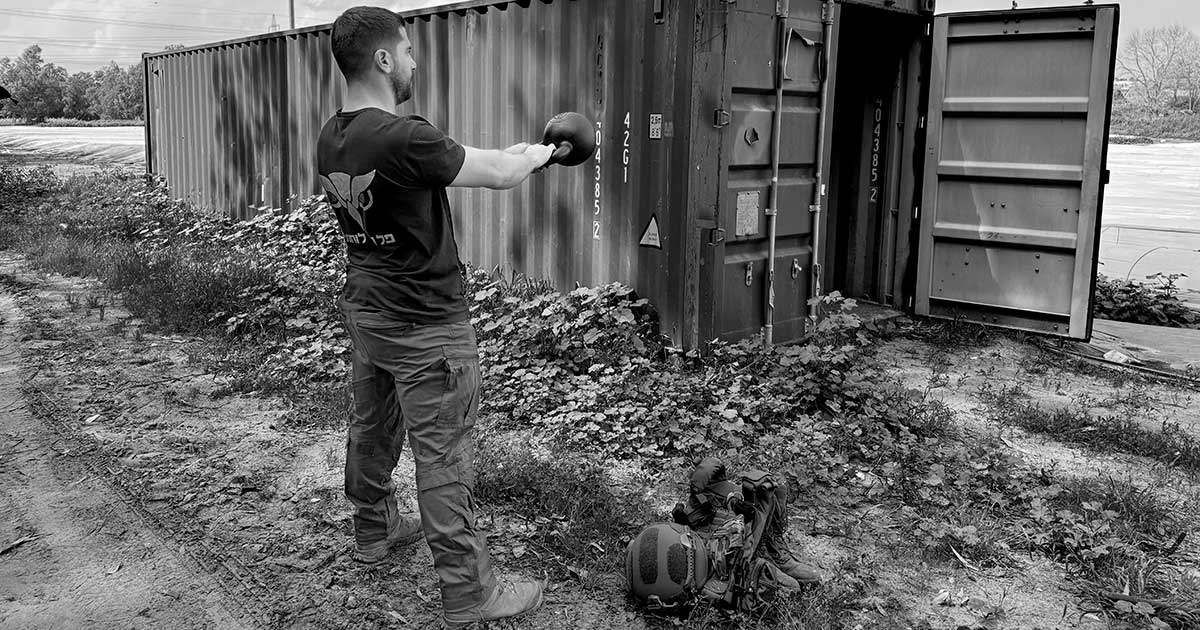
I have adapted the structure to the realities of fighters and the Israeli military, where there is rarely a fixed training routine. Life is built around frequent changes and many different types of training, including mandatory running sessions, Krav Maga, land navigation training, exhausting marches, and many other demands. The strength plan must stay flexible without losing its principles, so treat the wave as a sequence you continue whenever a strength slot appears, not as a rigid weekly schedule.
Template One: The Barracks “Even Easier Strength” with Kettlebells
This template is designed for minimal space and minimal equipment. It can be done as a standalone session in 15 to 25 minutes, or as a short strength “anchor” before or after technical training when the day allows it.
Start each session with a warm-up that opens the hips, grooves the hinge, and checks your positions.
Choose a press you can own with perfect alignment, usually the one-arm kettlebell military press. Choose a squat pattern that fits your knees and hips, often the double kettlebell front squat or a heavy goblet squat. Choose a hinge that can be explosive and repeatable, typically the two-arm swing with a bell heavy enough to demand tension but light enough to keep snap. Add a pull that supports the shoulders and grip, such as pullups, towel pullups, or heavy one-arm rows with strict body position. Finish with loaded carries, rotating suitcase and farmer carries depending on the day and space.
Now apply the wave as a rotation, not a calendar. Train two to five times per week, depending on the operational week. Most sessions are two sets of five across your chosen movements. About once every three to five sessions, use a 5/3/2 day: five reps with your 2×5 load, add a little weight for three, then add a little more for a crisp double. When you are fresh, insert a six singles day: add weight each single, no misses, never near a max. The following strength session is the light “tonic” day: one very easy set of ten that leaves you feeling better. Then return to two sets of five and keep the rotation moving.
How do you select loads with kettlebells? Follow Dan’s “too easy” principle. Your two sets of five should feel like practice, not work. If you are grinding, you chose the wrong bell. When the same bell begins to feel lighter at the same crisp speed, move up to the next bell or add only a small amount of work within the same constraints. The “rule of ten” is your guardrail: do not exceed ten reps per movement in a session.
Every two weeks, consider Dan and Pavel’s “same but different” idea. Keep the pattern but rotate the specific lift, such as switching the press from strict press to push press or switching the squat from double front squat to a heavy goblet squat.
Template Two: The Weight Room “Even Easier Strength” with a Barbell
This template is for units, gyms, or teams with a barbell (it can be done without a rack) and a little space to carry. The objective stays the same: frequent practice of a few lifts, never near failure, never missing reps, and never creating fatigue that steals from skill.
Pick a press that matches the warrior’s structure and shoulder history. Many do well with the floor press or the standing press. Pick a squat variation that can be done cleanly and confidently. I often recommend the Zercher squat because you do not need a rack, and it builds front-loaded strength and trunk stability. Pick a hinge you can train submaximally without wrecking the next day, such as a deadlift variation, and pair it with a pull (chin-ups, pullups, or barbell rows) to maintain shoulder balance. Finish with loaded carries, such as farmer carries or suitcase carries, for posture and contact readiness.
Run the same rotation described above: most sessions are two sets of five, occasionally you use a 5/3/2 day, once in a while you insert six singles, and you follow that with a very light “tonic” set of ten.
The coaching cues are simple. Every rep looks like a warm-up rep. Every bar speed stays consistent. If one day compromises the next, Dan’s guidance is clear: lighten the load and keep the quality.
Operational Readiness Placement
Far from competition or far from a major operational cycle, this approach can be run for 40 workouts as written in the original program, often eight weeks at two to five sessions per week. In that phase, let the steady exposure build a stronger chassis while skill training stays high quality.
As intensity rises or operational training becomes more demanding, keep the same movements but reduce the urge to “nudge” loads. Maintain technique, maintain speed, and let strength stabilize. In the final ten days before competition or a planned operation, shift to maintenance: a brief practice session once or twice, then focus on feeling sharp. Fighters do not lose strength quickly, but they do lose freshness quickly.
Why This Works: Fewer Injuries, More Skill Practice
Fighters are resilient, but their training schedule is unforgiving. The best strength program for a fight team is the one that allows consistent skill practice month after month. If your strength work leaves you fresh, you will train skill more often, with better quality, and with fewer interruptions.
Conclusion: Strength as a Martial Art
In The Book of the Warriors’ Teacher, I describe the body as the fighter’s primary tool. Strength training should be approached like martial arts: technical, patient, and purposeful. The goal is to do less but do it better. Build strength as a skill. Train power without teaching slowness. Condition without sacrificing speed.
If you are a StrongFirst instructor working with fighters or warriors, the promise of “Even Easier Strength” is not magic. It is discipline. Show up. Practice the same patterns. Never miss reps. Stay fresh. Let the quiet accumulation of quality work build a body that is a weapon.
Benjamin Mayer is a StrongFirst Certified Senior Instructor and a warriors’ coach in the Israeli military training system. He served 27 years at the Israeli Prime Minister’s Office and has dedicated his professional life to qualifying and training instructors, warriors, and operators. He is a martial art and Krav Maga expert, the author of The Book of the Warriors’ Teacher (Hebrew, currently being translated into English), CEO of Excellent Training Ltd., and co-founder of 10Dimensions Ltd. He holds an MA in Conflict Management and Public Administration from Tel Aviv University.
