

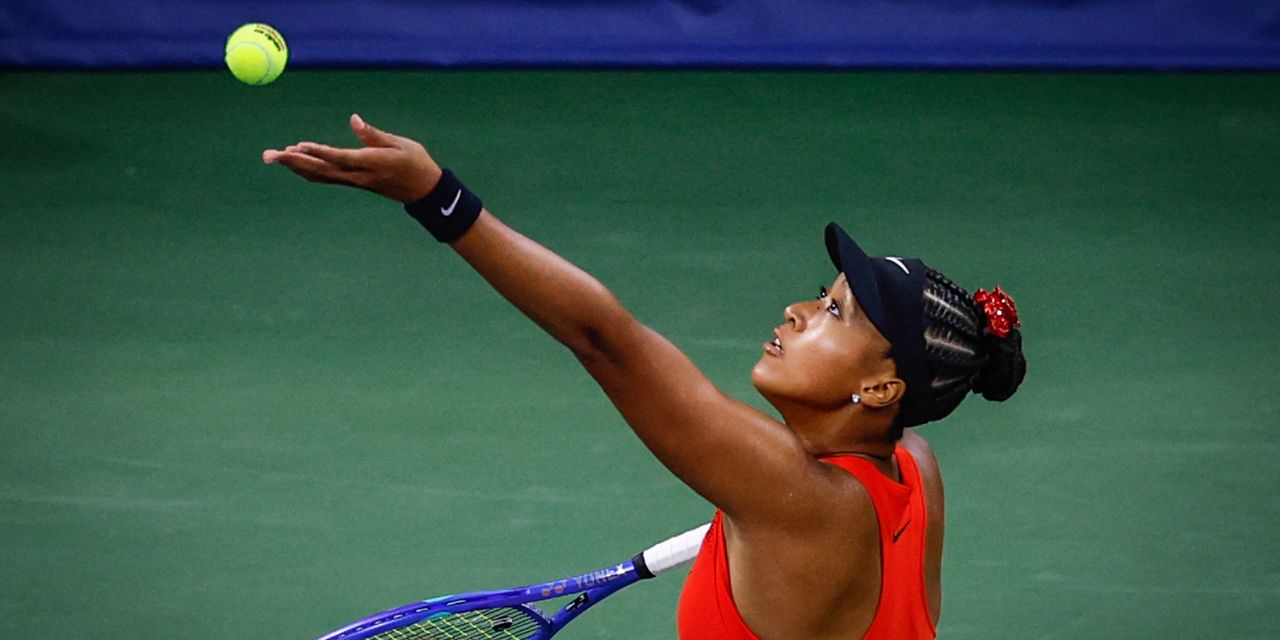
Every sport has its own little quirks and oddities (I’m still not clear on why a football field is technically called a “gridiron”), but tennis might rank among the strangest. From the illogical scoring system to Wimbledon’s all-white dress code and the end-of-match handshake, the sport is laden with rules, regulations, and traditions that make little to no sense to an outside observer—all of which are on full display right now as we enter the final stretch of the US Open.
If you’re a tennis buff (or even a new fan seduced by all the hype), you might have wondered about one particular occurrence on court: the serving player repeating the same individual series of motions before tossing the ball in the air on each serve. Rafael Nadal was famous for pulling at his shorts, tucking his hair behind his ears, and touching his nose, for example, while Serena Williams was known to bounce her ball a specific number of times (five on the first serve, and two on the second).
As a former high school tennis player who tunes into the occasional Grand Slam tournament on TV, I have long been aware that these sorts of behaviors are not rare among pros, but when a non-tennis-savvy friend asked me about them recently as we were watching a US Open men’s singles match last week, I realized I didn’t have a solid explanation on hand. Curious to investigate further, I reached out to an expert for input, hoping to learn more about the psychology at work—and how it affects a player’s overall game.
The series of actions leading up to a serve is known as the “service routine” or “pre-service routine.” When a player prepares to serve, “they’re going through several mental steps along with the physical steps,” Patrick Cohn, MS, PhD, a sports psychologist and the founder and president of Peak Performance Sports, tells SELF. They’re trying to forget about the last point so they can give the current one their undivided attention. They’re analyzing their game to pinpoint what’s working and what’s not. And finally, they’re identifying a target location in the service box (the square of court positioned diagonally across the way).
Those weird little mannerisms you might notice during a match—the hair-tucking, shorts-pulling, ball-bouncing, and everything in between—are part of that service routine, too. While not all players have readily identifiable idiosyncrasies (Roger Federer, for one—he would just step up and serve sans much preamble), enough do that it’s an established phenomenon during play. In essence, the regimen provides “mental comfort” and “helps the player feel in control,” Dr. Cohn says. “It helps them be in the moment and focus on the process. And, also, it develops some level of confidence.”
In addition to Nadal and Williams, plenty of other big names have been clocked performing little rituals. Maria Sharapova would turn her back to her opponent and walk to the rear of the court before serving. Naomi Osaka bobs on her feet, Iga Świątek checks her pockets to make sure she has a second ball at the ready in the event of a fault, and many female players in general adjust their jewelry or hairstyles.
Given their role in the player’s pre-service routine, these idiosyncrasies can actually be a crucial piece of the mental puzzle, according to Dr. Cohn—and in that sense, they serve a very important purpose (no pun intended!). Whatever the manifestation—hair-tucking, shorts-pulling, ball-bouncing, bobbing, pocket-checking, or something else entirely—the familiarity of these motions can have a soothing effect, calming the player’s nerves before a big shot.
In a psychologically demanding sport like tennis, where mental toughness is an asset as key as speed, stamina, or eye-hand coordination, that small edge can make all the difference. Without it, in theory, the player might feel thrown off or less secure in their serve, which, in turn, could affect the trajectory of the point (and potentially the game, and then the set, and then the match, because in tennis, it all snowballs. Take it from a former high school player!)
Related:
Get more of SELF’s great sports coverage delivered right to your inbox.
