

Key Takeaways
- The term ADD is outdated and is now considered a subtype of ADHD, predominantly inattentive, rather than a separate disorder.
- People with inattentive-type ADHD often appear calm and quiet, but struggle with forgetfulness, distractibility, disorganization, and difficulty following instructions.
- Treatment typically includes a personalized combination of medication, behavioral supports, accommodations, and lifestyle strategies to manage challenges and improve daily functioning.
The terms ADD and ADHD describe the same neurotype. “ADD” is an outdated term that once referred to people who struggled with focus but weren’t hyperactive. Today, the “Diagnostic and Statistical Manual of Mental Disorders” (DSM-5-TR) recognizes ADHD as a single condition with three types: inattentive, hyperactive-impulsive, and combined presentation.
ADD is now officially known as “attentional deficit/hyperactivity disorder, predominantly inattentive presentation” in the DSM.
While the term ADD is technically an outdated term—and no longer used by medical professionals—it is still sometimes used colloquially to refer to someone who has predominantly inattentive ADHD, which causes difficulty staying focused but does not include hyperactivity.
Key Differences Between ADD and ADHD
While many people continue to use the terms ADD and ADHD interchangeably, it’s important to recognize that they are not the same. Here are some key points to be aware of:
- ADD is an older term for what is now known as the inattentive type of ADHD.
- The term ADHD has been used to describe both inattentive and hyperactive types since the mid-1990s.
- However, some people continue to use the term ADD as a way to indicate that the condition does not include hyperactivity as a characteristic.
- The DSM-5-TR currently recognizes three subtypes of ADHD: inattentive type (sometimes casually called ADD), hyperactive-impulsive type, and combined type.
ADD (inattentive type ADHD) doesn’t manifest in the same way that predominantly hyperactive-impulsive or combined types do. Children with these presentations have different traits.
Children with hyperactive ADHD, for example, tend to have more challenges managing symptoms in classroom settings. Kids with this neurotype are sometimes labeled as having disciplinary problems when they are not provided the appropriate support and accommodations.
Children with inattentive-type ADHD are generally not disruptive in school. They may even sit quietly in class, but that doesn’t mean they’re not struggling to focus. In addition, not all children with inattentive-type ADHD are alike.
Children with combined type ADHD display several symptoms of both the hyperactive-impulsive type and the inattentive type.
Characteristics of ADD (Inattentive Type ADHD)
People with the inattentive type of ADHD struggle to pay attention or stay focused for long periods of time. To be diagnosed with this type, a person must display six of the following nine symptoms:
- Difficulty sustaining attention
- Often seeming not to be listening
- Ignoring details
- Difficulty organizing tasks and activities
- Frequently losing things
- Getting easily distracted
- Forgetfulness
- Avoiding tasks that require sustained mental effort
- Trouble following instructions
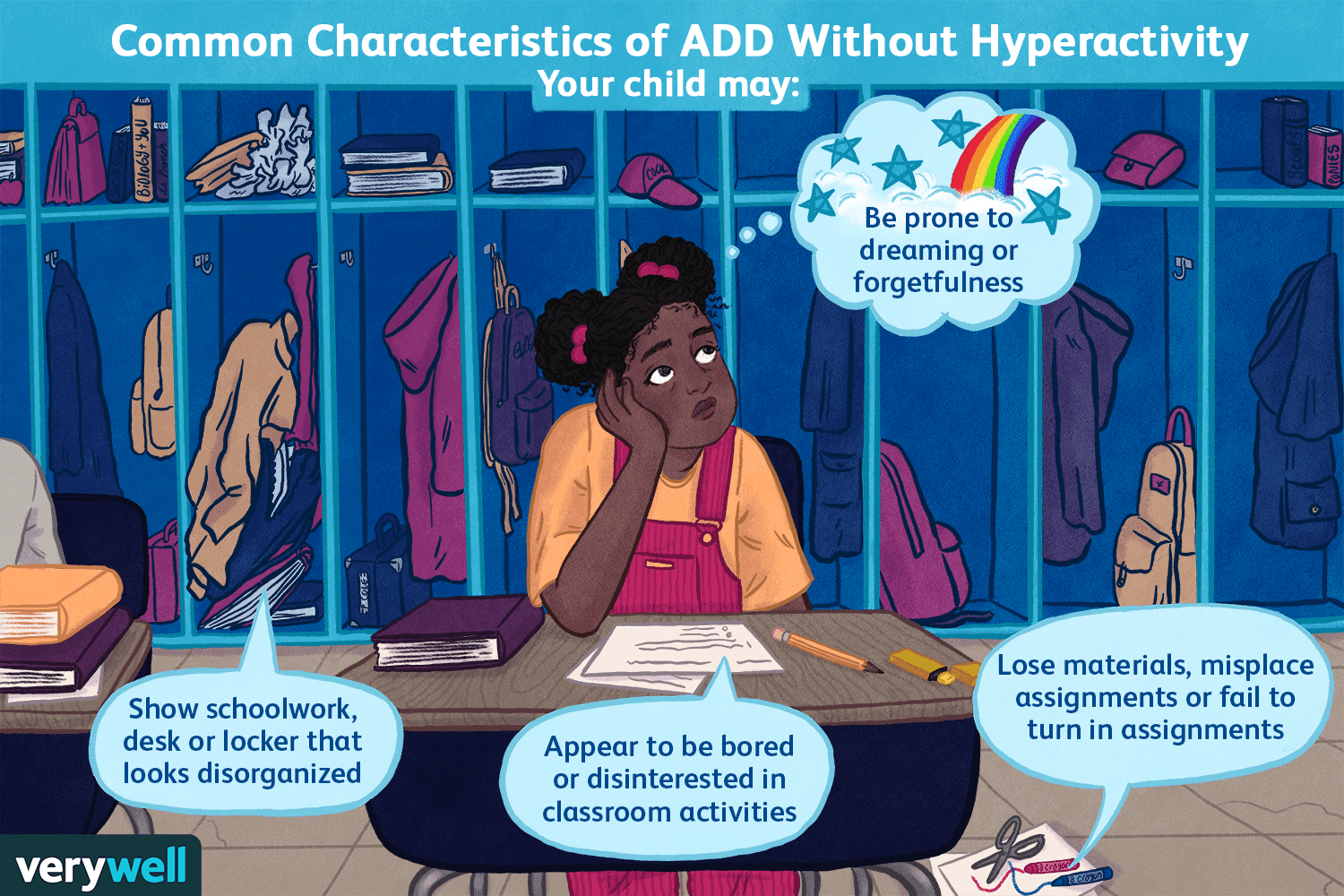
Children with ADHD without the hyperactivity component may appear to be bored or disinterested in classroom activities. They may be prone to daydreaming or forgetfulness, work slowly, and turn in incomplete work.
Their assignments, desks, and lockers may look disorganized. They may lose materials at school and at home, or misplace schoolwork and fail to turn in assignments. This can frustrate teachers and parents, who often mislabel this as a behavioral issue. This results in children earning poor marks in class and not getting the support they need.
Inattentive Type ADHD in Girls
While ADHD occurs in boys and girls at similar rates, boys are more likely to be diagnosed with the condition. Boys may be more likely to exhibit externalizing characteristics of the hyperactive-impulsive type of ADHD, increasing the diagnosis rate since such symptoms tend to be more disruptive. Girls tend to show more internalizing characteristics of ADHD, which may make it more difficult to spot, contributing to underdiagnosis.
Hyperactive-Impulsive ADHD
This presentation of ADHD is characterized by hyperactive and impulsive behavior. To be diagnosed, a person must display six of the following symptoms:
- Fidgeting hands and feet or squirming while seated
- Running or climbing inappropriately, or feelings of restlessness
- Difficulty engaging in activities quietly
- Seeming to always be on the go
- Excessive talking
- Blurting out responses
- Problems taking turns
- An inability to stay seated
- Frequently interrupting others
Combined Type ADHD
This presentation of ADHD involves exhibiting symptoms of both the inattentive and hyperactive-impulsive types. To be diagnosed with this type of ADHD, a person must display six or more inattention symptoms and six or more hyperactive-impulsive ADHD symptoms.
ADD Characteristics in Kids vs. Teens vs. Adults
While traits of the condition are similar in kids, teens, and adults, they may also change over time. Children may be more likely to be affected by hyperactivity. These characteristics may become more noticeable and disruptive when children are in classroom settings centered around neurotypical expectations.
While ADD characteristics change as people age, teens and adults will likely continue to experience symptoms such as lack of attention, difficulty remembering information, and trouble with organization.
Press Play for Advice On Improving Focus
Hosted by therapist Amy Morin, LCSW, this episode of The Verywell Mind Podcast, featuring Amishi Jha, PhD, a psychology professor, shares how to improve your attention span amid daily distractions. Click below to listen now.
Subscribe Now: Apple Podcasts / Spotify / Google Podcasts
Diagnosing ADD vs. ADHD
If you are curious about whether your child has ADHD, talk to your child’s school counselor, teacher, or physician about appropriate treatment. If you have any questions, begin these discussions today. Earlier support and accommodation can ensure that your child experiences fewer disruptions.
Your child’s pediatrician may recommend seeing a child psychologist who can further evaluate your child to see if they fit the criteria for ADHD and, if so, what traits they have and what type of support they may need. Not only can this evaluation help differentiate ADHD from other issues that may be causing difficulty with schoolwork, but it can be used to follow a child’s response to accommodations over time.
Depending on your child’s symptoms, they may be diagnosed with inattentive type ADHD, impulsive-hyperactive type ADHD, or combined type ADHD.
Treatment for Inattentive ADHD
While ADHD is considered a disability, it is important to note that this is because we live in a society based on neurotypical expectations. However, it is not a condition that requires a “cure.” Instead, it is a form of neurodivergence. It is essential to recognize this and offer people the right support and accommodations to help them thrive.
ADHD support often involves medications, classroom accommodations, and parent support. The type of treatment chosen depends on the child’s needs and characteristics. Some may need no treatment with suitable accommodations, but there is also nothing wrong with taking medications if needed or desired.
Medications
ADHD is often treated with one of three types of medication: psychostimulants, antidepressants, or non-stimulant drugs. These medications can help children with inattentive type ADHD (ADD) stay on task and focused.
- Psychostimulants: Psychostimulants affect neurotransmitters in the brain, and may help to boost energy and increase alertness. The extended-release form is often recommended (instead of the immediate-release form). Psychostimulants include amphetamines such as Adderall and methylphenidates such as Ritalin and Concerta.
- Antidepressants: Antidepressants also affect neurotransmitters in the brain, and may help to improve mood and attention. Common antidepressants prescribed for the inattentive presentation of ADHD include Wellbutrin (bupropion) and Effexor (venlafaxine).
- Non-stimulant drugs: Non-stimulant medications, such as Strattera (atomoxetine), Qelbree (viloxazine), and Intuniv (guanfacine), can be helpful for those who experience unwanted side effects from stimulants. They affect a specific neurotransmitter, norepinephrine, and may help regulate emotions and improve focus on specific tasks.
As with any medication, there are common side effects. Psychostimulants, antidepressants, and non-stimulants can cause dizziness, loss of appetite, upset stomach, and more. Be sure to talk to your doctor if you notice that your child is experiencing any unusual symptoms.
Therapy and Support
Whether or not parents choose medication, support and accommodations can help children develop new coping skills and better understand their neurotype.
Often, a combination of various methods is used, including:
- Family therapy: Your doctor or therapist might recommend family therapy so all family members can learn healthy ways to support your child. With young children, a therapist will usually meet with you and your child. A session often includes the therapist facilitating a conversation with your child or even providing them with an activity to help them express their feelings.
- Parent support: It can also be helpful for parents to learn more about how to best support a child with a form of neurodiversity. Parents may also learn strategies such as play therapy and talk therapy to allow their child to freely express their feelings and help them adopt healthy coping mechanisms to deal with challenging emotions.
- Accommodations at school: Your child may meet the criteria for extra assistance under the Individuals With Disabilities Education Act (IDEA) or Section 504 of the Rehabilitation Act of 1973. Accommodations may include extra time on tests, additional breaks, changes to their environment, positive reinforcement, and assignments made specifically for your child.
- Peer support: With this approach, a therapist or trained professional will lead a group of children in activities that teach them how to interact constructively with their peers. Skills such as having conversations, coping with teasing, and making friends are taught. Parents and teachers may be trained to reinforce the lessons at home and school.
Lifestyle Changes
Many people find that holistic methods are effective at managing some characteristics of ADHD in children. Engaging in regular physical exercise has been shown to improve mood, attention, and executive functioning in adults and children with ADHD.
Studies have shown improved focus and emotional regulation in people with ADHD after they practiced yoga.
