

Key Takeaways
- People with ADHD may have trouble calming down or changing their mood, making emotional dysregulation common.
- Naming emotions and using short bursts of high-intensity exercise can help manage strong emotions.
- Music or playing a musical instrument can improve emotional regulation in people with ADHD.
Emotional dysregulation is one of the more overlooked symptoms of ADHD, and one of the reasons people with ADHD are still misdiagnosed. Strong symptoms of emotional dysregulation can mimic other disorders like depression, bipolar, borderline personality, and even posttraumatic stress disorder (PTSD).
What Is Emotional Dysregulation?
Emotional dysregulation is an impaired ability to control your emotional response, leading to extreme or overblown reactions that don’t really fit the situation. Some of the key signs and symptoms include:
- Emotional reactions that seem out of sync with their cause
- Difficulty calming down, even if you’re aware that you’re overreacting
- Low tolerance for frustration or annoyance
- Temperamental or prone to sudden outbursts
- Feeling completely overwhelmed by your emotions
- Difficulty refocusing your attention away from the emotion
It feels very “all or nothing” or “zero to 100” for me. Any negative trigger, ranging from finding out the grocery store is sold out of my preferred brand of bread to being turned down for a dream job, results in almost the same level of overwhelming disappointment.
It’s often hard to see past the emotion and get perspective: Is this thing really as important as I feel like it is? What’s a more rational response to this situation?
It’s even harder to move past it and convince my brain to focus on something else. The second my partner sets the salt shaker on the counter instead of putting it back by the spice rack, that’s all I can think about until it’s resolved.
Emotional Dysregulation Impacts Every Aspect of Life
For one of the least talked about aspects of ADHD, emotional dysregulation can also be the most disruptive.
At work, the ability to moderate your emotional response is a huge advantage in customer-facing positions as well as any role where you’re expected to work with a team. If you’re the “hypersensitive” or “temperamental” coworker, it can make your work life stressful and harm your ability to advance in your career.
In personal relationships, minor pet peeves (like the sound of chewing or the fact that your partner loads the dishwasher differently than you) can lead to explosive reactions that make your friends and loved ones feel like they have to walk on eggshells around you.
Psychologically, it can also lead to a lot of self-doubt and uncertainty surrounding your feelings. If your overreactions and impulses have burned you in the past, it can be hard to trust any of your emotions, even those more in line with the situation.
Why Is Emotional Dysregulation So Common in ADHD?
The science we have so far shows two main causes of emotional dysregulation in the ADHD brain: an overactive amygdala and an underactive frontal cortex.
The amygdala is the part of the brain that triggers emotional responses so an overactive one is liable to trigger emotions that are stronger than they should be. Meanwhile, the frontal cortex is responsible for filtering and inhibiting those emotions so that you can react to a situation in a more adaptive and beneficial manner—like learning to hide your frustration and remain polite with an annoying customer to avoid escalating the situation into one that’s potentially even more frustrating.
If that cortex is underactive, it’s not inhibiting those emotional reactions as well as it could be. When you combine that with an amygdala that’s already generating emotions that are stronger than they need to be, it’s a recipe for impulsive behavior, explosive tempers, and hypersensitivity.
While science has shed some light on the parts of the brain responsible for emotional dysregulation, researchers still aren’t quite sure what part of the process is disrupted.
Emotional Regulation
The current model for emotional regulation breaks it down into five dimensions:
- Recognizing your own emotions
- Recognizing emotions in other people
- Emotional reactivity (your emotional threshold, or the level of intensity and duration of emotion that you’re able to tolerate without reacting to it)
- Arousal reduction (or the ability to calm yourself down)
- Emotional generation (or the ability to improve your mood)
A meta-analysis of 77 studies on emotional regulation in children with ADHD found that they had little problem recognizing emotions in themselves and others (the first two dimensions) and that those skills improved with age on par with children and young adults without ADHD.
Where people with ADHD struggled the most was in emotional reactivity, which makes sense when you consider that an overactive amygdala is generating intense feelings that might exceed their emotional threshold more often than a normally functioning amygdala.
They also struggled with the fourth and fifth dimensions of emotional regulation: calming themselves down and intentionally changing their mood.
How to Boost Your Emotional Regulation Skills
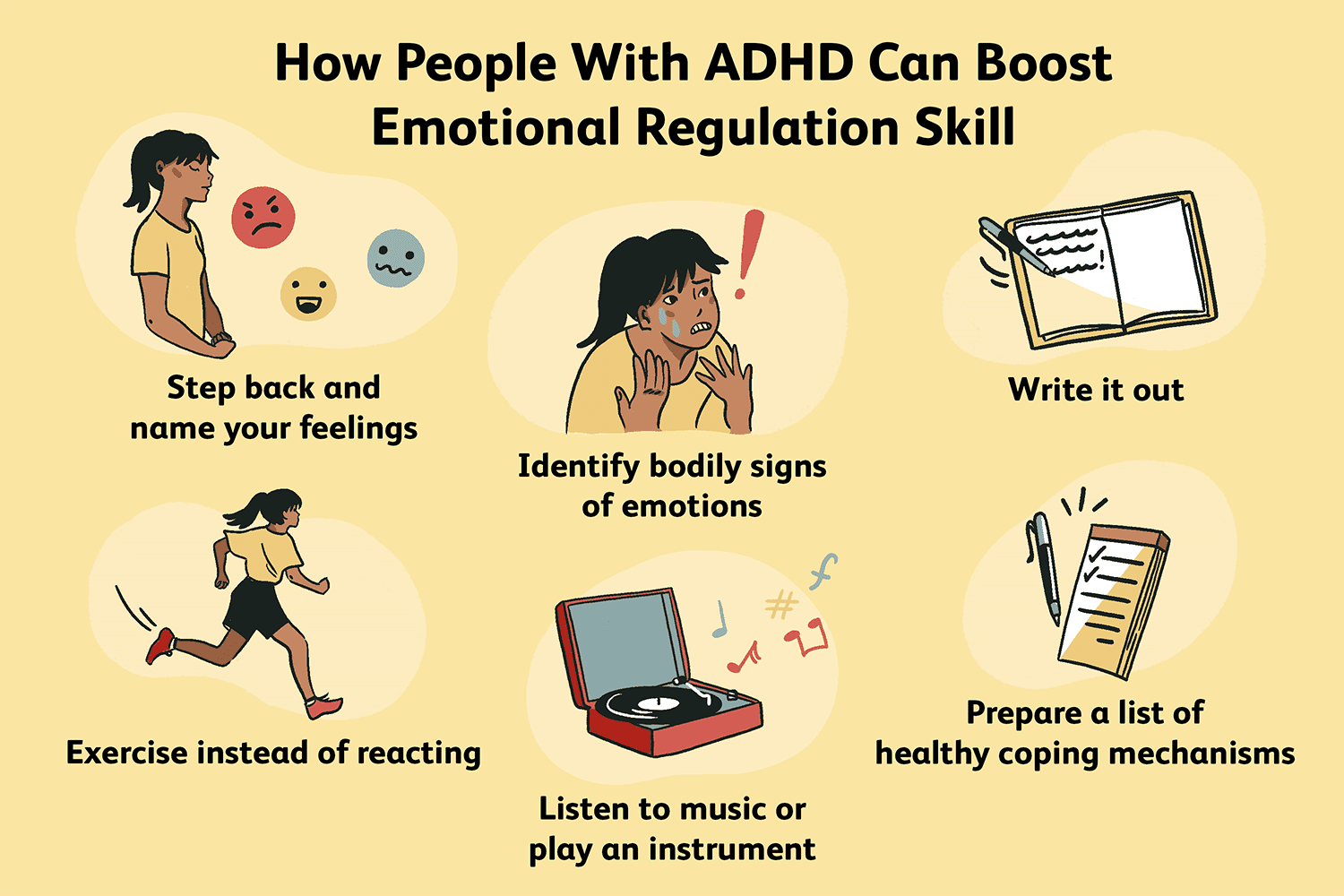
The neurological processes that seem to come naturally to those without ADHD may not work as well in an ADHD brain, but you can develop alternatives that function similarly and work with your brain with time and practice. Here are a few strategies you can try.
Step Back and Name Your Emotions
While people with ADHD don’t usually struggle with recognizing emotions, taking a break to acknowledge the feeling can be a first step toward regaining control. Before reacting or making any decision, do the following:
- Leave the situation. Go for a walk outside; go to the bathroom; get a glass of water, and stand in the backyard. If someone else is involved, say you need a few minutes to catch your breath and process.
- Identify all the bodily signs of your emotions. Is your heart racing? Is it hard to breathe? Are you sweating?
- Name the feeling. Anger? Shame? Sadness? Try to describe it as clearly and specifically as you can.
Because emotions can feel so overwhelming, and people with ADHD usually find challenges with calming down or talking themselves into a better mood, this exercise is a good compromise that can help dial down the intensity without relying on regulation skills you might not have.
It can help you detach a bit by putting you into the mode of analyzing the feeling rather than just being flooded by it.
Research has shown that naming your emotions, known as affective labeling, can reduce the intensity of negative emotions, possibly by increasing the intensity of positive ones.
Write It Out
For me, it often feels like the only way out is through. I can’t stop feeling an emotion, but I can see it through to the end without letting it do damage. To do that, I’ll usually write it out in a journal: explaining the situation, what triggered the emotion, what I’m feeling, and what my impulse or gut response is.
The process makes me feel like I’m expressing or acting on the feeling (which is what my brain wants to do) but in a way that won’t have long-term consequences. Then, once it feels less urgent, I can start thinking more clearly about an appropriate response.
If you’re angry, you’ll regret the mean things you said to someone you love after you calm down. If instead, you write those mean things down, you can let that feeling out without inflicting them on anyone. Then, tear it up or throw it away afterward.
Exercise Instead of React
The intensity of the emotion can give you this overwhelming urge to act, even if the rational part of your brain knows the emotion is wildly out of sync with the situation. Sometimes, you can channel that urge to take action into harmless exercise.
If a wave of emotion knocks you over, go for a run, lift weights or kick a punching bag. Physical exercise can use up that energy so that you don’t end up yelling at your partner or making impulsive decisions you’ll regret later.
For me, high-intensity exercises work the best (usually running as fast as I can) because it feels like the intensity of the activity matches the intensity of the emotion. But any physical movement can help, even if it’s just going for a walk or shooting hoops at a nearby basketball court.
Listen to Music (or Play an Instrument)
Studies confirm that people with ADHD experience improved moods after listening to music just like people without ADHD.
You may struggle to intentionally change your mood on your own but music can help jumpstart the process. Make a playlist (or a few) with your favorite songs and listen to it whenever you’re struggling with an intense emotion.
As a bonus, research also shows playing a musical instrument is linked to improved emotional regulation in people with ADHD. So taking some music lessons can be a way to reduce symptoms of emotional dysregulation in the long term.
Make a List of Your Coping Mechanisms
What works in one situation might not work for another. If you’re at work, for example, you might not be able to just clock out and go for a spontaneous run around the block when a customer is getting on your nerves.
Prepare yourself for different situations by writing down a list of healthy coping mechanisms for a range of scenarios so that you have a quick reference to choose from whenever you find yourself suddenly flooded with emotion.
ADHD Symptom Spotlight is a series that dives deep into a hallmark or overlooked symptom of ADHD each week. This series is written by experts who also share their tips on managing these symptoms based on firsthand experience and research-backed insights.
