

Key Takeaways
- Cognitive function refers to mental processes related to attention, learning, memory, reasoning, decision-making, and more.
- Staying healthy with a good diet and regular exercise can help improve cognitive skills.
‘Cognitive’ is a term used in psychology to describe anything related to thinking, learning, and understanding. So when you hear people talk about cognitive skills or processes, they are referring to different aspects of how the brain works—things like remembering information, learning new things, paying attention, and processing all of the information you encounter each day.
Cognitive abilities are something you use each and every day. For example, when you are learning a new instrument, you are using your cognitive skills to learn the basics of music theory, pick up melodies, learn the notes, and put that information together to produce music.
‘Cognitive’ refers to the mental processes involved in gaining knowledge and comprehension. Some of the many different cognitive processes include thinking, knowing, remembering, judging, and problem-solving.
These are higher-level brain functions that encompass language, imagination, perception, and planning. Cognitive psychology is the field of psychology that investigates how people think and the processes involved in cognition.
At a Glance
Cognitive psychology seeks to understand all of the mental processes involved in human thought and behavior. It focuses on cognitive processes such as decision-making, problem-solving, attention, memory, learning, and more. Keep reading to learn more about different types of cognitive processes, factors that can affect cognition, and the different uses for these cognitive processes.
Types of Cognitive Processes
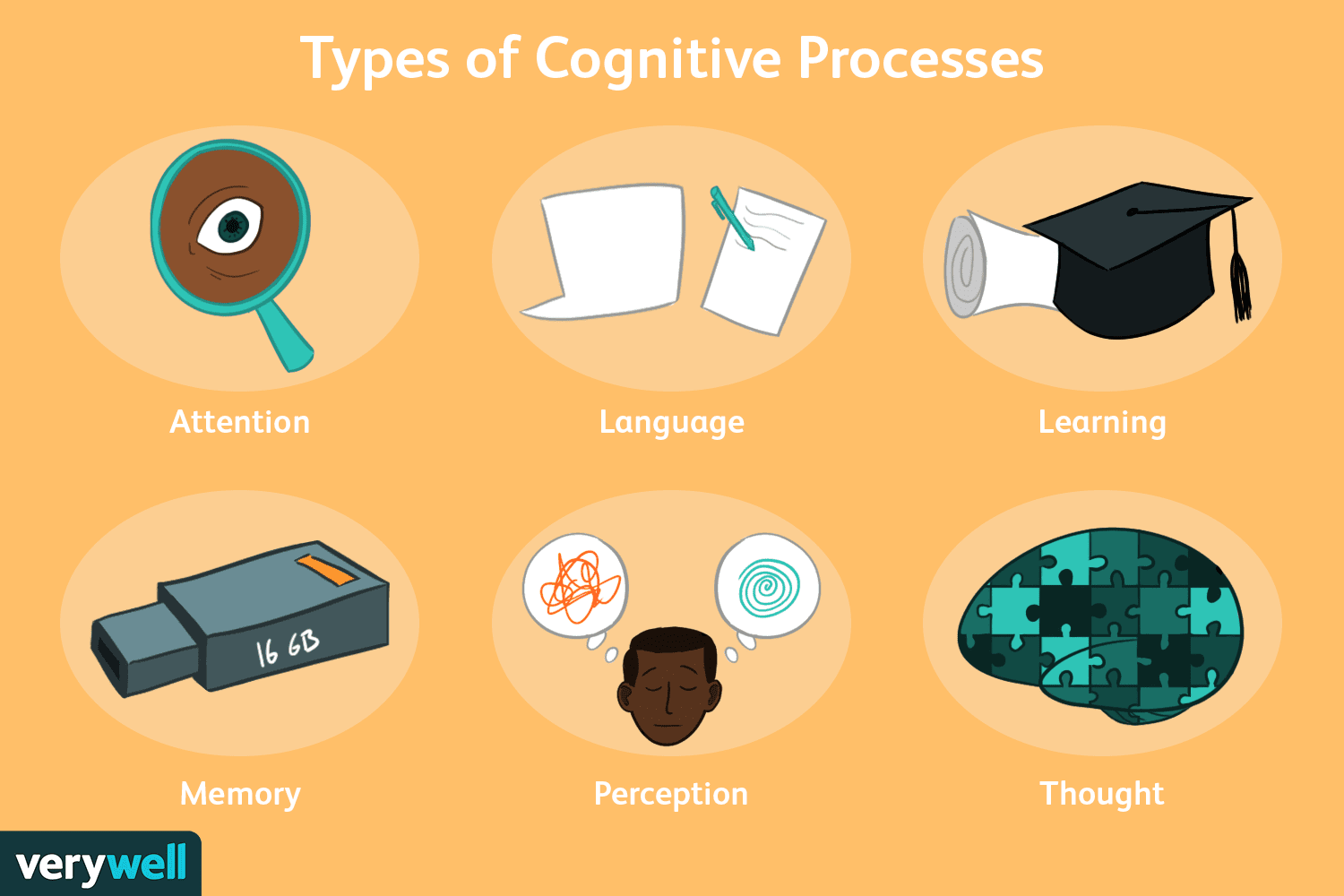
There are many different types of cognitive processes. They include:
Attention
Attention is a cognitive process that allows people to focus on a specific environmental stimulus. Attention is an important cognitive ability because it allows us to focus on the information we need, while also filtering out irrelevant distractions.
Language
Language and language development are cognitive processes that involve the ability to understand and express thoughts through spoken and written words. This allows us to communicate with others, including conveying our own thoughts and learning about others. It also plays an important role in thought.
Learning
Learning requires cognitive processes involved in taking in new things, synthesizing information, and integrating it with prior knowledge. Cognitive psychologists often study the mental processes that involved in processing, comprehending, and remembering information.
Memory
Memory is an important cognitive process that allows people to encode, store, and retrieve information. It is a critical component in the learning process and allows people to retain knowledge about the world and their personal histories.
Perception
Perception is a cognitive process that allows people to take in information through their senses, then utilize this information to respond and interact with the world.
Thought
Thought is an essential part of every cognitive process. It allows people to engage in decision-making, problem-solving, and higher reasoning.
Hot Cognition vs. Cold Cognition
Some split cognition into two categories: hot and cold. Hot cognition refers to mental processes in which emotion plays a role, such as reward-based learning. Conversely, cold cognition refers to mental processes that don’t involve feelings or emotions, such as working memory.
What is an example of cognition?
Cognition includes all of the conscious and unconscious processes involved in thinking, perceiving, and reasoning. Examples of cognition include paying attention to something in the environment, learning something new, making decisions, processing language, sensing and perceiving environmental stimuli, solving problems, and using memory.
History of the Study of Cognition
The study of how humans think dates back to the time of ancient Greek philosophers Plato and Aristotle.
Philosophical Origins
Plato’s approach to the study of the mind suggested that people understand the world by first identifying basic principles buried deep inside themselves, then using rational thought to create knowledge. This viewpoint was later advocated by philosophers such as Rene Descartes and linguist Noam Chomsky. It is often referred to as rationalism.
Aristotle, on the other hand, believed that people acquire knowledge through their observations of the world around them. Later thinkers such as John Locke and B.F. Skinner also advocated this point of view, which is often referred to as empiricism.
Early Psychology
During the earliest days of psychology—and for the first half of the 20th century—psychology was largely dominated by psychoanalysis, behaviorism, and humanism.
Eventually, a formal field of study devoted solely to the study of cognition emerged as part of the “cognitive revolution” of the 1960s. This field is known as cognitive psychology.
The Emergence of Cognitive Psychology
One of the earliest definitions of cognition was presented in the first textbook on cognitive psychology, which was published in 1967. According to Ulric Neisser, a psychologist and the book’s author, cognition is “those processes by which the sensory input is transformed, reduced, elaborated, stored, recovered, and used.”
What Can Affect Cognitive Processes?
It is important to remember that these cognitive processes are complex and often imperfect. Some of the factors that can affect or influence cognition include:
Age
Research indicates that as we age, our cognitive function tends to decline. Age-related cognitive changes include processing things more slowly, finding it harder to recall past events, and a failure to remember information that was once known (such as how to solve a particular math equation or historical information).
Attention Issues
Selective attention is a limited resource, so there are a number of things that can make it difficult to focus on everything in your environment. Attentional blink, for example, happens when you are so focused on one thing that you completely miss something else happening right in front of you.
Cognitive Biases
Cognitive biases are systematic errors in thinking related to how people process and interpret information about the world. Confirmation bias is one common example that involves only paying attention to information that aligns with your existing beliefs while ignoring evidence that doesn’t support your views.
Genetics
Some studies have connected cognitive function with certain genes. For example, a 2020 study published in Brain Communications found that a person’s level of brain-derived neurotrophic factor (BDNF), which is 30% determined by heritability, can impact the rate of brain neurodegeneration, a condition that ultimately impacts cognitive function.
Memory Limitations
Short-term memory is surprisingly brief, typically lasting just 20 to 30 seconds, whereas long-term memory can be stable and enduring, with memories lasting years and even decades. Memory can also be fragile and fallible. Sometimes we forget and other times we are subject to misinformation effects that may even lead to the formation of false memories.
Uses for Cognitive Processes
Cognitive processes affect every aspect of life, from school to work to relationships. Some specific uses for these processes include the following.
Learning New Things
Learning requires being able to take in new information, form new memories, and make connections with other things that you already know. Researchers and educators use their knowledge of these cognitive processes to create instructive materials to help people learn new concepts.
Forming Memories
Memory is a major topic of interest in the field of cognitive psychology. How we remember, what we remember, and what we forget reveal a great deal about how cognitive processes operate.
While people often think of memory as being much like a video camera—carefully recording, cataloging, and storing life events away for later recall—research has found that memory is much more complex.
Making Decisions
Whenever people make any type of a decision, it involves making judgments about things they have processed. This might involve comparing new information to prior knowledge, integrating new information into existing ideas, or even replacing old knowledge with new knowledge before making a choice.
Impact of Cognition
Our cognitive processes have a wide-ranging impact that influences everything from our daily life to our overall health.
Perceiving the World
As you take in sensations from the world around you, the information that you see, hear, taste, touch, and smell must first be transformed into signals that the brain can understand. The perceptual process allows you to take in this sensory information and convert it into a signal that your brain can recognize and act upon.
Forming Impressions
The world is full of an endless number of sensory experiences. To make meaning out of all this incoming information, it is important for the brain to be able to capture the fundamentals. Events are reduced to only the critical concepts and ideas that we need.
Filling in the Gaps
In addition to reducing information to make it more memorable and understandable, people also elaborate on these memories as they reconstruct them. In some cases, this elaboration happens when people are struggling to remember something. When the information cannot be recalled, the brain sometimes fills in the missing data with whatever seems to fit.
Interacting With the World
Cognition involves not only the things that go on inside our heads but also how these thoughts and mental processes influence our actions. Our attention to the world around us, memories of past events, understanding of language, judgments about how the world works, and abilities to solve problems all contribute to how we behave and interact with our surrounding environment.
Tips for Improving Cognitive Skills
Cognitive processes are influenced by a range of factors, including genetics and experiences. While you cannot change your genes or age, there are things that you can do to protect and maximize your cognitive abilities:
- Stay healthy. Lifestyle factors such as eating a nutritious diet and getting regular exercise can have a positive effect on cognitive functioning.
- Think critically. Question your assumptions and ask questions about your thoughts, beliefs, and conclusions.
- Stay curious and keep learning. A great way to flex your cognitive abilities is to keep challenging yourself to learn more about the world.
- Skip multitasking. While it might seem like doing several things at once would help you get done faster, research has shown it actually decreases both productivity and work quality.
Frequently Asked Questions
-
Does cognition mean thinking?
Thinking is an important component, but cognition also encompasses unconscious and perceptual processes as well. In addition to thinking, cognition involves language, attention, learning, memory, and perception.
-
What are the 5 cognitive skills?
People utilize cognitive skills to think, learn, recall, and reason. Five important cognitive skills include short-term memory, logic, processing speed, attention, and spatial recognition.
