

Key Takeaways
- Dreams might show your hidden desires, according to Freud’s theory.
- Jung believed that dreams reveal both personal and shared unconscious ideas.
- Calvin S. Hall said dreams reflect our waking thoughts and actions.
If you’ve ever had a truly bizarre dream, you’ve probably woken up and wondered…what was that all about? Dreams can be mysterious, exhilarating, hilarious, or even terrifying, but understanding what they mean can be downright baffling.
People have been trying to figure out the interpretation of dreams for centuries, from Freud (who thought they revealed repressed feelings) to modern psychologists (who take a more scientific approach).
While many theories exist to explain why we dream, no one yet fully understands their purpose, let alone how to interpret the meaning of dreams.
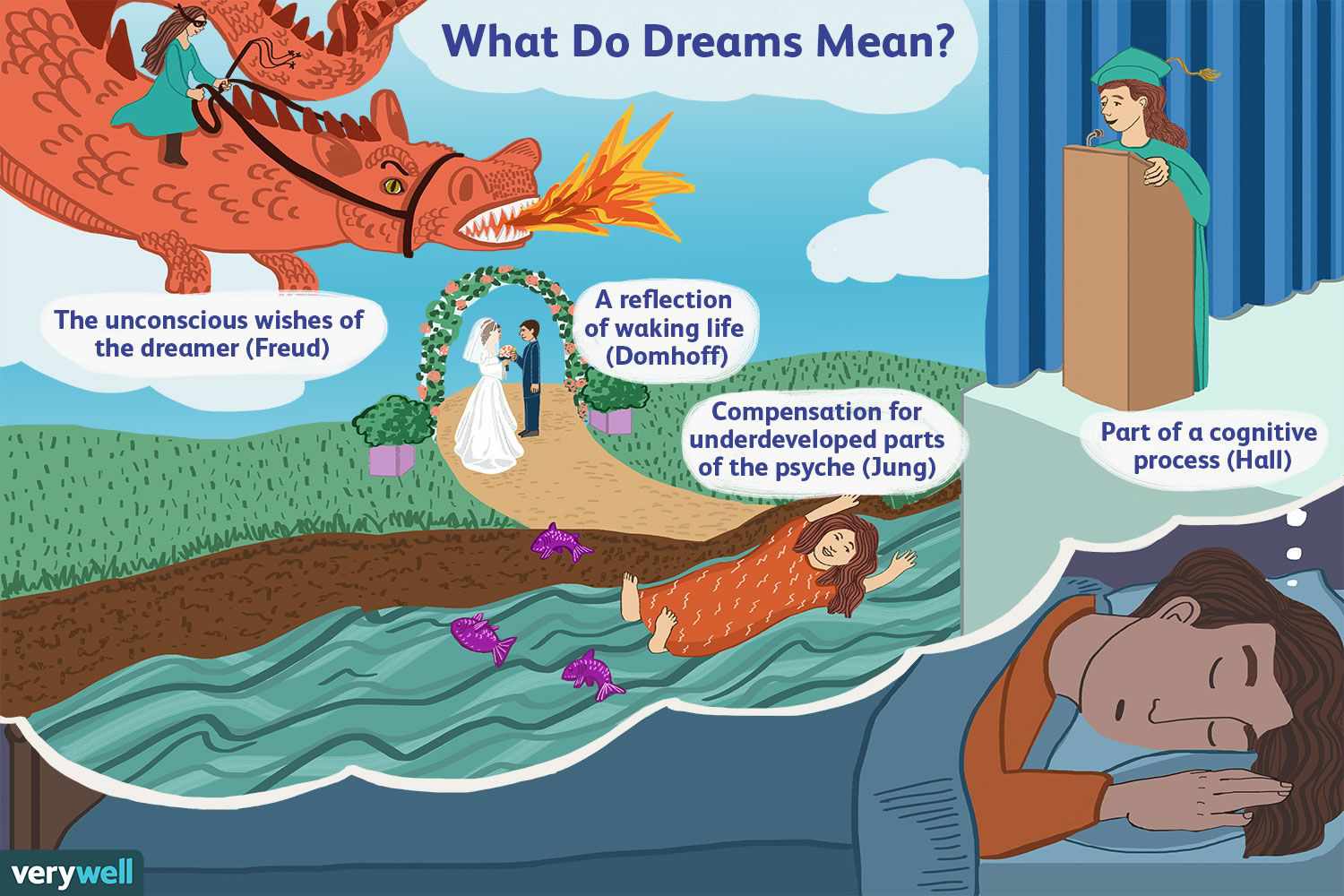
However, psychologists have developed theories that might explain what dreams mean. Four of the most common dream theories suggest that:
- Dreams reveal the unconscious mind: Sigmund Freud developed this theory stating that dreams signified what people desire.
- Dreams are linked to archetypes and the collective unconscious: Carl Jung also believed that dreams represented repressed wishes but also noted that dreams explored the underdeveloped parts of the mind.
- Dreams are a cognitive process: Calvin S. Hall theorized that what people do and think in their waking lives are what they see in their dreams.
- Dreams are a reflection of waking life: G. William Domhoff, who worked with Hall, theorized a similar explanation for dreams.
- Dreams are the result of neurobiological processes: Hobson suggest that dreams are the brain’s way of making sense of spontaneous neural activity that occurs during sleep.
Keep reading to learn more about each theory and how you can use them to interpret your dreams.
Freud: Dreams as the Road to the Unconscious Mind
In his book “The Interpretation of Dreams,” Sigmund Freud suggested that the content of dreams is related to wish fulfillment.
Dream Are Our Wishes
Freud believed that the manifest content of a dream or the actual imagery and events served to disguise the latent content or the unconscious wishes of the dreamer. In other words, Freud believed that the content of your dreams shows what you desire in life.
Dream Work
Freud also described four elements of this process that he referred to as “dream work:”
- Condensation: Many different ideas and concepts are represented within a single dream. Information is condensed into a single thought or image.
- Displacement: This element of dream work disguises the latent content’s emotional meaning by confusing the dream’s essential and insignificant parts.
- Symbolization: This operation also censors the repressed ideas in the dream by including objects meant to symbolize the latent content of the dream.
- Secondary revision: During this final stage of the dreaming process, Freud suggested that the bizarre elements of the dream are reorganized to make the dream comprehensible, thus generating the dream’s manifest content.
Jung: Archetypes and the Collective Unconscious
While Carl Jung shared some commonalities with Freud, he felt that dreams were more than an expression of repressed wishes.
Dreams Explore the Underdeveloped Mind
Jung suggested that dreams revealed both the personal and collective unconscious and believed that dreams compensate for parts of the psyche that are underdeveloped in waking life.
Jung’s Four Archetypes
Jung also suggested that archetypes such as the anima, the shadow, the animus, and the persona are often represented as symbolic objects or figures in dreams.
These symbols, he believed, represented attitudes that are repressed by the conscious mind.
Unlike Freud, who often suggested that specific symbols represent specific unconscious thoughts, Jung believed that dreams can be highly personal and that interpreting these dreams involved knowing a great deal about the individual dreamer.
Hall: Dreams as a Cognitive Process
Psychologist Calvin S. Hall looked for themes and patterns by analyzing thousands of dream diaries from participants, eventually creating a quantitative coding system that divided what’s in our dreams into several categories.
Dreams Contain Patterns Related to Waking Life
Hall proposed that dreams are part of a cognitive process in which dreams serve as “conceptions” of elements of our personal lives.
According to Hall’s theory, interpreting dreams requires knowing the following:
- The actions of the dreamer within the dream
- The objects and figures in the dream
- The interactions between the dreamer and the characters in the dream
- The dream’s setting, transitions, and outcome
The ultimate goal of this dream interpretation is not to understand the dream, however, but to understand the dreamer. Research by Hall revealed that the traits people exhibit while awake are the same as those expressed in dreams.
Domhoff: Dreams as a Reflection of Waking Life
G. William Domhoff is a prominent dream researcher who studied with Calvin Hall at the University of Miami.
Dreams Represent Daily Life
In large-scale studies on the content of dreams, Domhoff has found that dreams reflect the thoughts and concerns of a dreamer’s waking life.
Domhoff suggests a neurocognitive model of dreams in which the process of dreaming results from neurological processes and a system of schemas. Dream content, he suggests, results from these cognitive processes.
7 Theories on Why We Dream Simplified
Hobson: Dream’s as a Neurobiological Mechanisms
According to the activation-synthesis model proposed by researchers J. Allan Hobson and Robert McCarley, dreams are the brain’s attempt to make sense of random neural activity while sleeping.
This model suggests that the brain remains active, with parts of the brain that are responsible for running automatic processes generating signals that higher-level areas of the brain then interpret. This information is processed and woven into the narrative of a dream.
This theory suggests that dreams don’t hold a deep, significant meaning. Instead, they are a byproduct of the brain’s natural processes. The brain synthesizes the resting brain’s spontaneous activity and attempts to impose meaning on it, resulting in the experience of dreaming.
Popularizing Dream Interpretation
Since the 1970s, dream interpretation has grown increasingly popular. Ann Faraday’s 1974 book “The Dream Game” outlined techniques and ideas anyone can use to interpret their dreams.
Today, consumers can purchase various books that offer dream dictionaries, symbol guides, and tips for interpreting and understanding dreams.
How Biases Affect Dream Interpretation
Some older research suggests that how we interpret our own dreams is heavily influenced by our own biases. Researchers Carey Morewedge and Michael Norton studied the dreams of over 1,000 individuals from the United States, India, and South Korea.
They discovered that few college students who participated in the research believed that their dreams were simply the brain’s response to random stimulation. Instead, most endorsed Freud’s notion that dreams reveal unconscious wishes and urges.
They also discovered that the weight and importance people attach to their dreams depends mainly on their biases. People are more likely to remember negative dreams if they involve people they dislike. They are also more likely to take positive dreams seriously if they involve friends or loved ones.
In other words, people are motivated to interpret their dreams in ways that support their already existing beliefs about themselves, the world, and the people around them.
The researchers found that such things as the confirmation bias and the self-serving bias can impact how people respond to their dreams.
Because people tend to take their dreams seriously, the researchers suggest, they can also become a self-fulfilling prophecy. If you dream that you will fail an exam, you might be less motivated to study or even become so stressed out that you perform poorly.
Dreams may or may not have meaning, but the fact remains that interpreting dreams has become a popular pastime.
Verywell Mind uses only high-quality sources, including peer-reviewed studies, to support the facts within our articles. Read our editorial process to learn more about how we fact-check and keep our content accurate, reliable, and trustworthy.
-
Zhang W, Guo B. Freud’s dream interpretation: A different perspective based on the self-organization theory of dreaming. Front Psychol. 2018;9:1553. doi:10.3389/fpsyg.2018.01553
-
Scalabrini A, Esposito R, Mucci C. Dreaming the unrepressed unconscious and beyond: repression vs dissociation in the oneiric functioning of severe patients. Res Psychother. 2021;24(2):545. doi:10.4081/ripppo.2021.545
-
Guo A, Ma J. Archetype-based modeling of persona for comprehensive personality computing from personal big data. Sensors (Basel). 2018;18(3):684. doi:10.3390/s18030684
-
Hall, CS. A cognitive theory of dreams. J Gen Psychol. 1953;49(2):273-282. doi:10.1080/00221309.1953.9710091
-
Fogli A, Maria Aiello L, Quercia D. Our dreams, our selves: automatic analysis of dream reports. R Soc Open Sci. 2020;7(8):192080. doi:10.1098/rsos.192080
-
Domhoff GW. The neurocognitive theory of dreams at age 20: An assessment and a comparison with four other theories of dreaming. Dreaming. 2019;29(4):265-302. doi:10.1037/drm0000119
-
Scarpelli S, Alfonsi V, Gorgoni M, Giannini AM, De Gennaro L. Investigation on neurobiological mechanisms of dreaming in the new decade. Brain Sci. 2021;11(2):220. doi:10.3390/brainsci11020220
-
Morewedge CK, Norton MI. When dreaming is believing: The (motivated) interpretation of dreams. J Pers Soc Psychol. 2009;96(2):249-64. doi:10.1037/a0013264
Thanks for your feedback!
What is your feedback?
Helpful
Report an Error
Other
