

Key Takeaways
- Financial stress can cause health problems like anxiety, depression, and headaches.
- Delaying medical care due to financial stress can lead to worse health and more costs.
- Creating extra sources of income can help reduce financial stress.
If you’re worried about money, you’re not alone. Money is a common source of stress for American adults. In fact, according to the American Psychological Association (APA), 72% of adults report feeling stressed about money, whether it’s worrying about paying rent or feeling bogged down by debt. This is pretty significant given financial stress is linked to so many health issues.
Understanding Financial Stress
Financial stress is emotional tension that is specifically related to money. Anyone can experience financial stress, but financial stress may occur more often in households with low incomes. Stress can result from not making enough money to meet your needs such as paying rent, paying the bills, and buying groceries.
People with less income might experience additional stress due to their jobs. Their jobs might lack flexibility when it comes to taking time off. They might work in unsafe environments, but they are afraid to leave because they won’t be able to support themselves financially while they look for another job.
People with low incomes may not have access to resources to manage their financial stress, either, such as health insurance to receive mental health treatment.
Most people stress about money from time to time. But financial stress can become problematic if it disrupts your everyday life. For instance, you might find you can’t focus on or enjoy other parts of your life because your money-related stress is causing you to worry so much.
If your financial stress is severe, you will experience negative effects on your mental health and potentially even your physical health. Financial stress can lead to anxiety, depression, behavioral changes like withdrawing from social activities, or physical symptoms like stomachaches or headaches.
If you experience any side effects related to your financial stress, be sure to talk to a healthcare professional.
Impact on Your Health
Although any stress can take a toll on your health, stress related to financial issues can be especially toxic. Financial stress can lead to:
- Delayed health care: With less money in the budget, people who are already under financial stress tend to cut corners in areas they shouldn’t, like health care. According to Gallup’s annual Health and Healthcare poll, 29% of American adults held off seeking medical care in 2018 because of cost. Though this tactic may seem like a good way to keep costs down, delaying medical care can actually lead to worse health outcomes and higher costs, both of which can lead to more stress.
- Poor mental health: In many instances, the link between mental and financial health is cyclical—poor financial health can lead to poor mental health, which leads to increasingly poor financial health, and so on. For years, studies have shown that people in debt have higher rates of mental health issues like depression and anxiety than those who are debt-free.
- Poor physical health: Ongoing stress about money has been linked to headaches, stomachaches, migraines, heart disease, diabetes, sleep problems, and more. When we are constantly stressed, our bodies don’t have time to recover. Our immune systems are left susceptible to illnesses—this includes colds and viruses. If you already have a chronic medical condition, you may experience flare-ups of your symptoms.
- Unhealthy coping behaviors: Financial stress can cause you to engage in a variety of unhealthy behaviors, from overeating to alcohol and drug use. According to an APA survey published in 2014, 33% of Americans reported eating unhealthy foods or eating too much to deal with stress.
Tips for Coping
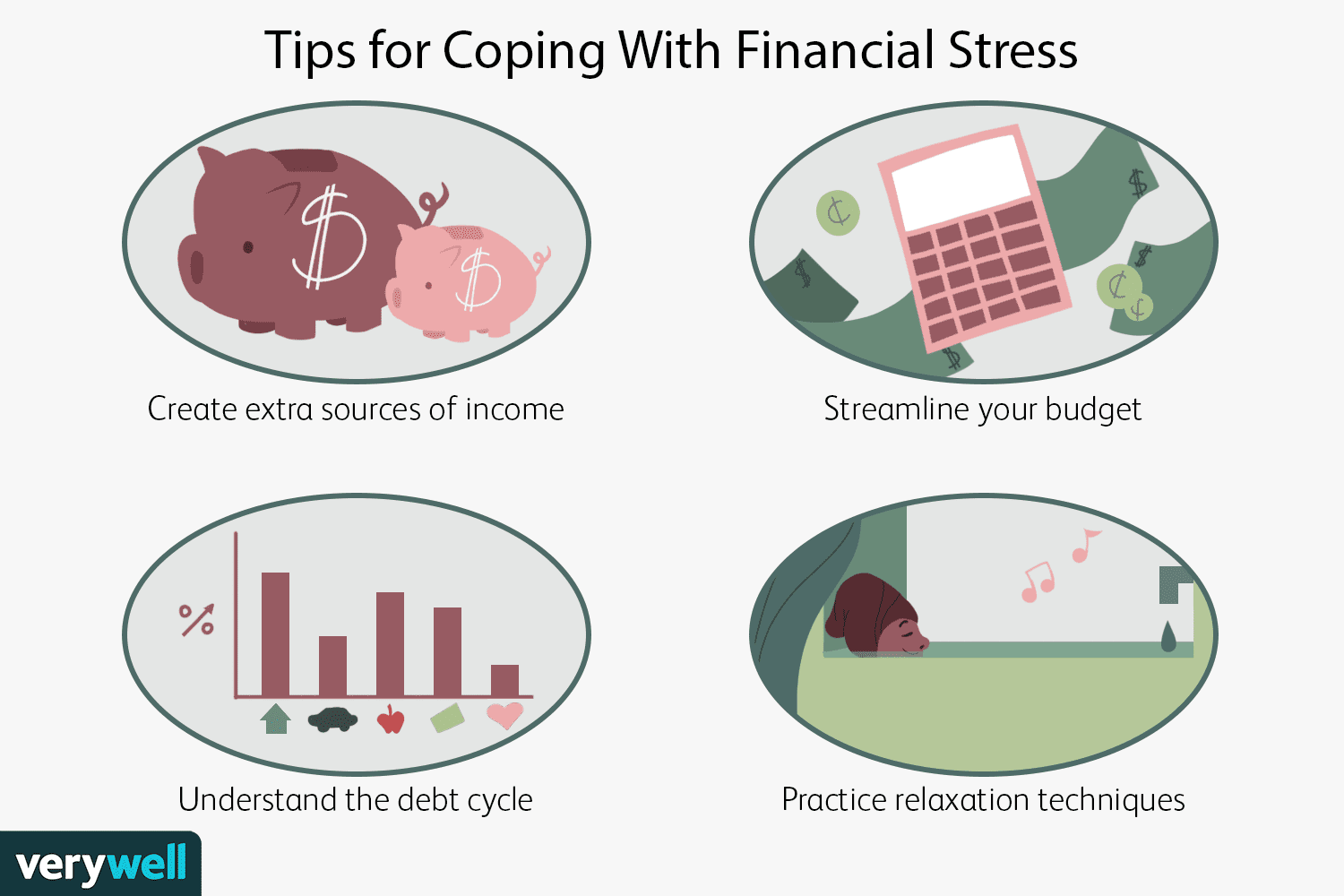
Learning to cope with financial stress and effectively manage your financial situation can help you feel more in control of your life, reduce your stress, and build a more secure future. Try some of the following tips to get started:
- Create extra sources of income. If you’re feeling stressed about finances, you likely already feel you need more money in your budget. But knowing how to increase your financial holdings without creating significant stress for yourself can be tricky, too. Thankfully, there are several ways to boost your income and relieve your stress.
- Declutter your budget. Since life is rarely constant, regular budget checkups are essential to improving your financial health. Take control of your finances by setting aside some time to schedule, organize, and declutter all of the money coming in and out of your bank account. The more control you have, the less stress you will feel.
- Don’t forget general stress management. As you work on improving your financial situation, you can reduce stress by practicing stress-reducing techniques and making other changes to create a low-stress lifestyle. Eating a nutritious diet, getting enough sleep every night, and doing some form of physical exercise are linked with reducing stress levels. You can also try mindfulness techniques like deep breathing and yoga to ease any anxiety.
- Understand the debt cycle. Understanding debt is the first step to getting yourself out of it. One study found that you may be able to pay off your debt more quickly by paying off one account at a time and by starting with your lowest debts first. Do your research and pay attention to interests rates. It’s advisable to first pay off the debt that has the largest interest rate to avoid paying higher costs over time.
Overcoming Financial Stress
It might be impossible to fix your financial problems overnight, but you can start planning for success right away. Remember, the stress you experience isn’t only a result of your financial situation—you can ease some of your anxiety by taking care of yourself.
Take Stock of Your Finances
Make a list of the financial struggles that most concern you. Take baby steps to tackle each problem one by one so you don’t overwhelm yourself.
Write down what you can start doing today or this week that can get you on track to financial stability. Try making a budget plan, only spending on necessities for a week or a month.
You can also try tracking your spending. Keep a daily or weekly list of what you spend money on, and see where you can spend less.
You might seek professional assistance to help you with your finances. For instance, you can research student loan forgiveness programs and income-based repayment programs that may create more manageable payments for your debt.
If you can’t pay your bills, try calling your bank, utility company, or credit card company to explain your situation—oftentimes, they can set up a payment plan that works for you.
Reach Out for Support
Try reaching out for support from your family and friends to help reduce stress. You might try attending a support group for people who are struggling with financial stress, too. Remember, you’re not alone. You can develop a system of trusted friends and family to help you stay optimistic about your finances.
In some cases, you may even choose to seek professional help from a mental health care provider. All options for support are valid.
Engage in Self-Care
Maintaining a healthy lifestyle is important to help you manage stress. Try to exercise for 30 minutes a day—move your body in whatever way feels good for you. This improves your mental and physical health. Walking is a great way to get a workout in and relieve stress at the same time.
Make time to relax. Though your financial stress can overwhelm you, remember that there are resources to help you manage your stress and your finances. Take time to unwind, meditate, enjoy a fun activity, and connect with others.
Verywell Mind uses only high-quality sources, including peer-reviewed studies, to support the facts within our articles. Read our editorial process to learn more about how we fact-check and keep our content accurate, reliable, and trustworthy.
-
Tran AGTT, Mintert JS, Llamas JD, Lam CK. At what costs? Student loan debt, debt stress, and racially/ethnically diverse college students’ perceived health. Cultur Divers Ethnic Minor Psychol. 2018;24(4):459-469. doi:10.1037/cdp0000207
-
American Psychological Association. Speaking of psychology: The stress of money.
-
Kraft AD, Quimbo SA, Solon O, Shimkhada R, Florentino J, Peabody JW. The health and cost impact of care delay and the experimental impact of insurance on reducing delays. J Pediatr. 2009;155(2):281-285.e1. doi:10.1016/j.jpeds.2009.02.035
-
Richardson T, Elliott P, Roberts R. The relationship between personal unsecured debt and mental and physical health: A systematic review and meta-analysis. Clinical Psychology Review. 2013;33(8):1148-1162. doi:10.1016/j.cpr.2013.08.009
-
Warth J, Puth M-T, Tillmann J, et al. Over-indebtedness and its association with sleep and sleep medication use. BMC Public Health. 2019;19(1):957. doi:10.1186/s12889-019-7231-1
-
Stress in America: Paying With Our Health. American Psychological Association..
-
Briguglio M, Vitale JA, Galentino R, et al. Healthy eating, physical activity, and sleep hygiene (HEPAS) as the winning triad for sustaining physical and mental health in patients at risk for or with neuropsychiatric disorders: Considerations for clinical practice. Neuropsychiatr Dis Treat. 2020;16:55-70. doi:10.2147/NDT.S229206
-
Zaccaro A, Piarulli A, Laurino M, et al. How breath-control can change your life: A systematic review on psycho-physiological correlates of slow breathing. Front Hum Neurosci. 2018;12:353. doi:10.3389/fnhum.2018.00353
-
Harvard Business Review. Research: The best strategy for paying off credit card debt.
-
American Psychological Association. Dealing with financial stress.
-
Han A, Kim J, Kim J. A study of leisure walking intensity levels on mental health and health perception of older adults. Gerontology and Geriatric Medicine. 2021. doi:10.1177/2333721421999316
Additional Reading
-
American Psychological Association. Stress in America: Paying with our health.
-
Kraft AD, Quimbo SA, Solon O, Shimkhada R, Florentino J, Peabody JW. The health and cost impact of care delay and the experimental impact of insurance on reducing delays. J Pediatr. 2009;155(2):281-285.e1. doi:10.1016/j.jpeds.2009.02.035
-
Richardson T, Elliott P, Roberts R. The relationship between personal unsecured debt and mental and physical health: a systematic review and meta-analysis. Clin Psychol Rev. 2013;33(8):1148-1162. doi:10.1016/j.cpr.2013.08.009
-
Saad L. Delaying care a healthcare strategy for three in 10 Americans.
-
Warth J, Puth M-T, Tillmann J, et al. Over-indebtedness and its association with sleep and sleep medication use. BMC Public Health. 2019;19(1):957. doi:10.1186/s12889-019-7231-1
Thanks for your feedback!
What is your feedback?
Helpful
Report an Error
Other
