

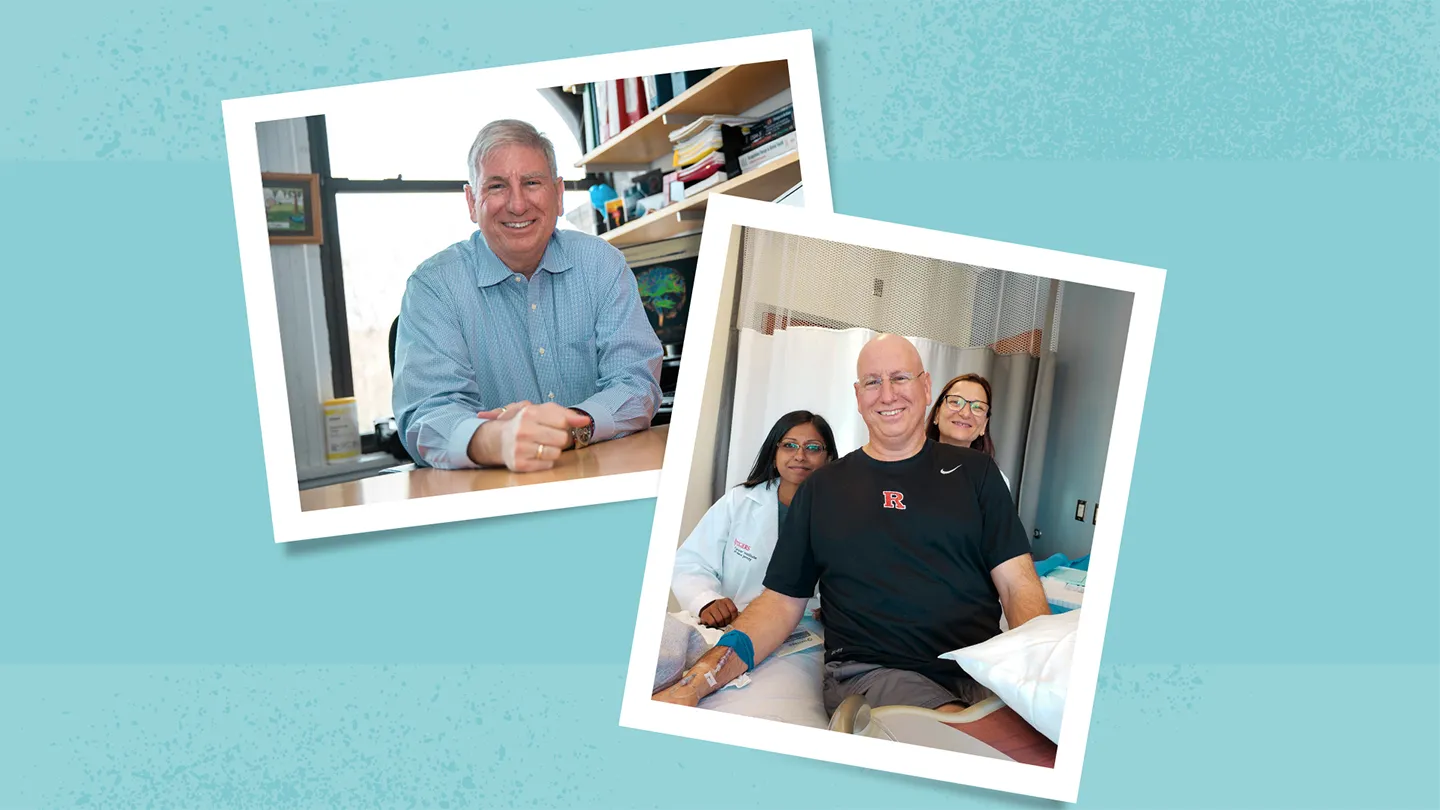
In early 2019, Gerald Voelbel, PhD, associate professor of cognitive neuroscience at New York University, was attending a scientific conference when he noticed that something felt “off.” That morning, he’d woken up with a terrible migraine, and as the day progressed, he began having difficulty with balance and coordination. When he wasn’t able to see a presentation projected on a screen that afternoon, he knew something was wrong. “That’s when I got scared,” Dr. Voelbel recalls.
He went to see his primary care doctor the next day, but it took a while — and many tests and appointments with multiple specialists — for him to learn what was wrong and start receiving treatment.
A Rare and Mysterious Illness
At first, Voelbel’s primary care doctor suspected that he’d had a stroke or had multiple sclerosis or another neurological condition.
He soon wound up in the care of Janet Rucker, MD, a neuro-ophthalmologist at NYU Langone, the hospital affiliated with the university where he worked. Fortunately, initial imaging didn’t show evidence of his primary doctor’s concerns. But after six weeks of close monitoring and further testing by Dr. Rucker, Voelbel’s condition still wasn’t improving.
So, Rucker ordered a spinal tap and sent a sample to the Mayo Clinic, where she knew they were doing research on paraneoplastic biomarkers. These biomarkers occur when the immune system responds to cancer in the body by mistakenly attacking healthy cells, usually in the neurological system.
[1]
This test wound up being a turning point for Voelbel. “I truly believe [Dr. Rucker] saved my life,” he says. The results of the spinal tap revealed the presence of a certain biomarker that indicated he might have cancer. Voelbel was then sent for more imaging tests and a biopsy.
He ultimately learned that he had two different types of lymphoma — diffuse large B-cell lymphoma, an aggressive form of non-Hodgkin lymphoma, and follicular lymphoma, a slow-growing form of the disease. Having two different types of lymphoma like this is known as composite lymphoma and is rare, only occurring in less than 5 percent of lymphoma cases.
[2]
Undergoing Cancer Treatment
Voelbel was quickly referred to yet another specialist — this time, an oncologist — to immediately begin treatment for lymphoma. This treatment consisted of two different combinations of chemotherapy, administered in two different ways: one via a spinal tap directly into his spinal canal (called intrathecal injections) and the other through the more common intravenous (IV) route. Along with his IV chemotherapy, Voebel also received an infusion of another treatment called monoclonal antibodies, which are proteins created in a laboratory to stimulate the immune system to fight cancer.
[3]
Treatment was grueling, physically and emotionally, Voebel says. In addition to the pain of the spinal injections, Voelbel experienced difficult side effects from chemotherapy, which started a few days after each infusion. “I couldn’t get out of bed. The fatigue was bad,” he says. “My whole body felt so heavy and I felt so weak.”
But other than taking time off to receive and recover from his injections and infusions, Voelbel worked throughout treatment, teaching and mentoring students, conducting research, and directing a new PhD program. He even embarked on a DIY project at home to renovate his unfinished basement. “I thought, ‘If I die, I want my wife to be able to sell the house for more money with a finished basement,’” he recalls. “Every weekend I would work [on the basement for] two to six hours until I was so fatigued.”
In December 2019, after six months of treatment, Voelbel learned that his cancer was in remission.
Debilitating Neurological Symptoms
But Voelbel’s search for healing and answers wasn’t over yet. While his lymphoma was in remission and the cancer treatment may have stopped the progression of his neurological symptoms, it didn’t reverse them. These symptoms, debilitating at times, persisted.
In January 2020, he began receiving a treatment called intravenous immunoglobulin to specifically address his neurological symptoms of double vision and coordination and balance difficulties. He initially had some improvement, but after a few months it quickly plateaued. Since his symptoms were no longer improving, he stopped that treatment.
It took several years for Voelbel to get definitive answers about the neurological component of his ailments. In 2023, after an extended period of experiencing migraines again, Voelbel was sent for another spinal tap. This time, the results confirmed that he had paraneoplastic neurological syndrome (PNS), a group of rare conditions that affect the nervous system of some people with cancer.
[4]
[5]
The cancer is usually still undiagnosed when neurological symptoms arise, says Rucker. And PNS is rare, affecting less than 1 percent of all cancer patients.
[6]
As part of his treatment for his neurological symptoms, Voelbel had to do occupational therapy, and his knowledge as a neuroscientist helped him be a more compliant patient. Through his research, Voelbel had learned that it’s very difficult for physical and occupational therapists to get their patients to do their assigned at-home exercises. But he also understood neuroplasticity — the brain’s ability to adapt and make different neural connections through behavioral repetition — and knew how important it was for his recovery to do these exercises as directed.
[7]
“I wanted to regain those neural connections, so I was doing everything [I could] to create [that],” he says.
Voelbel credits scientific and medical research for his survival and recovery. “Without research, I wouldn’t have had the treatments available [or] the evidence and knowledge for my providers to give me the proper treatment,” he says. “Treatment research played an important role in every aspect of my clinical care, and still does to this day.”
The Importance of Self-Advocacy
Self-advocacy also played a huge role in Voelbel getting the correct diagnosis and the care that he needed. When he first sought medical attention for his symptoms after that day at the conference, he was told he needed an MRI — but the earliest available appointment was 10 days away. Voelbel knew he couldn’t wait that long. That’s when he took the initiative to find another provider, the neuro-ophthalmologist Rucker, who got him the imaging he needed immediately.
While his knowledge and expertise as a researcher-scientist helped Voelbel advocate for himself, he points out that you don’t need to have a professional scientific background to be an informed, engaged patient and speak up for yourself. He encourages people to push for the information, answers, and the care they need.
A Powerful Lesson
Early on, after Voelbel had his biopsy, he took a trip to Belize with his wife that they’d planned before the onset of his symptoms, to celebrate their 25th anniversary. But he had to wait until they returned from vacation to receive his biopsy results, and fear set in.
“I thought that this [could be] the last time I’d go on vacation with my wife,” he says. While he was away, he oscillated between trying to relax and enjoy his vacation and researching possible outcomes from his biopsy. “[One minute], I’m enjoying the sea breeze on a hammock, [the next] I’m googling [possible diagnoses] or doing a search on [biomedical research database] PubMed.”
Luckily, his worst fears didn’t come to pass. Today, Voelbel, now 58, is in remission from lymphoma. But facing his mortality like this prompted him to make positive changes in his life.
Voelbel with his wife, Richelle, and their children, Zachary and Sydney, in September 2019.Photo courtesy of Gerald Voelbel
Voelbel admits that he “hid in his work,” using it to escape uncomfortable feelings, especially during treatment when he was confronted with fear, sadness, and grief. In remission, he has recognized that doing this took away time he could have been spending with his wife, Richelle, and children (son, Zachary, 28, and daughter, Sydney, 25) that he wouldn’t get back.
As a result, he now prioritizes spending time with his family. This includes simple, everyday acts like shutting his laptop when he and his wife are talking at home, so that he can be more present. He also makes a point to take trips with his wife to visit their children, who both live out of state, as well as going on memorable family vacations together. “The biggest gift I have [received] is time,” says Voelbel. “The time I’ve been given to live more years. The time I get to share with my family.”
Another Way to Think About Legacy
Going through a dual cancer diagnosis and mysterious neurological condition also put Voelbel’s ideas about the legacy he wants to leave into perspective.
“As a scientist, I thought, ‘I’ve got to make a mark in science,’” he says. But a discussion with a colleague shifted his thinking. “A friend who’s a physician-scientist said to me, ‘Jerry, I’ve got hundreds of publications. I’m never going to get the Nobel Prize. Your legacy is going to come in the way that you treat people and the way you love the people around you,’” Voelbel recalls.
“That was a lightbulb moment for me,” he continues. “I thought I was empathetic before, but now [I’m] even more so. Now, I don’t think I can have a bad word to say about anyone.”
