

Key Takeaways
- Maslow’s hierarchy of needs explains how human motivation progresses from basic physiological needs to higher-level growth needs.
- While the needs pyramid is widely used, newer research suggests that people don’t always meet these needs in a strict, progressive order.
- Understanding these needs can help you understand behavior, support well-being, and the factors that influence motivation and growth.
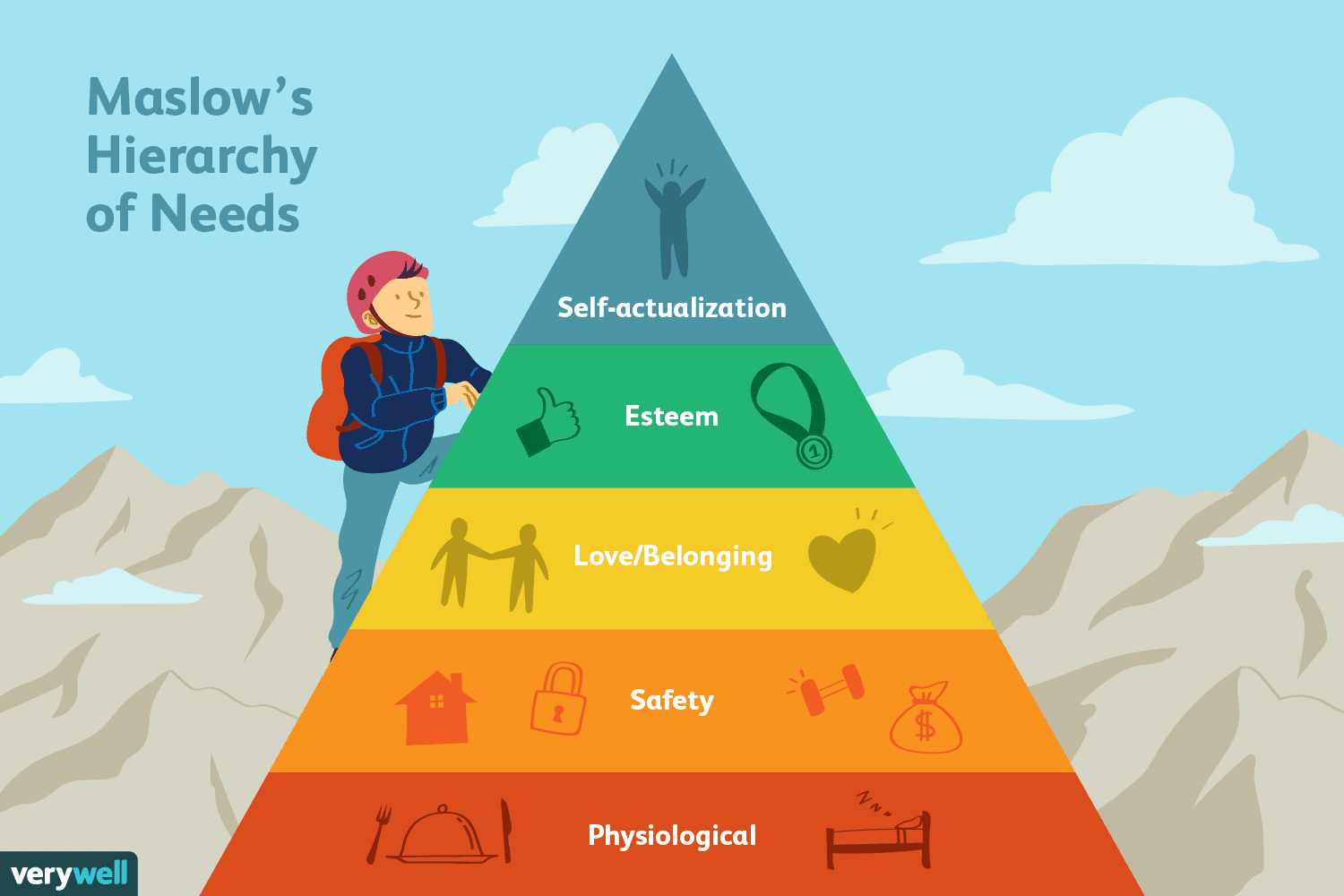
Maslow’s hierarchy of needs is a motivational theory that explains how human needs build from basic to complex. It proposes that people must first meet essential physiological and safety needs before they can focus on higher-level needs like belonging, esteem, and self-actualization. Often shown as a pyramid, the model helps explain why unmet basic needs can make it harder to pursue personal growth and fulfillment.
Joshua Seong / Verywell
Take the pop quiz at the end of the article to see how much you know about Maslow’s hierarchy.
Five Levels of Maslow’s Hierarchy of Needs
1. Physiological Needs
The physiological needs include those that are vital to survival. Some examples of physiological needs include:
In addition to the basic requirements of nutrition, air, and temperature regulation, physiological needs also include shelter and clothing. Maslow included sexual reproduction in this level of the hierarchy as well, since it is essential to the survival and propagation of the species.
2. Security and Safety Needs
At the second level of Maslow’s hierarchy, the needs start to become a bit more complex. At this level, the needs for security and safety become primary.
People want control and order in their lives. Some of the basic security and safety needs include:
Finding a job, obtaining health insurance and health care, contributing money to a savings account, and moving to a safer neighborhood are all examples of actions motivated by security and safety needs.
Together, the safety and physiological levels of Maslow’s hierarchy of needs make up what is often referred to as “basic needs.”
3. Love and Belonging
The social needs in Maslow’s hierarchy include love, acceptance, and belonging. At this level, the need for emotional relationships drives human behavior. Some of the things that satisfy this need include:
- Friendships
- Romantic attachments
- Family relationships
- Social groups
- Community groups
- Churches and religious organizations
In order to avoid loneliness, depression, and anxiety, it is important for people to feel loved and accepted by others. Personal relationships with friends, family, and lovers play an important role, as does involvement in groups—such as religious groups, sports teams, book clubs, and other group activities.
4. Esteem Needs
At the fourth level in Maslow’s hierarchy is the need for appreciation and respect. Once the needs at the bottom three levels have been satisfied, esteem needs start to play a much larger role in motivating behavior.
At this stage, people want to feel respected, valued, and recognized for their contributions. This includes both internal feelings of competence as well as external validation for accomplishments. Key aspects of esteem include:
- Feeling a sense of achievement and accomplishment
- Receiving recognition, appreciation, or praise from others
- Building self-esteem and confidence
- Developing a sense of self-worth and value
- Feeling respected in professional, academic, athletic, or social roles
People often meet these needs through accomplishments at work or school, participation in sports or teams, creative projects, or personal hobbies. When esteem needs are met, people tend to feel confident in their abilities. Conversely, those who lack self-esteem and the respect of others can develop feelings of inferiority.
Together, the esteem and social levels make up what is known as the “psychological needs” of the hierarchy.
5. Self-Actualization Needs
At the very peak of Maslow’s hierarchy are the self-actualization needs. Self-actualizing people are self-aware, concerned with personal growth, less concerned with the opinions of others, and interested in fulfilling their potential.
“What a man can be, he must be,” Maslow explained, referring to the need people have to achieve their full potential as human beings.
Maslow said of self-actualization: “It may be loosely described as the full use and exploitation of talents, capabilities, potentialities, etc. Such people seem to be fulfilling themselves and to be doing the best that they are capable of doing. They are people who have developed or are developing to the full stature of which they are capable.”
Understanding Maslow’s Hierarchy of Needs Theory
Abraham Maslow first introduced the concept of a hierarchy of needs in his 1943 paper, titled “A Theory of Human Motivation,” and again in his subsequent book, “Motivation and Personality.” This hierarchy suggests that people are motivated to fulfill basic needs before moving on to other, more advanced needs.
While some of the existing schools of thought at the time, such as psychoanalysis and behaviorism, tended to focus on problematic behaviors, Maslow was more interested in learning about what makes people happy and what they do to achieve that aim.
As a humanist, Maslow believed that people have an inborn desire to be self-actualized. In other words, people naturally desire to be all they can be. To achieve this ultimate goal, however, several more basic needs must be met. This includes the need for food, safety, love, and self-esteem.
Maslow believed that these needs are similar to instincts and play a significant role in motivating behavior.
Click Play to Learn More About Maslow’s Pyramid
What Are the Different Types of Needs?
Maslow’s hierarchy of needs can be separated into two types of needs: deficiency needs and growth needs.
- Deficiency needs: Physiological, security, social, and esteem needs are deficiency needs, which arise due to deprivation. Satisfying these lower-level needs is important to avoid unpleasant feelings or consequences.
- Growth needs: Maslow called the needs at the top of the pyramid growth needs. These needs don’t stem from a lack of something, but rather from a desire to grow as a person.
While the theory is generally portrayed as a fairly rigid hierarchy, Maslow noted that the order in which these needs are fulfilled does not always follow this standard progression.
For example, he noted that for some individuals, the need for self-esteem is more important than the need for love. For others, the need for creative fulfillment may supersede even the most basic needs.
How People Move Up the Pyramid
Maslow’s hierarchy of needs is often displayed as a pyramid.
- The lowest levels of the pyramid of needs are made up of the most basic needs, while the most complex needs are at the top.
- Once lower-level needs have been met, individuals can progress to the next level of needs.
- As people progress up the pyramid, needs become increasingly psychological and social.
- At the top of the pyramid, the need for personal esteem and feelings of accomplishment take priority.
Like Carl Rogers, Maslow emphasized the importance of self-actualization, a process of personal growth and development that enables individuals to reach their full potential.
Self-actualization is at the top of Maslow’s hierarchy of needs. This need refers to the desire to reach our full potential. According to Maslow, this need can only be met once all of the other needs are satisfied. Thus, it comes after physiological needs, safety needs, the need for love and belonging, and esteem needs.
Where Maslow’s Theory Falls Short
Maslow’s theory has gained widespread popularity both within and outside of psychology. The theory has had a particularly significant influence on the fields of education and business. But Maslow’s concept has not been without criticism. Chief among the long-held objections are:
- Needs don’t follow a hierarchy: While some research has shown support for Maslow’s theories, most of the research has not been able to substantiate the idea of a needs hierarchy. Wahba and Bridwell (researchers from Baruch College) reported that there was little evidence for Maslow’s ranking of these needs and even less evidence that these needs are in a hierarchical order.
- The theory is difficult to test: Maslow’s definition of self-actualization is difficult to test scientifically. His research on self-actualization was also based on a very limited sample of individuals, including people he knew as well as biographies of famous individuals whom Maslow believed to be self-actualized.
Some of the more recent critiques suggest that Maslow was inspired by the belief systems of the Blackfoot nation, but neglected to acknowledge this. Maslow studied the Northern Blackfoot tribe as an anthropologist. However, the popular views of the hierarchy are often seen as a misrepresentation of the Blackfoot worldview.
What Today’s Research Says About Maslow’s Hierarchy
Maslow’s hierarchy of needs marked an important shift in psychology. Instead of focusing on abnormal behavior and development, his humanistic approach emphasized how people can grow, thrive, and reach their potential.
Although research is limited, the hierarchy remains widely recognized and popular in fields such as psychology, business, education, mental health, and everyday life. Recent research suggests that:
- Satisfying needs contributes to well-being. However, people don’t necessarily need to meet these needs in the order suggested by the pyramid.
- Higher-level needs are still important in times of stress or crisis, even if lower-level basic needs are disrupted. This suggests that the needs hierarchy is more flexible than Maslow initially suggested.
- Research suggests that human needs don’t follow a fixed sequence, which challenges the idea of a universal series of needs.
- Needs shift over time, which means that the needs that influence our behavior are much more dynamic and fluid than the needs hierarchy suggests.
Such results suggest that while these needs can be powerful motivators of human behavior, they do not necessarily take the hierarchical form that Maslow described.
Why is Maslow’s hierarchy still important?
The basis of Maslow’s theory is that human beings are motivated by their needs. Additionally, if some of our most essential needs are unmet, we may be unable to progress and meet our other needs. This can help explain why we might feel “stuck” or unmotivated. It’s possible that our most critical needs aren’t being met, preventing us from being the best version of ourselves possible. Changing this requires examining what we need, then finding a way to obtain it.
How Maslow Expanded His Theory Over Time
In 1970, Maslow built upon his original hierarchy to include three additional needs at the top of his pyramid, for a total of eight:
- Cognitive needs: This centers on knowledge. People generally want to learn and know things about their world and their places in it.
- Aesthetic needs: This addresses the appreciation of beauty and form. People might fulfill this need through enjoying or creating music, art, literature, and other creative expressions.
- Transcendence needs: Maslow believed that humans are driven to look beyond the physical self in search of meaning. Helping others, practicing spirituality, and connecting with nature are a few ways we might meet this need.
