

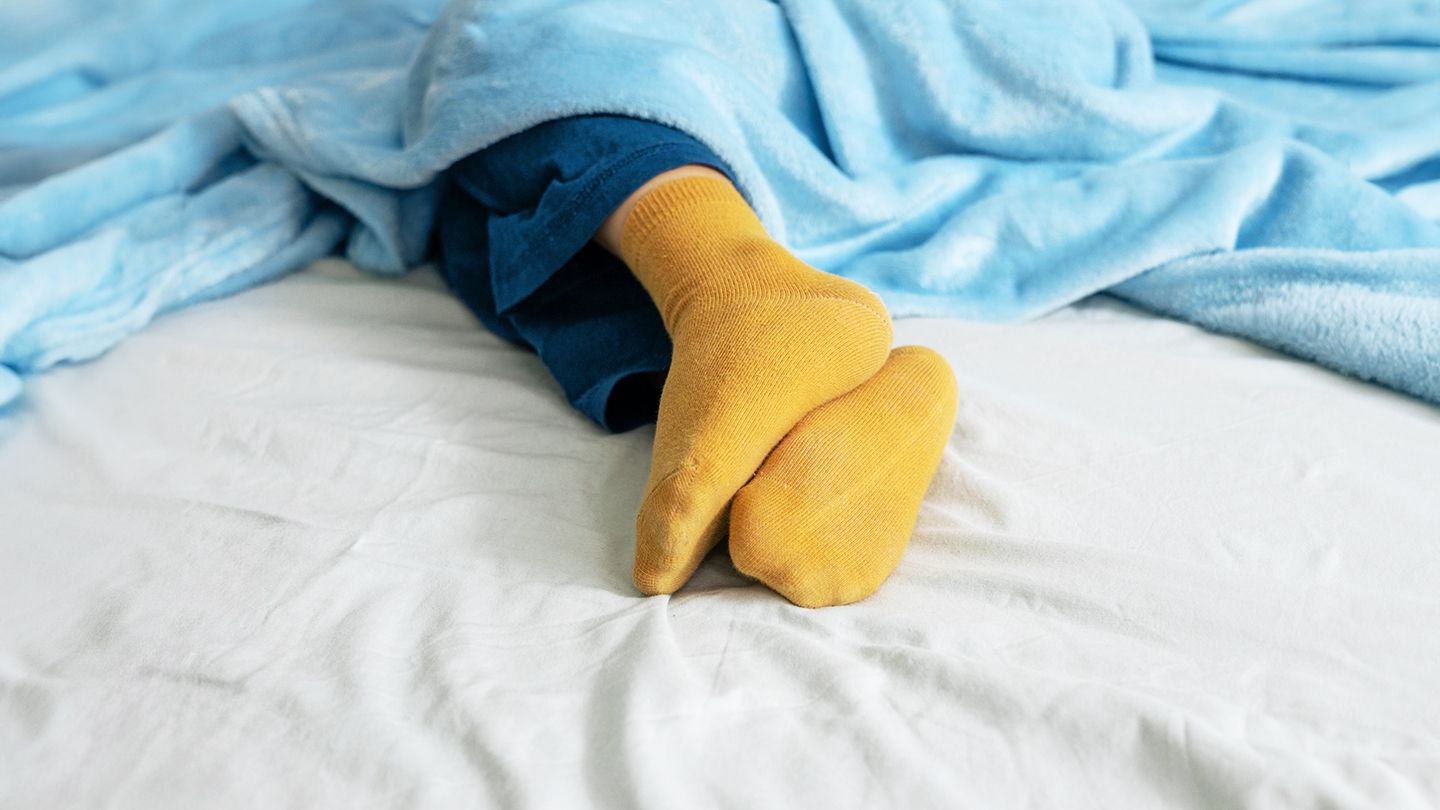
During the winter months, pulling on a pair of socks before hopping into bed might be your favorite way to get cozy and comfy, making it easier to fall asleep and stay asleep.
But is sleeping in socks hygienic? Especially if you spend most of your waking hours wearing socks, too?
If you’re wondering if there should be a pair of socks next to your sleep mask and earplugs, here’s what the science says about the pros and cons.
The Case for Sleeping in Socks
There isn’t a lot of research on the benefits of wearing socks to bed, but experts have some thoughts.
Wearing Socks to Bed May Help You Sleep Longer
As bedtime approaches, the body begins preparing for sleep by lowering its core temperature, which is a key part of the circadian rhythm (the body’s internal clock) that helps signal drowsiness.
[1]
The body releases heat in part through the hands and feet as we fall asleep, explains Yoel Green, MD, a sleep medicine physician and a clinical assistant professor of psychiatry and behavioral sciences at Stanford Healthcare in California.
Good news for people who are “pro-sock”: Wearing socks to bed doesn’t seem to get in the way of that heat-releasing process, says Dr. Green.
Scientific evidence on sleeping with socks is sparse, but one small experimental study offers some insight. In that study, six young, healthy men slept in a cool environment both with and without loose “bed socks.”
[2]
When participants wore socks, they fell asleep about seven minutes faster on average, slept roughly half an hour longer, and experienced fewer awakenings overnight. Objective sleep measures, including sleep efficiency, improved.
But the study subjects didn’t report feeling significantly more rested the next morning — a reminder that changes seen on sleep trackers don’t always translate into noticeable improvements in subjective experiences.
“There isn’t strong evidence that wearing socks to bed meaningfully improves sleep. The available evidence suggests only modest effects, and it’s not something we typically focus on in sleep care,” says Green.
But socks may help some people feel more comfortable at bedtime, which on its own can make it easier to fall asleep, he says.
Alleged Benefits Aren’t Backed Up by Science
Over the years, some people have made claims about wearing socks to bed that go beyond sleep.
Can Wearing Socks in Bed Make Orgasm Easier?
The claim that socks can make it easier to achieve orgasm can be traced to a small study published in 2005 that looked at brain activity during sex. The laboratory setting was chilly, and once participants put socks on, it was easier for them to reach climax.
[3]
Over time, that anecdote was misrepresented as evidence that wearing socks directly improves sexual response. While it does make sense that feeling chilly would make it more difficult to relax and enjoy sex, socks themselves aren’t a proven intimacy booster.
[4]
Can Wearing Socks in Bed Ease Hot Flashes or Night Sweats?
Claims about socks preventing hot flashes and night sweats are also shaky. Menopausal hot flashes are driven by hormone-related changes in the brain’s temperature-regulation system — not simply by cold feet.
Indeed, research suggests that being too warm at night raises the risk of a hot flash.
[5]
On the positive side, there’s evidence that hot flash severity and frequency may be lowest in the winter months.
[6]
Cons of Sleeping With Socks On
People who are “anti-sock” have some valid concerns.
Wearing Socks Might Promote Bacterial and Fungal Growth
If socks make your feet feel overheated, sweaty, or uncomfortable, they’re unlikely to help with sleep.
Keeping your feet in a warm, damp environment can promote bacterial and fungal growth, which can contribute to foot odor and potentially infection. Fungal infections like athlete’s foot thrive in warm, moist environments like sweaty socks, and can lead to itching, scaling, and cracked skin between the toes.
Athlete’s foot can spread easily to other parts of the body or to other people and may be more difficult to manage in people who sweat heavily or have conditions such as diabetes.
If you’re wearing socks to bed and waking up with very sweaty feet and damp socks, you may want to rethink the habit.
[7]
Do Your Socks Interfere With Circulation or Make Your Legs Restless?
For generally healthy people, wearing socks to bed shouldn’t cause circulation issues, says Green — if you’re wearing proper socks.
“Socks shouldn’t feel tight or restrictive, particularly for people with known circulation issues or diabetes, who should follow individualized medical guidance,” he says.
Separately, if you notice that wearing socks makes your legs restless, you’re probably not helping your sleep by wearing them.
“If someone notices persistent leg restlessness or an urge to move the legs at night that interferes with sleep — especially if it improves with movement — that may reflect a sleep-related condition such as restless leg syndrome and is worth discussing with your doctor,” says Green.
How to Choose Bed Socks
For people who want to try sleeping with socks, experts recommend keeping it simple.
- Socks should feel breathable — think cotton or wool — and not overly warm, says Green.
- Socks should also be clean (not the ones you’ve worn all day, especially if your feet tend to sweat), loose and nonrestrictive, and comfortable enough that you don’t notice them once you’re in bed.
[1]
- Compression socks should not be worn to bed unless recommended by your doctor.
- Take your socks off if your feet get too hot during the night.
The Bigger Picture on Better Sleep
Sleep specialists emphasize that good sleep is rarely about finding a single hack.
“Good sleep is about protecting sleep opportunity, supporting healthy habits, and routines, and removing obstacles that get in the way,” says Green.
“Sleep opportunity” is all about consistently giving your body a real chance to sleep.
In practical terms, it usually means things like:
- Allowing enough time in bed to meet your sleep needs (for most adults, 7 to 9 hours), instead of chronically cutting sleep short.
- Keeping a consistent sleep schedule so your brain knows when sleep is supposed to happen.
- Reducing barriers to sleep, such as late-night screen use, noise, light, caffeine, or work bleeding into bedtime.
