

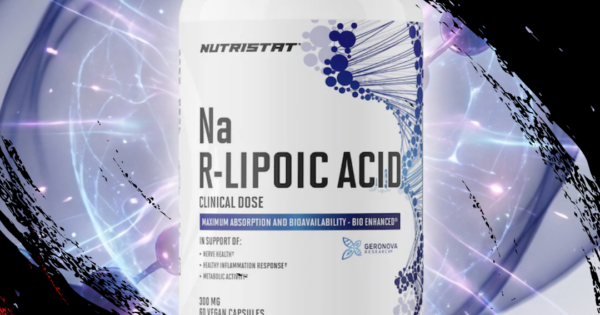
Ultimate alpha lipoic acid guide explaining why most supplements fail, sodium-stabilized forms, mechanisms, and clinical research on dosing.
Alpha lipoic acid (ALA) functions as an essential cofactor for mitochondrial energy production while simultaneously serving as one of nature’s most versatile antioxidants. This dual role, combined with its unique ability to work in both water and fat-soluble environments throughout the body, has earned it recognition as the “antioxidant of antioxidants”.
But standard alpha lipoic acid supplements face a fundamental challenge: poor absorption. Most R-alpha lipoic acid products, despite containing the naturally occurring and biologically active form, suffer from serious stability problems that dramatically limit bioavailability.
Nutristat’s Na-R-Alpha Lipoic Acid solves this problem with their Bio-Enhanced® Na-R-Alpha Lipoic Acid, a sodium-stabilized form delivering up to 40 times greater absorption than unstabilized R-alpha lipoic acid. Each 300mg capsule provides 260mg of actual R-alpha lipoic acid in a form your body can absorb and utilize.
As we’ll detail in this article, sodium-stabilized R-alpha lipoic acid achieves therapeutic plasma concentrations, while unstabilized forms fall short, and that’s why it’s important to use Na-R-ALA.
You can check prices with PricePlow, and then let’s get into the science behind it all:
Nutristat Na-R Lipoic Acid – Deals and Price Drop Alerts
Get Price Alerts
No spam, no scams.
Disclosure: PricePlow relies on pricing from stores with which we have a business relationship. We work hard to keep pricing current, but you may find a better offer.
Posts are sponsored in part by the retailers and/or brands listed on this page.
Before getting into the science of the antioxidant ingredient itself, let’s get into the solution that was needed to maximize its efficacy:
The Bioavailability Crisis: Why Most ALA Supplements Fall Short
R-Alpha Lipoic Acid: Biological Superiority Creates a Formulation Problem
R-alpha lipoic acid is the only naturally-occurring form of alpha lipoic acid and the exclusive form used by all known biological systems.[1] The S-enantiomer exists solely as a byproduct of achiral manufacturing processes, yet serves no biological function.
Despite this clear biological preference, pure R-alpha lipoic acid faces a critical limitation: instability. The compound tends to polymerize, meaning individual molecules link together into chains that drastically reduce both solubility and absorption.[1] This polymerization translates directly into poor aqueous solubility and poor bioavailability in supplement form.
So the industry at this point has two choices:
- Use standard alpha lipoic acid
- Find a way to make R-Lipoic Acid more stable.
Only one path makes sense, though. Let’s continue:
The Racemic Paradox: Why Cheaper Forms Sometimes Absorb Better
This instability of R-Lipoic Acid creates an unexpected situation: racemic alpha lipoic acid (containing 50% R-form and 50% S-form) ironically often delivers better bioavailability than poorly formulated pure R-alpha lipoic acid supplements.
The mechanism behind this paradox is straightforward. The presence of the S-enantiomer in racemic mixtures prevents R-alpha lipoic acid polymerization to some extent, improving its stability and bioavailability.[2] While the S-form provides no biological benefit itself, it functions as a stabilizer that allows the R-form to remain absorbable.
Research comparing the two forms confirms this effect. One study administered 500mg doses of both R-alpha lipoic acid and racemic lipoic acid to subjects, finding that some individuals absorbed the racemic mixture more effectively than pure R-alpha lipoic acid.[3]
This explains why some racemic products deliver clinical results despite containing only 50% of the active enantiomer (they’re simply more bioavailable than unstabilized R-alpha lipoic acid).
Thankfully, there’s an even better way:
The Sodium Salt Solution: Pharmaceutical Chemistry Solves the Problem
Converting R-alpha lipoic acid to its sodium salt solves the fundamental stability problem through established pharmaceutical chemistry. Salts of weak acids demonstrate higher aqueous solubility and absorption than their corresponding free acids, a principle that applies directly to lipoic acid.[1]
These mirror-image molecules look nearly identical, but only the R-form works in your body’s enzymes. The S-form is just a manufacturing byproduct with no biological function, which is why the naturally-occurring R-enantiomer is what you want to supplement.[1]
The sodium stabilization prevents polymerization while making the compound completely water-soluble. When ingested, sodium R-lipoate reconverts to free R-alpha lipoic acid in the stomach’s acidic environment, where rapid absorption begins.[1] The free acid then undergoes extensive absorption in the proximal duodenum, resulting in faster and more efficient uptake compared to unstabilized forms that must transit through the more alkaline intestinal pH.
Landmark Study: The 17-25 Fold Bioavailability Advantage
A 2007 pharmacokinetic study published in Alternative Medicine Review provided direct human data comparing 600mg doses of pure R-alpha lipoic acid versus sodium R-lipoate (Na-R-LA).[1]
In one male subject, sodium R-lipoate produced a maximum plasma concentration (Cmax) of 14.1 mcg/mL compared to just 0.7 mcg/mL for pure R-alpha lipoic acid — a 25.86-fold increase. Total bioavailability (area under the curve, AUC) increased 3.3-fold, from 1.56 mcg·hr/mL to 5.18 mcg·hr/mL.
A female subject showed similar results: Cmax increased 17.9-fold (from 1.01 to 18.1 mcg/mL), while overall bioavailability increased 2.67-fold (from 2.14 to 5.71 mcg·hr/mL).[1]
Nutristat Na-R-Alpha Lipoic Acid delivers over 40x the absorption of standard R-ALA supplements. Bio-Enhanced® sodium salt form achieves therapeutic plasma concentrations for real metabolic and antioxidant support. Clinical dosing at 300mg per capsule.
The broader study of 12 healthy subjects receiving 600mg sodium R-lipoate confirmed these findings, with an average Cmax of 16.03 mcg/mL and a median time to peak concentration of just 15 minutes.[1] This rapid absorption enables the compound to reach therapeutic concentrations quickly, concentrations that unstabilized R-alpha lipoic acid simply cannot achieve.
The Bottom Line on Bioavailability
The research leads to a clear conclusion: pure R-alpha lipoic acid should only be treated as raw material for further processing into stable, bioavailable forms rather than as a finished supplement ingredient.[1]
Many animal and cell culture studies demonstrating lipoic acid’s benefits used high concentrations that are unachievable with poorly absorbed forms in humans. The sodium salt formulation bridges this gap, delivering plasma concentrations comparable to those used in successful research models.
This is the difference between achieving therapeutic concentrations and falling short. That’s why it’s used in Nutristat’s Na-R-Alpha Lipoic Acid (Nutristat is the sponsor of this article).
With the ingredient improvements explained, let’s talk about ALA itself:
Alpha Lipoic Acid: Mechanisms of Action
-
Essential Cofactor for Mitochondrial Energy Production
Alpha lipoic acid functions as an essential cofactor for mitochondrial enzymes that convert food into cellular energy. The compound plays a critical role in the pyruvate dehydrogenase complex, which converts pyruvate from glycolysis into acetyl-CoA, the molecule that enters the Krebs cycle to generate ATP.[4]
This isn’t a minor supporting role, either. The pyruvate dehydrogenase step bridges glycolysis and the citric acid cycle, making it essential for aerobic metabolism. Without adequate lipoic acid, this critical step in energy production cannot function efficiently.[5]
Blood levels of sodium R-lipoate peak rapidly at around 15 minutes and stay elevated for over an hour. This fast absorption and sustained presence is exactly what you want from a properly formulated supplement.[1]
During this process, lipoic acid cycles between its oxidized form (ALA) and reduced form (dihydrolipoic acid, or DHLA), accepting and donating electrons to facilitate the enzymatic reactions that produce cellular energy.[4]
R-alpha lipoic acid also inhibits pyruvate dehydrogenase kinase, an enzyme that would otherwise shut down the pyruvate dehydrogenase complex. By blocking this inhibitor, R-alpha lipoic acid helps maintain optimal energy production in cells.[1]
-
Direct Antioxidant Activity: Scavenging Multiple Radical Species
Alpha lipoic acid stands apart from other antioxidants due to its amphipathic nature (it’s soluble in both water and fat), allowing it to function throughout the body, including crossing the blood-brain barrier.[2]
Both ALA and DHLA directly quench reactive oxygen species, though DHLA demonstrates stronger antioxidant activity. The two forms work as a redox couple, with DHLA capable of scavenging peroxyl radicals, superoxide, and hydroxyl radicals, while ALA neutralizes singlet oxygen and hypochlorous acid.[2]
The compound also chelates redox-active metals like iron and copper, preventing them from catalyzing free radical reactions.[2] This metal-chelating activity doesn’t deplete these essential minerals from the body; it simply prevents them from participating in damaging oxidative reactions.
-
The Antioxidant Network Effect: Regenerating Glutathione and Vitamins
Alpha lipoic acid earned the title “antioxidant of antioxidants” through its unique ability to regenerate other crucial antioxidant molecules.[5]
When one subject took three 600mg doses spaced 15 and 30 minutes apart (solid line), blood levels stacked dramatically higher than a single dose (dashed line). This demonstrates the compound’s excellent absorption capacity even with repeated dosing.[1]
The compound increases intracellular glutathione levels through multiple mechanisms: it acts as a transcriptional inducer of genes regulating glutathione synthesis and increases substrate availability for glutathione production.[2] Glutathione is the body’s primary intracellular antioxidant, protecting cells from oxidative damage while supporting detoxification.
ALA also regenerates vitamin C from its oxidized form, and vitamin C in turn regenerates vitamin E, creating a synergistic antioxidant network.[2] Research from 1959 demonstrated that alpha lipoic acid could prevent symptoms of both vitamin E and vitamin C deficiency, suggesting its powerful role in maintaining these other antioxidants in their active forms.[2]
This network effect amplifies the antioxidant capacity throughout the cell, making alpha lipoic acid far more valuable than compounds that only provide direct radical scavenging.
-
Blood Glucose Disposal and Insulin Sensitivity
Alpha lipoic acid stimulates glucose uptake independent of insulin. In severely insulin-resistant mice, muscle incubation with alpha lipoic acid increased glucose uptake by 300%, while insulin alone had no effect.[4]
The mechanisms underlying this effect are well-characterized. ALA activates the insulin receptor cascade, stimulating PI3K activity and phosphorylating insulin receptor substrate-1 (IRS-1) in adipocytes.[4] This activation leads to translocation of GLUT4 (the glucose transporter) to the cell membrane, enabling glucose entry into cells.
Alpha lipoic acid also activates AMPK (AMP-activated protein kinase), a cellular fuel sensor that induces GLUT4 translocation and plays a crucial role in mitochondrial biogenesis.[4] This pathway shares similarities with metformin’s mechanism of action, explaining why ALA demonstrates insulin-sensitizing effects even in insulin-resistant conditions.
Beyond immediate glucose uptake, ALA influences mitochondrial biogenesis through increased expression of markers like TFAM, PPARγ, and PGC1α, while upregulating antioxidant enzymes including glutathione peroxidase and superoxide dismutase.[4]
-
Neuroprotective Effects: Diabetic Neuropathy and Nerve Function
Diabetic peripheral neuropathy affects up to 50% of patients with diabetes, causing pain, numbness, and increased risk of injury. Alpha lipoic acid addresses both symptoms and underlying mechanisms.
The compound improves nerve blood flow, reduces oxidative stress, and enhances distal nerve conduction in diabetic neuropathy.[6] Animal studies demonstrate that ALA provides neuroprotection from ischemia-reperfusion injury of peripheral nerves and reduces oxidative stress while improving nerve conduction velocity.[4]
A systematic review and meta-analysis of clinical trials found that treatment with 300-600mg alpha lipoic acid daily (administered intravenously for 2-4 weeks) significantly improved both nerve conduction velocities and positive neuropathic symptoms.[6] Improvements were observed in median and peroneal motor nerve conduction velocity, as well as sensory nerve conduction velocity.
Multiple clinical trials detailed in a 2023 review demonstrated that 600mg daily of alpha lipoic acid improved Total Symptom Score (a measure of pain, burning, numbness, and paresthesia) in patients with diabetic polyneuropathy.[4]
Nutristat: Research. Purity. Performance.
The benefits extend beyond diabetes-related neuropathy. ALA’s ability to cross the blood-brain barrier positions it as a neuroprotective agent for various neurological conditions where oxidative stress plays a role.[2]
-
Cardiovascular Health: Endothelial Function and Blood Pressure
Oxidative stress drives atherosclerosis development through LDL oxidation, endothelial dysfunction, and inflammatory processes. Alpha lipoic acid addresses multiple cardiovascular risk factors simultaneously.
Endothelial Function
Endothelial dysfunction serves as an early marker of atherosclerosis. A double-blind, placebo-controlled trial in overweight and obese youth found that 800mg daily of alpha lipoic acid for three months significantly increased both basal and peak diameter of the brachial artery, demonstrating improved vascular tone and endothelial function.[2]
In diabetic patients with hypertension, combining ALA (600mg daily) with ACE inhibitors enhanced treatment effects: the combination reduced proteinuria by 53% compared to 30% with ACE inhibitors alone, while flow-mediated dilation increased 116% versus 58%.[2]
Blood Pressure Reduction
Multiple studies demonstrate ALA’s blood pressure-lowering effects. A randomized controlled trial in stroke patients found that 600mg daily for 12 weeks significantly reduced both systolic and diastolic blood pressure compared to placebo.[2]
Quality matters in creatine. Nutristat uses premium Creapure® in all their products, ensuring 99.9% purity without harmful impurities.
Animal studies show that alpha lipoic acid normalizes systolic blood pressure in hypertensive rats, restores glutathione peroxidase activity, and normalizes aortic superoxide generation.[2]
LDL Oxidation Protection
DHLA increases lag time before LDL oxidation in a concentration-dependent manner while chelating copper ions that would otherwise catalyze LDL oxidation. Research shows that 600mg daily of alpha lipoic acid increased LDL oxidation lag time following both copper and AAPH-catalyzed oxidation, suggesting protection against premature atherosclerosis.[5]
Lipid Profile Effects
Studies in diabetic rats show that ALA supplementation at 300mg/kg daily decreased plasma triglyceride concentrations, though effects on cholesterol varied across studies.[5] Clinical trials in humans with diabetic neuropathy have shown modest improvements in triglyceride levels alongside symptom improvement.[2]
Clinical Evidence: What the Meta-Analyses Show
-
Diabetic Peripheral Neuropathy: The Primary Indication
A 2012 systematic review and meta-analysis published in the European Journal of Endocrinology analyzed randomized controlled trials investigating alpha lipoic acid’s effects on diabetic peripheral neuropathy.[6]
The analysis included 15 trials examining treatment with 300-600mg ALA administered intravenously daily for 2-4 weeks. Results demonstrated significant improvements in nerve conduction velocities:
- Median motor nerve conduction velocity: 4.63 m/s improvement
- Median sensory nerve conduction velocity: 3.17 m/s improvement
- Peroneal motor nerve conduction velocity: 4.25 m/s improvement
- Peroneal sensory nerve conduction velocity: 3.65 m/s improvement
The odds ratio for efficacy (improvement of symptoms, tendon reflex, and nerve conduction velocities) was an impressive 4.03 in favor of ALA treatment. Furthermore, no serious adverse events were observed during the treatment period.[6]
-
Metabolic Health and Weight Management
A 2017 meta-analysis published in Obesity Reviews examined alpha lipoic acid supplementation for weight loss across 10 randomized, placebo-controlled trials.[7]
ALA treatment resulted in a statistically significant 1.27kg greater mean weight loss compared to placebo (95% CI: 0.25 to 2.29). BMI decreased by 0.43 kg/m² more in the ALA group compared to placebo (95% CI: -0.82 to -0.03).[7]
While the effect size is modest, the compound’s excellent safety profile and additional metabolic benefits make it a valuable adjunct to weight management strategies. More recent analyses in specific populations (e.g., overweight/obese adults) continue to support modest benefits on intermediate markers.
-
Optimal Dosing and Safety Profile
The clinical research consistently supports 600mg as the optimal daily dose for most applications. This dose achieves therapeutic plasma concentrations while minimizing side effects.[6]
Higher doses (1200-1800mg daily) increase gastrointestinal side effects without providing additional benefits. At 1200mg, nausea incidence reaches 21%, jumping to 48% at 1800mg, compared to just 13% at 600mg.[6]
Most pre-workouts use 1-2.5g betaine to check the box. NutriStat Pre Script uses 3g of betaine because research shows dose-dependent benefits. Betaine enhances cellular hydration under stress AND supports creatine synthesis. When training hard, that extra 500mg matters.
The 600mg dose has demonstrated efficacy across multiple conditions:
- Peripheral neuropathy symptom improvement and nerve conduction enhancement
- Blood pressure reduction in hypertensive and stroke patients
- Endothelial function improvement in metabolic syndrome
- Enhanced insulin sensitivity in type 2 diabetes
- Weight loss support in overweight individuals
The compound’s safety profile is excellent at therapeutic doses. Multiple long-term studies spanning months to two years report no serious adverse events at 600mg daily, with the formulation being rated as “very good” or “good” in tolerability by the vast majority of participants.[2]
Nutristat Na-R-Alpha Lipoic Acid: Maximum Bioavailability, Clinical Dose
Like their approach with premium Creapure® creatine and 3g betaine dosing in Pre Script, Nutristat refuses to compromise on ingredient quality or effective dosing.
Why Bio-Enhanced® Na-R-ALA from GeroNova Research
Nutristat sources Bio-Enhanced® Na-R-Alpha Lipoic Acid from GeroNova Research, the company that conducted the definitive Carlson 2007 pharmacokinetic research demonstrating the 17-25 fold bioavailability advantage. This is basically a pharmaceutical-grade sodium salt formulation backed by rigorous human pharmacokinetic data.
The sodium stabilization permanently solves the polymerization problem that plagues standard R-alpha lipoic acid supplements. When other brands use unstabilized forms or racemic mixtures (to cut costs or avoid stability issues), they’re delivering products that cannot achieve therapeutic plasma concentrations.
Clinical Dose with Maximum Absorption
Nutristat PÜR NATIVE delivers Native Whey Protein extracted directly from milk, not cheese production. Lab-tested with 3.1g+ leucine per serving and enhanced with NativeZyme technology for superior absorption. Research shows faster recovery and better gains.
Each capsule of Nutristat Na-R-Alpha Lipoic Acid delivers 300mg of Bio-Enhanced® Na-R-Alpha Lipoic Acid (providing 260mg R-alpha lipoic acid and ~30mg sodium). This sodium salt formulation enables:
- Rapid absorption: Median time to peak concentration of 15 minutes
- High bioavailability: 17-25x greater Cmax than unstabilized R-ALA
- Therapeutic concentrations: Achieving plasma levels demonstrated effective in clinical research
- Consistent results: Stable formulation with predictable pharmacokinetics
At 1-2 capsules daily, you’re receiving 260-520mg of actual R-alpha lipoic acid, delivered in a form that reaches the concentrations used in successful clinical trials.
The Nutristat Quality Philosophy
The use of Bio-Enhanced® Na-R-ALA mirrors Nutristat’s broader commitment to evidence-based quality. When research shows a better way, they implement it, even when it costs more:
Product specifications:
- GMP Certified
- Made in the USA with global ingredients
- Free from banned substances
- Vegan capsules with rice hull as filler
- No unnecessary additives
How to Use Nutristat Na-R-Alpha Lipoic Acid
The recommended dosing is 1-2 capsules daily on an empty stomach before meals. Taking Na-R-alpha lipoic acid before meals optimizes absorption, as the rapid uptake in the stomach and proximal duodenum occurs most efficiently without competing nutrients.
The 300mg dose per capsule (providing 260mg R-alpha lipoic acid) aligns with the clinically studied amounts that achieve therapeutic plasma concentrations. At 1-2 capsules daily, you’re receiving dosing within the 300-600mg range demonstrated effective across multiple clinical applications.
Why Form Matters as Much as Dose
Many animal and cell culture studies demonstrating lipoic acid’s benefits used high concentrations that simply aren’t achievable with poorly absorbed forms in humans. When researchers incubated muscle tissue with ALA and saw 300% increases in glucose uptake, they were using concentrations that standard R-alpha lipoic acid supplements cannot deliver.[4]
The Carlson 2007 study’s conclusion is unequivocal: “pure RLA is not suitable for use in nutraceutical or pharmaceutical products. Rather, it should be treated as raw material for further processing into stable, bioavailable dosage forms.”[1]
The enhanced bioavailability of Bio-Enhanced® Na-R-alpha lipoic acid means the plasma concentrations used in successful research models can actually be reached through oral supplementation. When you compare:
- Unstabilized R-ALA at 600mg → Peak plasma concentration: 0.7-1.0 mcg/mL
- Na-R-ALA at 600mg → Peak plasma concentration: 14-18 mcg/mL
The difference is achieving therapeutic thresholds or falling short. It’s reaching the concentrations where clinical benefits occur or wasting money on poorly absorbed products.
For those seeking the metabolic, antioxidant, and neuroprotective benefits that alpha lipoic acid research promises, form matters as much as dose. Nutristat’s use of the sodium-stabilized form, sourced from the company that conducted the definitive bioavailability research, ensures you’re getting a supplement that delivers therapeutic concentrations rather than just impressive label claims.
High-quality products like Nutristat Na-R-Alpha Lipoic Acid are what you get when supplement companies prioritize effectiveness over cost savings.
Nutristat Na-R Lipoic Acid – Deals and Price Drop Alerts
Get Price Alerts
No spam, no scams.
Disclosure: PricePlow relies on pricing from stores with which we have a business relationship. We work hard to keep pricing current, but you may find a better offer.
Posts are sponsored in part by the retailers and/or brands listed on this page.
