

2026 Trends
Initiative Chair: John Toomey, CEO, The Wellbeing Thought Leaders, Australia
Initiative Vice-Chair: Vishal Patel MD PhD, Chief Science and Innovation Officer, Sensei, United States
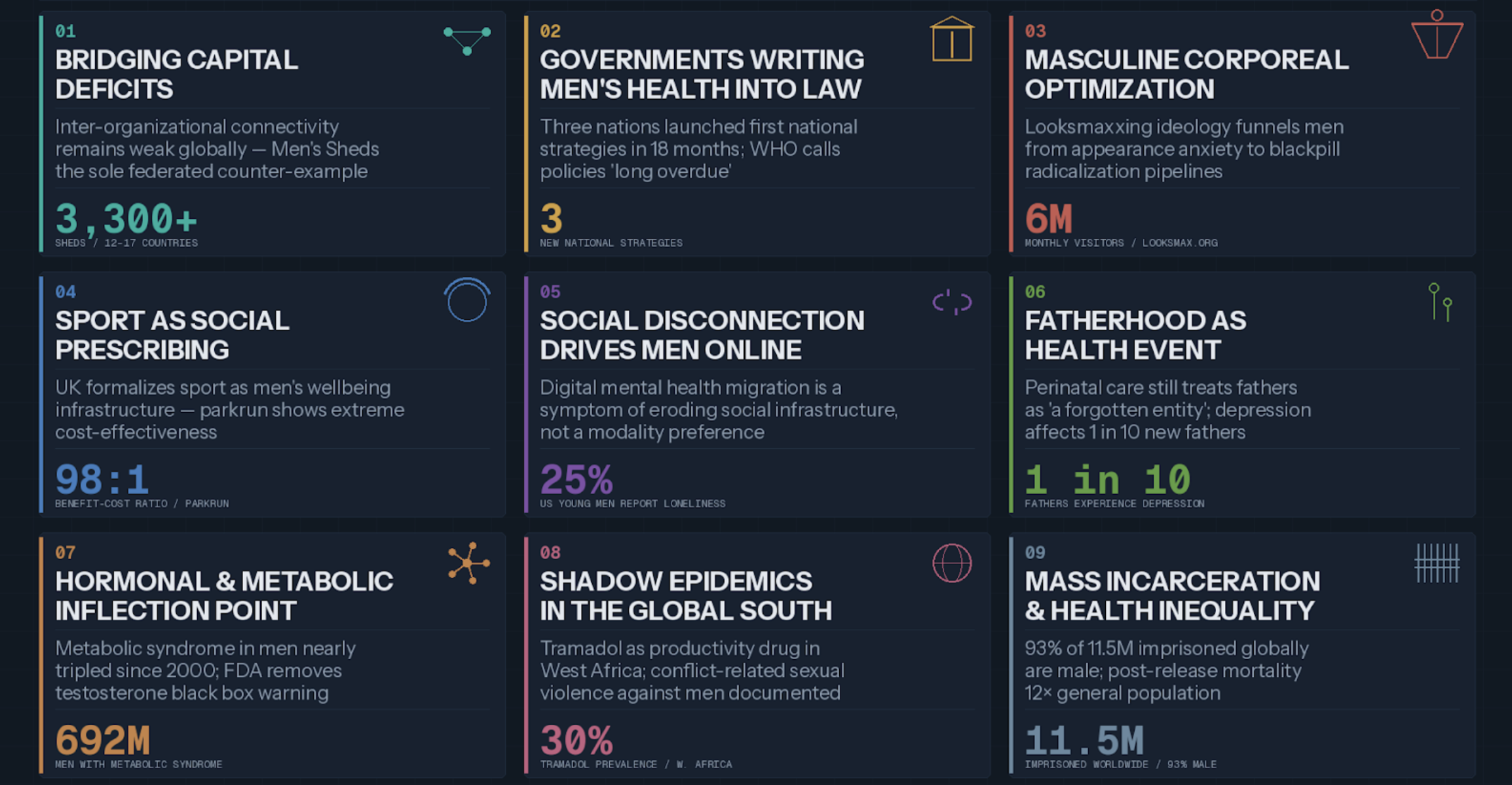
Men’s wellbeing in 2026 is defined by a central tension: institutional momentum is accelerating while the connective infrastructure between organizations, sectors and geographies remains weak. Three nations launched their first national men’s health strategies in 18 months. Sport is being formalized as social prescribing infrastructure. Fatherhood is gaining recognition as a perinatal health event for men. Governments and regulatory bodies are acting with unprecedented specificity. At the same time, men’s wellbeing organizations globally operate with strong bonding capital and negligible bridging capital—no shared protocols, no referral pathways, no coordinating structures outside a few national exceptions. Meanwhile, crises compounding in the Global South—opioid-driven productivity epidemics, conflict-related sexual violence against men, mass incarceration as a disease amplifier—remain largely absent from mainstream frameworks. These nine trends map the field’s advances and its structural gaps.
TREND 1: Bridging Capital Deficits in Men’s Wellbeing Organizations Globally
The men’s wellbeing ecosystem—spanning peer-support circles, retreats, coaching practices, Men’s Sheds, breathwork programs and leadership foundations—has expanded rapidly, yet inter-organizational relationships, shared practices or referral pathways that connect these groups to one another have not been globally cultivated. The Men’s Sheds movement stands as the single, striking counter-example. Now numbering over 3,300 Sheds across approximately 12–17 countries, the movement operates through national associations federated under the International Men’s Sheds Organisation (IMSO), established in 2011. Australia’s AMSA (ca. 1,300 Sheds), the UK’s UKMSA (ca. 900), Ireland’s IMSA (ca. 450), and newer bodies in Canada, New Zealand, Denmark and the United States share knowledge through conferences, newsletters and Shed Radio. A mixed-methods systematic review by Foettinger et al. (2022) documented benefits to self-rated health, social isolation and wellbeing across the federated network. The Australian Men and Boys’ Health Alliance (AMBHA), formed in May 2023 at the invitation of the Australian Department of Health, brings together AMSA, Movember, Healthy Male, The Men’s Table, MATES, OzHelp, Parents Beyond Breakup and academic researchers. It produced eight key recommendations and represents the closest example of inter-organizational bridging in the men’s wellbeing space—but it is geographically limited to Australia and primarily policy-focused rather than operational. No other category of men’s wellbeing organization has a comparable coordinating structure, nor any formal mechanism for cross-type knowledge exchange.
The field remains dominated by bonding capital, with weak external bridging links, and it is ripe for unification through bridge building.
Resources:
- Golding, B. “Men’s Sheds Internationally.” 9 September 2024. barrygoanna.com
- Australian Men’s Shed Association. “Men’s Sheds Around the World.” mensshed.org
- Foettinger, L., et al. “The Role of Community-Based Men’s Sheds in Health Promotion for Older Men.” American Journal of Men’s Health 16(2) (2022): 1–18. SAGE Journals
- Valente, T. W., et al. “Resilience and Fragmentation in Healthcare Coalitions.” Social Networks 71 (2022): 103–114. PMC
- Haafkens, J. A., et al. “An Integrative Perspective on Interorganizational Multilevel Healthcare Networks.” BMC Health Services Research 22 (2022): 1197. BMC
TREND 2: Governments Are Writing Men’s Health into Law
In the 18 months between November 2024 and March 2026, three of the world’s largest English-speaking nations either launched or began developing their first national men’s health strategies, joining a small club that previously included only Ireland (2008), Brazil (2009) and Australia (2020). England published its first Men’s Health Strategy (November 2025) with £3.6 million earmarked for middle-aged male suicide prevention; Canada opened public consultations on a Men and Boys’ Health Strategy (the first by any G7 nation other than the UK); and Ireland launched its second National Men’s Health Action Plan.
At the institutional level, the Bulletin of the World Health Organization published its first editorial calling men’s health policies “long overdue,” and the Lancet Public Health introduced the 5R Framework—Research, Reach, Respond, Retain, Relational—as the first actionable design tool for gender-responsive health systems serving men. The Lancet Commission on Gender and Global Health acknowledged that “gender in global health” has functioned as shorthand for women and girls. In the US, the American Institute for Boys and Men received $20 million from Melinda French Gates, and the AMA passed a resolution supporting federal and state offices of men’s health. Brazil’s National Policy on Comprehensive Healthcare for Men (PNAISH) serves as a pioneering global model for integrating male-specific health services into primary care.
Resources:
- UK DHSC. “Government Unveils England’s First Ever Men’s Health Strategy.” GOV.UK, 19 Nov 2025. GOV.UK
- Health Canada. “Improving the Health of Men and Boys in Canada.” 2025. Canada.ca
- Cornell, M. “Men’s Health Policies: Long Overdue.” Bull. WHO, July 2025. PMC
- Galdas., et al. “Designing Men’s Health Policy: The 5R Framework.” Lancet Public Health, 2025. The Lancet
- Lancet Commission on Gender and Global Health. “Standing Up for Gender Justice.” The Lancet 405, April 2025. The Lancet
TREND 3: Masculine Corporeal Optimization – A New Body Crisis with an Ideological Engine
A cluster of practices—looksmaxxing, cosmetic surgery, liposuction, testosterone supplementation, leg lengthening and bone smashing—has coalesced into what researchers are beginning to call “masculine corporeal optimization.” Looksmaxxing is a community-driven ideology with its own pseudo-scientific taxonomy, where users rate attractiveness on numerical scales, measure facial angles and classify men into hierarchical ranks. The “blackpill”—the belief that physical appearance deterministically controls life outcomes—originated on incel forums but has been laundered into mainstream platforms through looksmaxxing discourse. This ideological scaffolding transforms diffuse appearance anxiety into a systematized worldview with diagnostic tools (PSL ratings), treatment protocols (surgical roadmaps) and a community of practice. The dedicated forum looksmax.org receives six million unique visitors monthly.
Men now account for 14.5% of cosmetic procedure patients globally (ISAPS 2024), with gynecomastia surgery, liposuction and eyelid surgery leading among US men. The global testosterone replacement therapy market exceeds $1.6 billion, the hair transplant market ranges from $6–12 billion, and anabolic steroid use carries a 6.4% lifetime prevalence among men globally. The human cost is severe: body dysmorphic disorder carries a 3.5-fold increased risk of suicide (Rautio et al., 2024, population-level Swedish cohort) and cosmetic surgery does not resolve the underlying pathology. Halpin et al. (2025) documented users encouraged toward self-harm when judged to have failed masculine appearance standards. Turing Institute researchers found 44% of looksmaxxing TikTok videos also used blackpill hashtags, suggesting that these hashtags algorithmically funnel young men from looksmaxxing content to more extreme blackpill and neo-Nazi content.
While men’s body dissatisfaction has been compounding over decades, several recent trends have accelerated this phenomenon, including, but not limited to:
- Dating apps restructuring the mating market around visual appearance
- Social media algorithms amplifying unrealistic body standards
- Economic precarity eliminating alternative status pathways, disproportionally affecting men
- Influencer culture modeling a “pharmaceutical masculinity.” Manosphere influencers have accumulated billions of views promoting appearance-optimization content, frequently presenting steroid-enhanced physiques as naturally achievable, creating what researchers call “the natty-or-not problem.”
- COVID-19 accelerating every underlying trend. “Zoom dysmorphia” was documented as a clinical phenomenon, with dermatologists reporting substantial increases in patients dissatisfied with their appearance during and after the pandemic.
- K-pop globalizing alternative male beauty standards and normalizing men’s cosmetic procedures.
Resources:
- Halpin, M., et al. (2025). “When Help Is Harm: Health, Lookism and Self-Improvement in the Manosphere.” Sociology of Health & Illness 47(3):e70015. DOI: 10.1111/1467-9566.70015
- Rautio, D., et al. (2024). “Intentional Self-Harm and Death by Suicide in Body Dysmorphic Disorder.” Biological Psychiatry 96(11):868–875. DOI: 10.1016/j.biopsych.2024.05.006
- Rück, C., et al. (2024). “Body dysmorphic disorder.” Nature Reviews Disease Primers 10(1):92. https://doi.org/10.1038/s41572-024-00577-z
- Solea, A. I. & Sugiura, L. (2025). “Digital Subcultural Diffusion Theory: Rebranding the incel ideology through Looksmaxxing, Sub5s and the PSL scale.” Crime, Media, Culture: An International Journal. https://doi.org/10.1177/17416590251387245
- Redmond, J., Small, R., and Hughes, M. (2025). “From Looksmaxxing to Mass Shootings: Radicalisation and Online Misogyny.” CETaS Expert Analysis. Alan Turing Institute. https://cetas.turing.ac.uk/publications/looksmaxxing-mass-shootings-radicalisation-and-online-misogyny
TREND 4: Sport Is Becoming Formalized Social Prescribing Infrastructure for Men
The UK government’s January 2026 “Team Up” campaign—backed by the Premier League, EFL, Rugby Football League, Movember and Andy’s Man Club, alongside £400 million in grassroots sports facilities investment—marks the first time a national government has formally recognized sport as social infrastructure for men’s wellbeing rather than recreation. The evidence supporting this shift is now substantial. Haake, Quirk & Bullas (2024) demonstrated a benefit-cost ratio of 16.7 to 98.5 to 1 for parkrun, making it several times more cost-effective than comparable physical activity interventions. A follow-up study of 967,478 UK parkrunners identified males as a priority target subpopulation, suggesting untapped potential. Football Fans in Training (FFIT) remains the most rigorously evaluated sport-based men’s health intervention globally, with RCT evidence of sustained weight loss at 3.5 years and successful scale-out across four European countries. Social prescribing—clinical referral to community activities—is the bridging mechanism, but England’s £5.77 million Green Social Prescribing evaluation found a familiar problem: within-sector networks were strong, but communication across sectors was weak, and no agreement existed on who should strengthen inter-organizational connections. The EFL Trust’s 72 football club community charities have demonstrated through published research that their social hubs produce the greatest impact on mental wellbeing rather than physical outcomes.
Resources:
TREND 5: Social Disconnection—Not Digital Preference—Is Driving Men Online for Mental Health Support
The framing of digital mental health tools as men’s “preferred modality” deserves scrutiny. The evidence increasingly supports a darker interpretation: men’s migration to apps and AI chatbots is substantially a symptom of eroding social infrastructure, not a genuine modality preference. Gallup’s 2023–2024 data found 25% of US men aged 15–34 felt lonely “a lot of the previous day,” making the US the only OECD country where young men are significantly lonelier than the general population. Pew Research (2025) found men far less likely than women to turn to friends, family or professionals for support. The Surgeon General’s 2023 Advisory equated the mortality impact of lacking social connection to smoking 15 cigarettes daily. Against this backdrop, Opozda et al.’s systematic review found that of 184 studies on e-mental health interventions, only seven papers (N=552 men) presented male-specific data—the entire evidence base was built without attending to the population most likely to rely on digital tools as a primary modality. Zainal et al. (2025) confirmed a gender engagement gap: women engage significantly more than men with digital interventions. In sub-Saharan Africa, where formal psychiatric workers are scarce, traditional healers and faith-based organizations function as the de facto mental health infrastructure for men, challenging the assumption that AI-enabled teletherapy will be beneficial globally.
Resources:
- Holt-Lunstad, J., Smith, T. B. & Layton, J. B. (2010). “Social Relationships and Mortality Risk.” PLOS Medicine 7(7):e1000316. https://doi.org/10.1371/journal.pmed.1000316
- Opozda, M. J., et al. (2024). “Facilitators of, barriers to, and preferences for e-mental Health Interventions for depression and anxiety in men: metasynthesis and recommendations.” Journal of Affective Disorders 346:75–87. https://doi.org/10.1016/j.jad.2023.11.015
- U.S. Surgeon General. “Our Epidemic of Loneliness and Isolation.” Advisory, May 2023. https://www.ncbi.nlm.nih.gov/books/NBK595227
- Zainal, N. H., et al. (2025). “What Factors Are Related to Engagement with Digital Mental Health Interventions?” Health Psychology Review.
- https://doi.org/10.1080/17437199.2025.2547610
- Emmanuel, G. O., et al. (2024). Prevalence and patterns of substance use in West Africa. PLOS Global Public Health, 4(12), e0004019. https://doi.org/10.1371/journal.pgph.0004019
TREND 6: Fatherhood Is Recognized as a Men’s Health Event
Approximately one in 10 new fathers experience depression and men experience significant increases in depressive symptoms in the first five years of fatherhood. Fathers remain what a 2024 BMJ Open scoping review of 37 qualitative studies across 11 countries called “a forgotten entity” in perinatal care. The health consequences are intergenerational: a 2025 Deakin University review—described as the most comprehensive to date—found consistent links between paternal distress and adverse child developmental outcomes across multiple domains. A longitudinal analysis from Australia’s Ten to Men cohort found pre-conception wellbeing predicted lower post-natal depressive symptoms, suggesting screening should begin before birth. Policy is catching up. England’s Men’s Health Strategy identifies fatherhood as a “critical life stage.” The ILO reports 105 of 186 countries now offer paid paternity leave (up from 68 a decade ago), though the global average remains four days, with a 22.5-week gap between total paid leave available to mothers versus fathers. The OECD found “father quotas” more effective than mandates alone, and Health Affairs called for multisector city- and county-level partnerships to address paternal depression as a population health concern. The shift underway is from treating fatherhood as a women’s health adjacency—something that happens to mothers’ partners—to recognizing it as a perinatal health event for men requiring its own screening protocols, intervention pathways and evidence base.
Resources:
TREND 7: Men’s Hormonal, Metabolic and Environmental Health Reaches an Inflection Point
Three converging evidence lines are making men’s biological health one of the most consequential and contested domains in wellbeing. The TRAVERSE trial (Lincoff et al., 2023, n=5,246), the largest RCT of testosterone therapy ever conducted, established cardiovascular safety in monitored hypogonadal men, and in February 2025 the FDA removed the cardiovascular risk black box warning from all testosterone products—a pivotal regulatory moment. Testosterone prescriptions have grown substantially, with the sharpest increases among men aged 35–44, driven partly by telehealth platforms entering hormone therapy. The cultural shift from treating testosterone deficiency as a medical condition to framing it as “optimization” blurs clinical and lifestyle boundaries. On the metabolic side, Noubiap et al. (2025) found metabolic syndrome prevalence among men nearly tripled from 9.0% in 2000 to 25.7% in 2023, with an estimated 692 million men now affected. Low testosterone is both consequence and contributor to metabolic syndrome, driving increases in measurement and supplementation of testosterone. The male fertility debate has also sharpened: Levine et al.’s updated meta-analysis found sperm concentration declined 51.6% globally between 1973 and 2018, with the rate of decline accelerating post-2000. Yet, these findings may differ within populations, as Lewis et al. (2025) found no clinically significant decline among fertile American men. In the Global South, an epidemic of Chronic Kidney Disease of unknown etiology (CKDu) is devastating young male agricultural workers in Central America and Sri Lanka, driven by extreme heat stress and climate-related occupational hazards.
Resources:
- Lincoff, A. M., et al. (2023). “Cardiovascular Safety of Testosterone-Replacement Therapy.” NEJM 389:107–117. DOI: 10.1056/NEJMoa2215025
- Noubiap, J. J., et al. (2025). “Worldwide Trends in Metabolic Syndrome from 2000 to 2023: A systematic review and modelling analysis.” Nature Communications. DOI: 10.1038/s41467-025-67268-5.
- Levine, H., et al. (2023). “Temporal Trends in Sperm Count.” *Human Reproduction Update* 29(2):157–176. https://doi.org/10.1093/humupd/dmac035
- Lewis, T. P., et al. (2025). “Sperm Concentration Remains Stable Among Fertile American Men.” Fertility and Sterility. https://doi.org/10.1016/j.fertnstert.2024.08.322
- Mulawkar, P. M., et al. (2023). “Anabolic-Androgenic Steroids and Male Fertility.” Journal of Human Reproductive Sciences 16(4):268–285. DOI: 10.4103/jhrs.jhrs_90_23
- WHO/WMO. (2025). Climate change and workplace heat stress: Technical report and guidance. World Health Organization and World Meteorological Organization. https://wmo.int/resources/publication-series/climate-change-and-workplace-heat-stress/climate-change-and-workplace-heat-stress
TREND 8: The Shadow Epidemics – Substance Abuse and Violence in the Global South
Mainstream men’s health frameworks are increasingly challenged by distinct, male-predominant crises in the Global South that do not fit the Western “deaths of despair” model. In West Africa, the abuse of Tramadol has reached a pooled prevalence of 30% in studied populations. Unlike recreational drug use in the West, this is often a “productivity epidemic,” where manual laborers in informal economies use the synthetic opioid to sustain grueling physical work. Simultaneously, Southeast Asia is grappling with a record-breaking methamphetamine crisis, with over 230 tons seized in 2024. This surge is fueled by civil instability and cross-border trafficking, creating a cycle of addiction and economic precarity that targets young men in industrial and conflict zones.
Beyond substance use, the nature of documented violence against men is undergoing a paradigm shift. The conflict in Ukraine has provided a historic evidence base for systematic conflict-related sexual violence (CRSV) against men; the UN documented 350 male victims out of 484 total cases between 2022 and 2025. This data, coupled with UNICEF’s first global estimates revealing that up to one in seven boys and men experienced sexual violence before age 18, shatters the long-standing “gender-neutral” or female-exclusive perception of sexual trauma. In Ukraine, the 2025 establishment of the first male survivor support network signals a growing institutional recognition of this trauma, which was previously silenced by gendered stigmas. These epidemics require interventions that move beyond individual Western-style therapy to address the specific economic and safety realities of men living in the Global South.
Resources:
TREND 9: Mass Incarceration as a Primary Engine of Global Health Inequality
With 11.5 million people imprisoned worldwide—roughly 93% of whom are male—mass incarceration has transitioned from a legal issue to a primary driver of global health inequality. Prisons now function as institutional amplifiers for infectious diseases that eventually leak back into the general population. In Latin America, incarceration is the leading risk factor for the tuberculosis (TB) epidemic, with notification rates in prisons running nearly 29 times higher than in the community. Research indicates that over 40% of prison-acquired TB cases only manifest after a man has been released, effectively “exporting” the disease into under-resourced neighborhoods and families.
The danger persists well beyond the period of confinement. The time immediately following release is a window of extreme physiological vulnerability. Men leaving prison face an all-cause mortality rate 12 times higher than the general population in their first two weeks of freedom, with drug overdose risk skyrocketing by 129 times as they navigate a sudden lack of institutional structure. This crisis is being further exacerbated by the rise of “mega-prisons,” such as El Salvador’s CECOT, and the record expansion of US immigration detention, the majority of whom are men. These systems represent a parallel, often invisible, humanitarian crisis where systemic medical neglect and documented torture have become institutionalized. Addressing men’s wellbeing in 2026 requires recognizing that the prison wall is a porous membrane, and the health of the community is inextricably linked to the health of its incarcerated and formerly incarcerated male population.
Resources:
- Fair, H., & Walmsley, R. (2024). World prison population list (14th ed.). Institute for Crime & Justice Policy Research (ICPR). https://www.prisonstudies.org/sites/default/files/resources/downloads/world_prison_population_list_14th_edition.pdf
- Human Rights Watch & Cristosal. (2025). “You have arrived in hell”: Torture and abuse in El Salvador’s CECOT. https://www.hrw.org/reports
- Office of the United Nations High Commissioner for Human Rights. (2025). Report on the human rights situation in Ukraine, 1 December 2024 – 31 May 2025. https://ukraine.ohchr.org/en/Report-on-the-Human-Rights-Situation-in-Ukraine-1-December-2024-31-May-2025
- Borschmann, R., MARIC Consortium, & Kinner, S. A. (2024). Rates and causes of death after release from incarceration among 1,471,526 people in eight high-income and middle-income countries: An individual participant data meta-analysis. The Lancet, 403(10435), 1459–1470. https://doi.org/10.1016/S0140-6736(24)00344-1
- Liu, Y. E., Mabene, Y., Camelo, S., Rueda, Z. V., Pelissari, D. M., Johansen, F. D. C., … & Andrews, J. R. (2024). Mass incarceration as a driver of the tuberculosis epidemic in Latin America and projected effects of policy alternatives: A mathematical modelling study. The Lancet Public Health, 9(11), e841–e851. https://doi.org/10.1016/S2468-2667(24)00192-0
EXPLORE THE MEN’S WELLNESS INITIATIVE
