

Does everything feel like too much these days? Get When Life Sucks: 21 Days of Laughs and Light for free when you join the Tiny Buddha list.
“Trauma is not what happens to you, but what happens inside you as a result of what happens to you.” ~Dr. Gabor Maté
Most people think trauma comes from what frightened us.
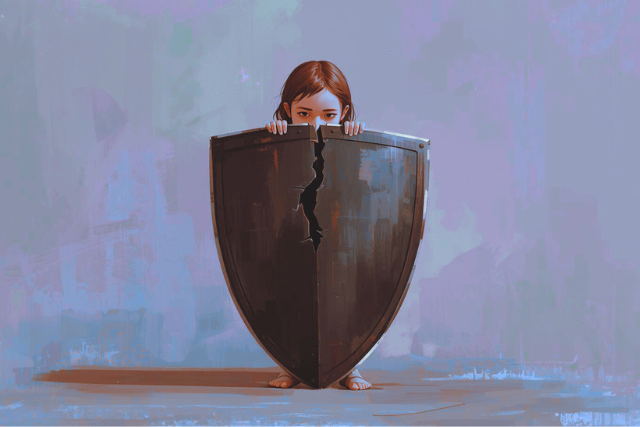
But not all trauma is rooted in fear. Some wounds come from betrayal—when something violates our sense of right and wrong, and we’re left to carry the cost alone.
This kind of injury doesn’t happen simply because something bad occurred. It happens because a moral line was crossed—by a person, an authority, or a system we believed would protect us. What follows isn’t just pain but a lasting psychological and relational aftermath.
I didn’t have language for this when it first happened. I was a child.
When Telling the Truth Didn’t Protect Me
I was sitting in class, staring at a stack of worksheets I hadn’t done. My body was there, but I wasn’t.
My teacher walked over and asked if I was okay.
She hadn’t asked all year. I often came to school dirty and exhausted. But that day, she kept pressing. She told me I wouldn’t get in trouble if I told the truth.
What made that promise complicated was that she kept a paddle in her classroom. She had used it on other children. I knew eventually it would be my turn too.
Still, she was an adult. And at that point, she felt like the last one I could trust.
I told her because she had knowledge and power—the kind that looked enormous from where I stood. She knew things I didn’t. She could do things I couldn’t. I believed that if anyone could stop what was happening, it would be someone like her.
So I told her.
I told her about the beatings. About being afraid to go home. About my stepmother. About my stepsister.
She promised she would make sure it stopped.
It didn’t.
Child Protective Services came to the house that week. They knocked. No one answered. They left.
And then I got in trouble.
She was the last adult I trusted after that.
The Injury Beneath the Fear
The deepest wound wasn’t only what was happening at home.
It was what happened afterward.
Moral injury occurs when someone witnesses, fails to prevent, or is betrayed by actions that violate deeply held moral beliefs. Sometimes it comes from what someone does. Sometimes from what they don’t do. And sometimes from betrayal—when people with power fail to follow through.
That was the line that was crossed.
I told the truth. An adult promised protection. Systems designed to intervene did not act. The transgression wasn’t just the abuse—it was the abandonment that followed.
What formed inside me wasn’t panic, but something quieter. Shame instead of fear. Guilt instead of anger. The belief that speaking up had been dangerous.
How the Past Followed Me into Adulthood
As I grew older, I gravitated toward helping roles. I became a teacher and, later, a school counselor.
That wasn’t accidental.
Some part of me needed to believe the world was fundamentally good—that if harm was named clearly enough, goodness and protection would follow.
So I became someone who spoke it.
I reported abuse. I advocated for children being harmed by people with more power. I documented, escalated, followed procedure. I fought hard while watching others step back because the fight was too complicated, too much work, too political, or too costly.
For a long time, I believed persistence itself could redeem the system.
But over time, reality answered differently.
I did everything I was supposed to do—and still watched the system fail. Children continued to be harmed. Responsibility was diffused. Truth was acknowledged and then neutralized.
Letting go of the belief that goodness would automatically prevail required a grief I didn’t expect.
When Helping Became Reenactment
Eventually, I had to face something harder to admit.
Much of my relentless drive to protect others wasn’t only altruism. It was also trauma reenactment.
Every vulnerable child I encountered carried the outline of the little girl I once was—the one who spoke up and wasn’t protected. Each situation activated the same urgency: This time, it will be different.
What I see more clearly now is how much of my fighting was about wanting to know that I mattered. Somewhere along the way, that truth became contingent on whether the outside world acknowledged it.
What I’m untangling now is more specific. When a child came to me needing help, some part of me believed that if I could protect them, they would know they mattered. And in some quiet, unconscious way, the little girl inside me would finally know she mattered too.
I didn’t know I was doing this. It wasn’t a strategy or a choice. It was the nervous system trying to complete something unfinished—trying to repair a moment when care didn’t come and power didn’t protect.
The problem wasn’t compassion. The problem was scope.
I was trying to use personal sacrifice to repair systemic failure, taking responsibility for outcomes I didn’t have the power to control. And each time those efforts failed, the old injury reopened.
The Grief That Came with Clarity
And now, I’m tired.
After years of fighting—naming harm, pushing back, insisting on accountability—I’ve reached a point where my body and mind can no longer absorb the cost. Not because I’ve stopped caring, and not because the world has become safer or fairer.
But because staying in constant resistance has a price I can no longer pay.
Fighting was how I claimed agency in a world that once taught me I didn’t matter. I needed to do it until I couldn’t anymore.
I let the anger burn all the way through.
Now, what remains are embers.
They still flicker when I witness harm that feels familiar or systems repeating the same failures. But I’m no longer living inside the fire. I’m more interested now in protecting my peace, my space, and the life I’m building.
Trauma Reenactment Versus Trauma Repair
This has left me with different questions.
As we watch the world burn—politically, socially, relationally—how do we know when we’re responding from present-day agency and when the past is quietly repeating itself?
Trauma reenactment often feels urgent and compulsory. Trauma repair feels chosen.
Both can look like caring. Both can look like action. The difference isn’t always visible on the outside.
The distinction lives inside.
A Different Kind of Alignment
So the question becomes: Where are you leaning in because it comes from your present-day values—and where might an old moral wound be asking you to repeat what you once survived?
This doesn’t mean you have to stop helping. It doesn’t mean you disengage from the world.
It simply means you notice.
And sometimes, that noticing is the shift.
I’ve come to see that my worth is not contingent on being believed or vindicated. My protection is not dependent on whether systems respond the way they should. What matters now is staying aligned with my internal compass, keeping my boundaries intact, and being careful about what—and who—I allow close.
It looks like pausing before leaping in and asking: “Am I doing this because it’s right or because I still need to be righted?”
It looks like no longer sacrificing sleep or peace for institutions that count on burnout to win.
It looks like choosing to care, but not to collapse.
It looks like letting others step up, especially those who have been silent. Because stepping back isn’t the same as stepping away. And it’s not complicity to rest when you’ve been carrying more than your share—it’s clarity.
There are too many who’ve stayed quiet, waiting for someone else to do the hard thing. That silence is a kind of complicity. But continuing to over-function while others under-function only reinforces the imbalance.
And sometimes, others won’t step up. The harm will persist. And you will face the ache of knowing that justice still hasn’t come—and might not.
That’s when grief enters. Not panic, not frenzy. But a steady mourning for what remains broken.
And with that grief comes a deeper truth: you are one person in a world of eight billion. You are not the whole solution. You never were.
This is not about quickness or fiery force. This is about sustainability. Endurance. Staying intact.
So now, I do the work differently.
I walk beside the adult survivors who come to me. Not on the front line but the second. They have agency now. They have a choice. And we work together, not so I can fight their battles, but so they can reconnect with the child inside them who wasn’t protected and learn how to protect that part of themselves now.
Because when they do that—when they fight for themselves—they are fighting for others too. For every child who was never protected. For every person still finding their voice.
We all have our own way of showing up. And no one’s path should require the erasure of another’s.
It looks like saying no even when you could say yes. It looks like letting silence be enough when your voice has already spoken.
It looks like honoring your own limits as sacred—because they are.
I will never again allow people or systems access to my inner life if they require me to fight for my emotional integrity.
Maybe this kind of discernment doesn’t save the world.
But maybe it lets us stay in the world with our wholeness intact. Maybe it lets us keep caring—without self-erasure. Maybe it even calls others forward.
And maybe that’s how real repair begins.
About Allison Briggs
Allison Jeanette Briggs is a therapist, writer, and speaker specializing in helping women heal from codependency, childhood trauma, and emotional neglect. She blends psychological insight with spiritual depth to guide clients and readers toward self-trust, boundaries, and authentic connection. Allison is the author of the upcoming memoir On Being Real: Healing the Codependent Heart of a Woman and shares reflections on healing, resilience, and inner freedom at on-being-real.com.
See a typo or inaccuracy? Please contact us so we can fix it!
