

Key Takeaways
- Repression is when the mind unconsciously hides upsetting feelings or memories.
- Repressed thoughts can cause stress, anxiety, or even physical symptoms.
- Suppression is when someone consciously chooses to ignore painful thoughts.
Repression is the unconscious blocking of unpleasant emotions, impulses, memories, and thoughts from your conscious mind. First described by Sigmund Freud, the purpose of this defense mechanism is to try to minimize feelings of guilt and anxiety.
However, while repression might initially be effective at calming these difficult emotions, it can lead to greater anxiety down the road. Freud believed that repression could lead to psychological distress.
Repression vs. Suppression
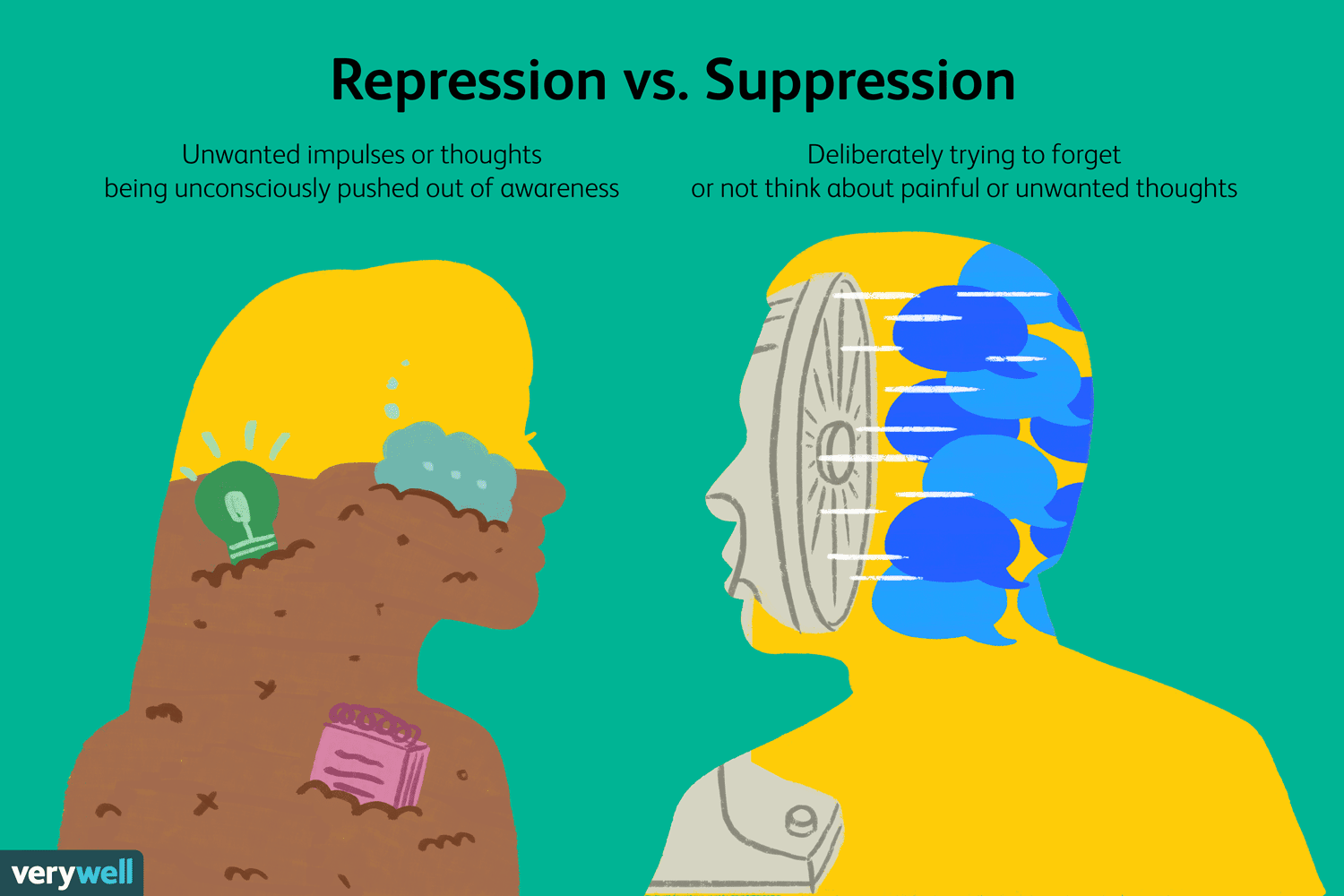
Repression is often confused with suppression, another type of defense mechanism. Where repression involves unconsciously blocking unwanted thoughts or impulses, suppression is entirely voluntary. Specifically, suppression is deliberately trying to forget or not think about painful or unwanted thoughts.
History of Repression
In order to understand how repression works, it is important to look at how Sigmund Freud viewed the mind. Freud conceived of the human mind as being much like an iceberg.
The top of the iceberg that you can see above the water represents the conscious mind. The part of the iceberg that is submerged below the water, but is still visible, is the preconscious. The bulk of the iceberg that lies unseen beneath the waterline represents the unconscious. We may not be aware of what lies in the unconscious, but its contents can still affect our behavior in a number of different ways.
Freud believed that the unconscious mind has a powerful impact on personality and could potentially lead to psychological distress.
As Freud worked to help patients uncover their unconscious feelings, he began to believe that there was some mechanism at work that actively kept unacceptable thoughts hidden. This led to his development of the concept of repression.
Repression was the first defense mechanism Freud identified and he believed it to be the most important. In fact, the entire process of Freudian psychoanalysis focused on bringing these unconscious feelings and urges into awareness so they could be dealt with consciously.
Signs of Repression
Freud suggested that repression could be linked to physical symptoms. Research has identified various signs and symptoms associated with repressed emotions, including:
- High Blood Pressure
- Skin Conditions
- Fatigue
- Obesity
- Headache
- Dizziness
- Pain in the Back, Neck, Chest, and Abdomen
Psychologically, repression may lead to stress, anxiety, and depression. Some evidence indicates that accepting rather than repressing negative emotions could improve stress response and promote psychological health.
Behavioral signs of repression might include difficulty discussing thoughts or feelings and defensiveness when asked about them. Individuals may also feel numb or engage in activities like drinking alcohol or spending excessive time on social media to avoid confronting difficult emotions.
How Repression Is Used
Repression is one way the mind handles difficult thoughts or emotions and can sometimes be helpful. A research review concluded that distorting reality through repression often improves psychological and social functioning. People with a repressive coping style may experience less depression and cope better with pain.
Other research indicates that repressive coping is more common in older adults, suggesting it develops over time. It is also linked to better well-being. However, using repression to avoid confronting difficult experiences and feelings can have significant consequences.
Impact of Repression
Research supports that selective forgetting can block awareness of unwanted thoughts or memories. This can occur through retrieval-induced forgetting.
Retrieval-induced forgetting happens when recalling certain memories makes related information harder to access. For example, frequently retrieving positive memories might make traumatic or unwanted memories less accessible.
Repression and Dreams
Freud believed that dreams were one way to peek into the unconscious mind. By analyzing the manifest content of dreams (or the literal events that take place in a dream), he believed that we could learn more about the latent content of the dream (or the symbolic, unconscious meanings).
Repressed feelings may pop up in the fears, anxieties, and desires that we experience in these dreams.
Repression and Slips of the Tongue
Freudian slips of the tongue are another example of how repressed thoughts and feelings can make themselves known. Freud believed that mistaken slips of the tongue could be very revealing, often showing what we really think or feel about something on an unconscious level.
While these feelings may be repressed, they have a way of sneaking out when we least expect them. Calling your romantic partner the name of someone you work with might just be a simple mistake—but Freud would suggest that it might be a sign that you have repressed sexual desires for that co-worker.
Repression and the Oedipus Complex
In his theory of psychosexual development, Freud suggested that children go through a process during the genital stage where they initially view their same-sex parent as a rival for the opposite-sex parent’s affections. In order to resolve this conflict, they repress these feelings of aggression and instead begin to identify with their same-sex parent.
Repression and Phobias
Phobias can be an example of how a repressed memory might continue to exert an influence on behavior. For example, a young child is bitten by a dog. They later develop a severe phobia of dogs but have no memory of when or how this fear originated. They have repressed the painful memory of the fearful experience with the dog, so they are unaware of exactly where their fear came from.
Controversies About Repression
The notion of repressed memories, or the existence of memories that are so painful or traumatic that they are kept out of conscious awareness, has been a controversial topic in psychology.
Repression and Psychoanalysis
While repression is a term frequently used in psychology, it is considered a loaded and controversial concept. It has long served as a core idea within psychoanalysis, yet critics have questioned the validity and even the existence of repression.
Psychoanalytic theory suggests that repression plays a role in distorting an individual’s reality, which may then lead to neurosis and dysfunction. However, some research suggests that these distortions may have a beneficial impact in some circumstances.
It is also important to note that even if repression does exist and certain things are hidden from awareness, this does not mean that this process necessarily contributes to mental disorders.
While it was once thought that psychoanalysis helped people by surfacing repressed memories, it is currently believed that there are many other therapeutic actions that contribute to the success of any type of psychological therapy, psychoanalysis or otherwise.
Repression and Memory
Repressed memories came to the spotlight during the 1980s and 1990s when a number of high-profile cases involving recovered memories of childhood abuse captured media attention.
Researchers such as Elizabeth Loftus have repeatedly demonstrated that false memories of events that did not actually happen form quite readily. People are also prone to confabulation of memories. People may fully believe that such memories are accurate, even though the events did not actually occur as remembered.
Freud himself noted that people sometimes experienced a “recovery” of repressed childhood memories during the course of psychoanalytic therapy. In his book “Introductory Lectures on Psychoanalysis,” he concluded that “these scenes from infancy are not always true. Indeed, they are not true in the majority of cases, and in a few of them they are the direct opposite of the historical truth.”
One of the key assumptions in the classic tradition of psychoanalysis has been that traumatic memories can be repressed. However, most research has found that trauma actually tends to heighten memory of the painful event.
In many cases, trauma can actually strengthen the memory of an event. People may develop post-traumatic stress disorder (PTSD) as a result of traumatic experiences, causing them to experience vivid flashbacks of the events. Rather than experiencing repression of the painful memories, people relive them again and again, involuntarily.
This does not necessarily mean that memories of these events are completely accurate. Memory distortions are common, especially because the encoding, storage, and retrieval processes are prone to errors.
While Freud believed that lifting repression was the key to recovery, this has not been supported by research. Instead, some experts believe that bringing repressed material to light can be the first step toward change. Understanding something, after all, is not enough to fix a problem. But it can lead to further efforts that may result in real relief and lasting changes.
Frequently Asked Questions
-
Why is repression considered the most basic ego defense mechanism?
Repression is considered the basis of all other defense mechanisms because it fundamentally affects conscious awareness. If an uncomfortable thought, memory, or emotion is repressed, the conscious mind is not aware of it and therefore does not need to, or have the opportunity to, employ any other defense mechanisms.
-
What are some examples of repression?
Incidents that prompt fears or phobias may be repressed. For example, a child may have a bad experience in a swimming pool and later develop a fear of water, but not connect the two. Or, the mind may cope with other uncomfortable experiences or thoughts by repressing them. These could include anything from being ridiculed by a classmate to losing a pet to neglect or abuse.
-
How do you know if you have repressed something?
If you have repressed something, you might see some physical or emotional signs, such as stress, anxiety, or chronic pain. You might notice behavioral signs, such as discomfort with talking about your feelings. You might even discover that you and a loved one have different recollections of certain events or situations.
If you are concerned about how you are reacting to stress or to past or present life experiences, talking with a therapist may be helpful. A therapist can help you learn healthy coping skills.
-
Which is worse, suppression or repression?
Suppression is generally regarded as a mature, healthy defense mechanism. It allows people to cope with distress by consciously blocking something painful from awareness until the individual is better able to respond. Repression, while sometimes useful, tends to lead to greater psychopathology.
-
What is the difference between repressed and suppressed emotions?
Suppressed emotions are ones that are consciously withheld. It can sometimes be an effective strategy that allows people to deal with an emotion at a more appropriate time. Repressed emotions are those that are unconsciously avoided. They are often removed from awareness before a pereson has a chance to process them. People raised in households where they were shamed or punished for their emotions may be more likely to engage in emotional repression.
-
What is an example of suppression?
An example of suppression might be suppressing your feelings of anger when a co-worker makes an insensitive comment. You might use strategies like deep breathing or counting to ten to avoid reacting and put the thought out of your mind. After work, you might then revisit your feeling when you vent about your day to your friends.
