

Key Takeaways
- Splitting is a symptom of borderline personality disorder where a person sees everything as black or white.
- Understanding splitting can help you support someone with borderline personality disorder.
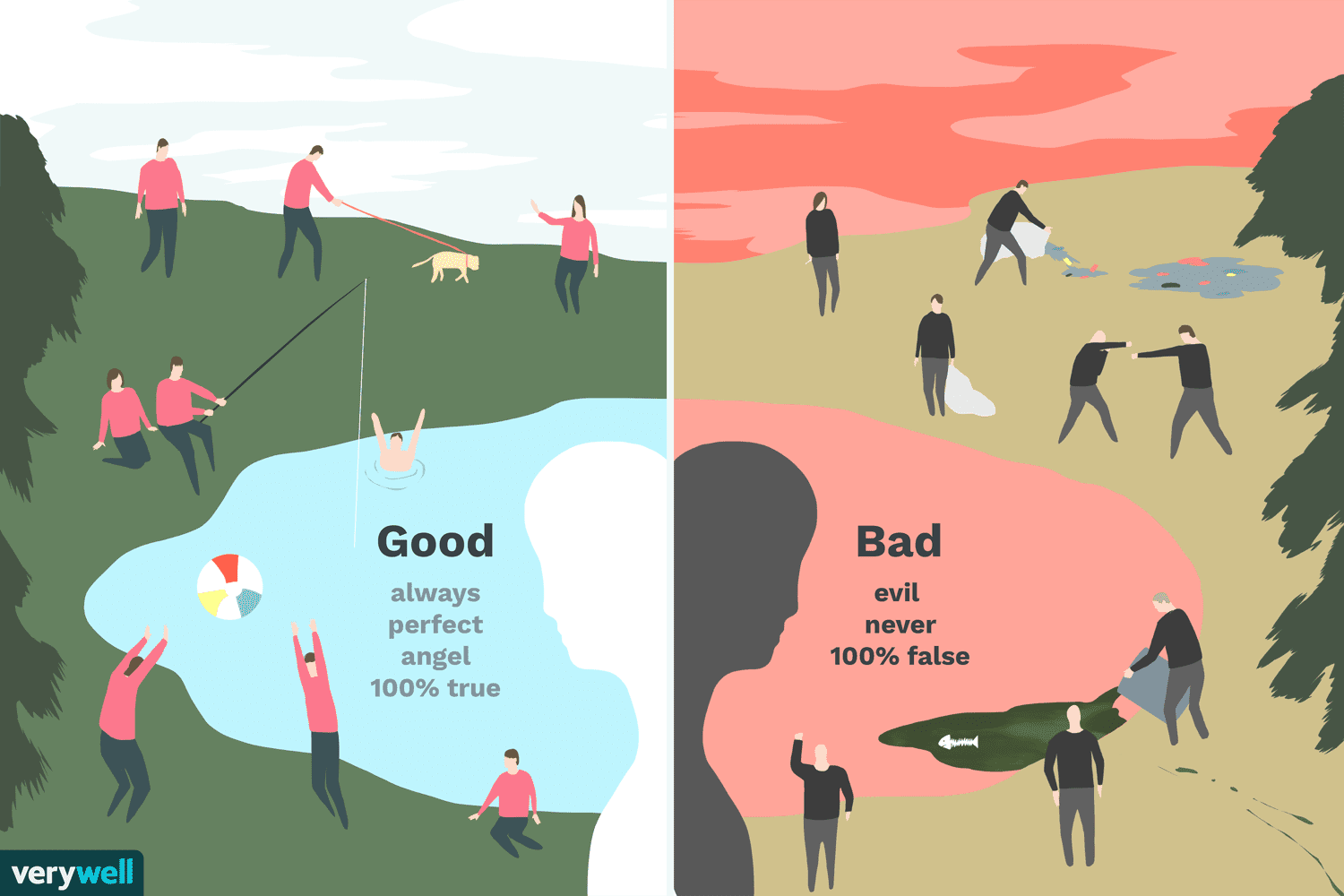
Splitting is a term used in psychiatry to describe the inability to hold opposing thoughts, feelings, or beliefs. Some might say that a person who splits sees the world in terms of black or white—all or nothing. It’s a distorted way of thinking in which the positive or negative attributes of a person or event are neither weighed nor cohesive.
Verywell / Hugo Lin
Common in those with borderline personality disorder (BPD), splitting is considered a defense mechanism by which people with BPD view others, events, or even themselves in all-or-nothing terms. Splitting allows them to readily discard things they have assigned as “bad” and to embrace things they consider “good,” even if those things are harmful or risky.
Click Play to Learn More About Splitting
Effects of Splitting
Splitting can interfere with relationships and lead to intense and self-destructive behaviors. A person who splits will typically frame people or events in terms that are absolute, with no middle ground for discussion.
Examples
Examples of splitting behavior may include:
- Opportunities can either have “no risk” or be a “complete con”
- People can either be “evil” and “crooked” or “angels” and “perfect”
- Science, history, or news is either a “complete fact” or a “complete lie”
- Things are either “always” or “never”
- When things go wrong, a person will feel “cheated,” “ruined,” or “screwed”
What makes splitting all the more confusing is that the belief can sometimes be iron-clad or shift back and forth from one moment to the next. People who split are often seen to be overly dramatic or overwrought, especially when declaring that things have either “completely fallen apart” or “completely turned around.” Such behavior can be exhausting to those around them.
Symptoms
By itself, splitting may seem almost commonplace, a behavior easily attributed to any number of individuals we know and maybe even ourselves. However, splitting in BPD is considered a consistent and distorted behavior usually accompanied by other symptoms, such as:
- Acting out (acting without consideration to consequences)
- Denial (consciously ignoring a fact or reality)
- Emotional hypochondriasis (trying to get others to understand how severe your emotional pain is)
- Omnipotence (the belief that you possess superiority in intelligence or power)
- Passive aggression (an indirect expression of hostility)
- Projection (assigning an undesirable emotion to someone else)
- Projective identification (denying your own feelings, projecting them onto someone else, and then behaving toward that person in a way that forces them to respond to you with the feelings you projected onto them)
Diagnosis and Management
Understanding the process of diagnosis and the careful management of borderline personality disorder can be helpful in understanding behaviors like splitting that are associated with the condition.
Diagnosis
A BPD diagnosis can only be made by a qualified mental health specialist. To make the diagnosis, the doctor would need to confirm five of nine symptoms outlined in the Diagnostic and Statistical Manual of Mental Disorders (DSM-5-TR), including:
- A warped view of yourself that affects your emotions, values, moods, and relationships
- Anger issues, such as violent outbursts followed by extreme guilt and remorse
- Extreme attempts to avoid abandonment or extreme feelings of abandonment
- Extreme depression, anxiety, or irritability that can persist for hours and days
- Feeling dissociated from yourself, including paranoia and amnesia
- Feeling persistently empty or bored
- Impulsive behavior, such as abusing substances or driving recklessly
- Intense and stormy relationships that involve splitting
- Suicidal thoughts and/or self-harming behaviors
Caring and Management
There is no easy answer on how to deal with a loved one who has BPD, especially when symptoms are extreme. How you cope depends largely on the nature of your relationship and the impact your loved one’s symptoms are having on your family.
However, there are some guiding principles that may help, including:
- Cultivate empathy. Start by reminding yourself that splitting is part of the disorder. While certain actions may seem intentional and manipulative, your loved one is not doing any of this to gain satisfaction. These are simply defense mechanisms they turn to whenever they feel defenseless.
- Encourage and support treatment. Your loved one can live a better life with treatment, which may include medication and/or talk therapy, most likely dialectical behavior therapy (DBT). Encourage them to start or continue with treatment, and learn everything you can about what they are going through. If needed, participate in therapy with your loved one.
- Maintain lines of communication. Discussing a situation when it happens allows you to isolate that event rather than piling one situation on top of the next. Failure to communicate only serves to fuel your loved one’s rejection anxiety.
- Remind your loved one that you care. People with BPD are often terrified of being rejected or abandoned. Knowing that someone cares often helps reduce the splitting behavior.
- Set boundaries. Dealing with the challenges of BPD is one thing; becoming the object of abuse is another. Always set limits with a loved one who has BPD. If that line is ever crossed, explain why you are backing away, and try to do so dispassionately. Setting boundaries helps preserve the relationship rather than challenging it.
- Take care of yourself. This may include finding your own therapist to help you balance your needs along with those of your loved one.
- Try to manage your response. If your loved one has BPD, keep in mind that you are in a better position to control your temper. Yelling or engaging in hostility will only serve to make the situation even worse.
Get Help Now
We’ve tried, tested, and written unbiased reviews of the best online therapy programs including Talkspace, Betterhelp, and Regain. Find out which option is the best for you.
Safety
There may be times where you will need to take more drastic action. In the event that the relationship is harming your family, your work, and your sense of well-being, you may be faced with the reality that the relationship cannot continue.
While this is an incredibly painful choice for everyone involved, it can also be the healthiest one in some cases. If needed, this decision should be made with the help of a qualified mental health professional.
Thanks for your feedback!
What is your feedback?
Helpful
Report an Error
Other
