

Key Takeaways
- Child development theories help explain how children grow socially, emotionally, and cognitively over time.
- Understanding child development is valuable for appreciating the physical, emotional, and educational growth children experience from birth to early adulthood.
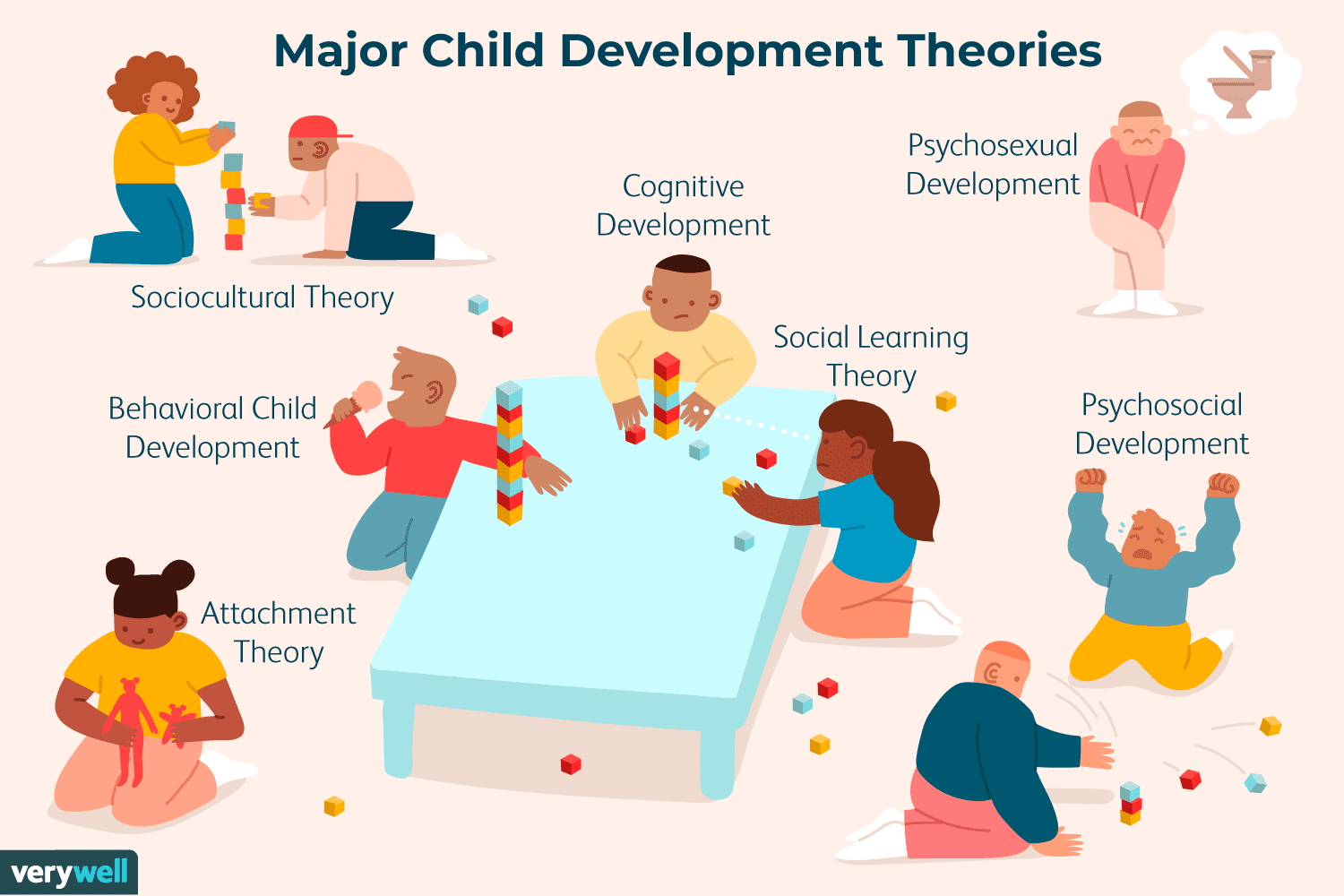
Why do children behave the way they do at different ages? Child development theories explain how children grow, learn, and develop over time. Such theories include Piaget’s cognitive stages, Freud’s psychosexual stages, Vygotsky’s sociocultural theory, Bandura’s social learning theory, behavioral theory, and Erikson’s psychosocial stages.
These theories focus on key areas of development, including cognitive, social, emotional, and behavioral changes. These theories help us understand, explain, and predict behaviors that occur throughout the lifespan.
Verywell / JR Bee
1. Piaget’s Cognitive Developmental Theory
Cognitive theory explores the development of a person’s thought processes. It also looks at how these thought processes influence how we understand and interact with the world.
Theorist Jean Piaget proposed one of the most influential theories of cognitive development.
Piaget proposed an idea that seems obvious now, but helped revolutionize how we think about child development: Children think differently than adults.
Piaget’s cognitive stages of development describes and explains the development of thought processes and mental states. It also looks at how these thought processes influence the way we understand and interact with the world.
Piaget then proposed a theory of cognitive development to account for the steps and sequence of children’s intellectual development.
- Sensorimotor stage: A period of time between birth and age two during which an infant’s knowledge of the world is limited to his or her sensory perceptions and motor activities. Behaviors are limited to simple motor responses caused by sensory stimuli.
- Pre-operational stage: A period between ages 2 and 6 during which a child learns to use language. During this stage, children do not yet understand concrete logic, cannot mentally manipulate information, and are unable to take the point of view of other people.
- Concrete operational stage: A period between ages 7 and 11 during which children better understand mental operations. Children begin thinking logically about concrete events but have difficulty understanding abstract or hypothetical concepts.
- Formal operational stage: A period between age 12 and adulthood when people develop the ability to think about abstract concepts. Skills such as logical thought, deductive reasoning, and systematic planning also emerge during this stage.
2. Vygotsky’s Sociocultural Theory
Another psychologist named Lev Vygotsky proposed a seminal learning theory that has gone on to become very influential, especially in the field of education. Like Piaget, Vygotsky believed that children learn actively and through hands-on experiences.
His sociocultural theory also suggested that parents, caregivers, peers, and the culture at large were responsible for developing higher-order functions.
In Vygotsky’s view, learning is an inherently social process. Through interacting with others, learning becomes integrated into an individual’s understanding of the world.
This child development theory also introduced the concept of the zone of proximal development, defined as the gap between what a person can do with support and what they can do independently. With the help of more knowledgeable others, people can progressively learn and expand their skills and understanding.
3. Erikson’s Psychosocial Developmental Theory
Psychoanalytic theory was an enormously influential force during the first half of the twentieth century. Those inspired and influenced by Freud went on to expand upon Freud’s ideas and develop theories of their own. Of these neo-Freudians, Erik Erikson’s ideas have become perhaps the best known.
Erikson’s eight-stage theory of psychosocial development describes growth and change throughout life, focusing on social interaction and conflicts that arise during different stages of development. His eight-stage theory of human development described this process from infancy through death:
- Unlike many other developmental theories, Erik Erikson’s psychosocial theory focuses on development across the entire lifespan.
- At each stage, children and adults face a developmental crisis that serves as a major turning point, impacting later functioning and further growth.
- Successfully managing the challenges of each stage leads to the emergence of a lifelong psychological virtue.
While Erikson’s theory of psychosocial development shared some similarities with Freud’s, it is dramatically different in many ways. Rather than focusing on sexual interest as a driving force in development, Erikson believed that social interaction and experience played decisive roles.
4. Freud’s Psychosexual Developmental Theory
Psychoanalytic theory originated with the work of Sigmund Freud. Through his clinical work with patients suffering from mental illness, Freud came to believe that childhood experiences and unconscious desires influenced behavior.
Developmental Conflicts
According to Freud, conflicts that occur during each of these stages can have a lifelong influence on personality and behavior. Freud proposed one of the best-known grand theories of child development.
Freud’s psychosexual theory suggests that child development occurs in a series of stages focused on different pleasure areas of the body.
- During each stage, the child encounters conflicts that play a significant role in development.
- The energy of the libido is focused on different erogenous zones at specific stages.
- Failure to progress through a stage can result in fixation at that point in development, which Freud believed could influence adult behavior.
- Successfully completing each stage leads to the development of a healthy adult personality.
Failing to resolve the conflicts of a particular stage can result in fixations that can then have an influence on adult behavior.
While some other child development theories suggest that personality continues to change and grow over the entire lifetime, Freud believed that early experiences play the greatest role in shaping development. According to Freud, personality is largely set in stone by the age of five.
5. Behavioral Child Development Theories
During the first half of the twentieth century, a new school of thought known as behaviorism rose to become a dominant force within psychology. Behaviorists believed that psychology needed to focus only on observable and quantifiable behaviors to become a more scientific discipline.
Behavioral theories of child development focus on how environmental interaction influences behavior and are based on the work of theorists such as John B. Watson, Ivan Pavlov, and B. F. Skinner. These theories deal only with observable behaviors. Development is considered a reaction to rewards, punishments, stimuli, and reinforcement.
Two important types of learning that emerged from this approach to development are classical conditioning and operant conditioning.
- Classical conditioning involves learning by pairing a naturally occurring stimulus with a previously neutral stimulus.
- Operant conditioning utilizes reinforcement and punishment to modify behaviors.
This theory differs considerably from other child development theories because it gives no consideration to internal thoughts or feelings. Instead, it focuses purely on how experience shapes who we are.
6. Bowlby’s Attachment Theory
There is extensive research on the social development of children. John Bowlby proposed one of the earliest theories of social development. Bowlby believed that early relationships with caregivers play a major role in child development and continue to influence social relationships throughout life.
Bowlby’s attachment theory suggested that:
- Children are born with an innate need to form attachments.
- Such attachments aid in survival by ensuring that the child receives care and protection.
- These attachments are characterized by clear behavioral and motivational patterns.
In other words, both children and caregivers engage in behaviors designed to ensure proximity. Children strive to stay close and connected to their caregivers, who in turn provide a safe haven and a secure base for exploration.
Researchers have also expanded upon Bowlby’s original work and have suggested that a number of different attachment styles exist:
- Secure attachment: Children who receive consistent support and care are more likely to develop a secure attachment style.
- Insecure attachment: Those who receive less reliable care may develop an ambivalent, avoidant, or disorganized style.
7. Bandura’s Social Learning Theory
Social learning theory is based on the work of psychologist Albert Bandura. Bandura believed that the conditioning and reinforcement process could not sufficiently explain all of human learning.
For example, how can the conditioning process account for learned behaviors that have not been reinforced through classical conditioning or operant conditioning? According to social learning theory:
- Behaviors can be learned through observation and modeling.
- By observing the actions of others, including parents and peers, children develop new skills and acquire new information.
- Observation plays a critical role in learning, but this observation does not necessarily need to take the form of watching a live model.
- People can also learn by listening to verbal instructions about how to perform a behavior.
- They can also learn by observing real or fictional characters exhibiting behaviors in books or films.
Types of Child Development Theories
Many child development theories have been proposed by theorists and researchers. These include:
- Grand theories: These attempt to describe every aspect of development, often using a stage approach.
- Mini-theories: These instead focus only on a fairly limited aspect of development, such as cognitive or social growth.
How These Theories Are Used Today
While not all of these theories are fully accepted today, they all had an important influence on our understanding of child development.
Today, contemporary psychologists often draw on a variety of theories and perspectives to understand how children grow, behave, and think. These theories represent just a few of the different ways of thinking about child development.
In reality, fully understanding how children change and grow over the course of childhood requires looking at many different factors that influence physical and psychological growth. This includes:
- Genes
- The environment
- The interactions between the two
Understanding these forces helps researchers and parents determine how kids grow physically as well as mentally.
Why Child Development Theories Matter
Developmental theories provide a framework for thinking about human growth and learning. But why do we study development? What can we learn from psychological theories of development? If you have ever wondered about what motivates human thought and behavior, understanding these theories can provide useful insight into individuals and society.
An understanding of child development is essential because it allows us to fully appreciate the cognitive, emotional, physical, social, and educational growth that children go through from birth to early adulthood.
History of Child Development Theories
While we spend a lot of time today talking about how kids grow and change over the course of childhood, that hasn’t always been the case. In fact, the child development that takes place from birth to adulthood was largely ignored throughout much of human history.
Children were often viewed simply as small versions of adults. Little attention was paid to the many advances in cognitive abilities, language usage, and physical growth that occur during childhood and adolescence.
Interest in child development emerged early in the 20th century, but it tended to focus on abnormal behavior. Eventually, researchers became increasingly interested in other topics, including typical child development and the influences on development.
More recent theories outline the developmental stages of children and identify the typical ages at which these growth milestones occur.
