

We may earn a commission from links on this page.
I just got back from CES 2026, and you can see my real-time reports on some of the best and weirdest things I saw in our CES 2026 live blog. I tried on six(!) different exoskeletons, perked up my ears whenever I heard about a new smart strap, and looked in vain for new models of familiar fitness tech like watches. Here are the biggest trends I noticed and some notes on what was conspicuously missing. I’ve included prices where possible; anything without a price is likely too far from market to have one yet.
The number of non-Whoop smart bands just doubled
Luna band (underside)
Credit: Beth Skwarecki
This is a continuation of a trend that really got going in 2025. Whoop is no longer the only player in the screenless fitness strap space. Last year we saw straps from Amazfit ($99) and Polar ($199), plus a sleep band from Garmin ($169). At CES I learned about two more.
The Luna Band is likely to be the next one to market—the company’s reps said to expect it to ship sometime in the next month or two. (I plan to review it once units are available.) It will be $149, won’t require a subscription, and it will use the same app as the Luna Ring, which I’m currently reviewing. Its maker, Noise, is new to the U.S. wearables market but is one of the leading smartwatch makers in India.
Besides the new hardware, Noise also announced that the Luna app will soon have a system to take voice notes to give context to your health data. (This is coming to the app in the next few weeks.) For example, if you tell the app that you had a few glasses of wine, it will remember this when it sees your poor sleep the next morning, and it will adjust its recommendations accordingly—say, reminding you to hydrate, rather than telling you to take a nap.
Speediance Strap prototypes
Credit: Beth Skwarecki
Speediance also announced the Speediance Strap, although it doesn’t seem to be as close to market. No price has been announced, and the units at the show were clearly prototypes. The Strap will collect sleep and recovery data, without requiring a subscription to view it, although some more advanced metrics will require a premium subscription.
Rings are everywhere
RingConn gen 3
Credit: Beth Skwarecki
Oura has had competitors for years (and has taken up suing them to stop sales), but it seems like the number of smart rings out there is just exploding—though not all of them are fitness or health oriented. Besides Pebble’s Index 01 ($75), which is charmingly simple, there are plenty of rings that pack in more functions—NFC payments, AI voice processing, haptic alerts, and more. There are so many I can’t give a full list, but to name a few: there’s the Muse Ring One ($323), the Dreame Ring, and the Vocci AI ring.
RingConn announced its third-generation ring, with blood pressure insights (I’m skeptical) and haptic alerts, including the ability to buzz for a smart alarm (I’m intrigued). This one isn’t on the market yet, and a rep at the booth asked me what price I thought it should go for. In the meantime, RingConn gave me a gen 2 ring to compare to Oura and others—watch for my review soon.
Watches (mostly) aren’t exciting anymore
Credit: Beth Skwarecki
The companies that make smartwatches and fitness watches tend to be on their own release cycles, not necessarily tied to CES. Apple certainly wasn’t going to announce a new Apple Watch; Google and Fitbit didn’t show up, either. Amazfit had a new watch, the Active Max ($169) in its lineup, but it was more of a refinement to the product line than a new exciting announcement.
The only real exception I can think of is Pebble, but you’ve heard from me already on why it bucks the trend. I got to go hands-on with the Time 2 (announced last year) and the Round 2 (announced last week), which was so thin and sleek it made the Coros on my wrist feel like a big ol’ hunk of plastic. As a reminder, the Round 2 doesn’t have a heart rate monitor and Pebble is trying not to be a fitness watch brand. (I’m still looking forward to reviewing its watches anyway.)
Pebble Time 2
Credit: Beth Skwarecki
I think the main reason for the stagnation here is that watches already have everything they need to have for fitness and health tracking. There’s not a lot of room left to innovate; either you give a device slightly better battery life (nice, but yawn) or you stick something else into it just to say you did—like a flashlight or a microphone. That’s nothing against flashlights or microphones, which are both great in context, but we’re hardly in game-changing territory anymore. Companies like Oura and Whoop are pivoting to services like blood tests that take the focus off their hardware. My colleague Stephen Johnson said it best: tech launches don’t feel magical anymore, partly because we don’t have many problems left that consumer tech can easily solve, and partly because every new advice adds a hassle to your life.
And so Garmin’s main announcement this weekend was a nutrition tracking feature in its Connect+ subscription. I thought at least there was a good chance of a new watch from Garmin—nope. Garmin announced the Instinct 3 at last year’s CES, but no new hardware this year besides a camera system for truckers (I’m happy for them).
What do you think so far?
A few other companies used the buzz around CES to announce non-hardware developments as well: Oura is finally shipping the charging case it promised last fall, and Ultrahuman announced a limited-time free tier of its blood testing service with 20+ markers. Its other tiers give you 50+ markers for $99, or a 100+ marker test followed by a 60+ marker follow-up test for $365. (Ultrahuman told me that the exact blood tests it’s able to offer vary slightly by state, hence the vague numbers.)
AI was present, but not center stage
A prototype of Amazfit’s V1TAL camera, which analyzes the food on your plate
Credit: Beth Skwarecki
There were, of course, plenty of mentions that “AI” is baked into this or that fitness app. But the companies mostly seemed to understand that while AI might help to create features their users want, users don’t buy devices for the AI. (See also: Dell executives commenting that its customers don’t seem to want AI, and that it has adjusted the marketing for its computers to de-emphasize it.)
I heard at CES that apps are using AI to identify foods from photos (Garmin and Amazfit) or that AI is helping to find patterns in data (basically everybody). Merach did say it would let me try an AI-powered treadmill, but a rep apologetically told me the device wasn’t available in time to ship the prototype to CES.
They’re trying to make exoskeletons happen
The Sumbu hip-based exoskeleton
Credit: Beth Skwarecki
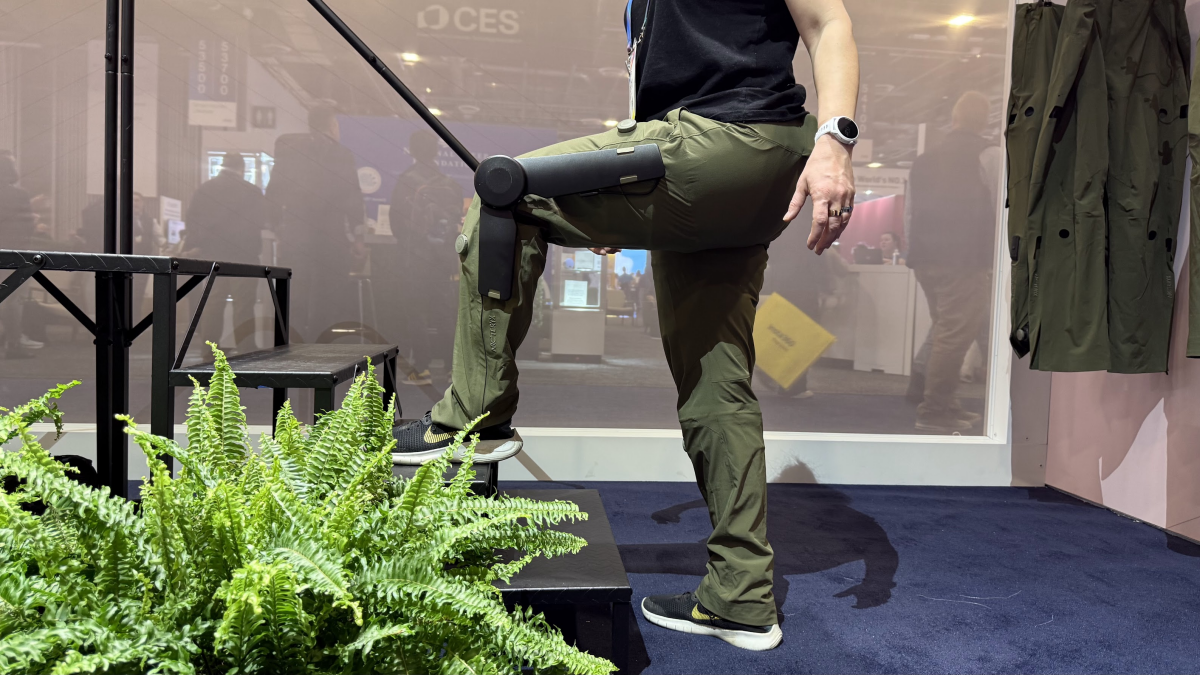
Exoskeletons were the biggest new-to-me trend at CES. These are devices that you strap on to your body, and their motors give an added boost to what your muscles are doing. Several of the companies described them as being like an e-bike for walking.
I gave myself a side quest of trying every exoskeleton that was available to demo. That ended up being a total of six: four that assisted you at the hip, one at the knee, and one at the ankle. One device made by Ascentiz ($1,299-$1,848) can be configured with combined hip and knee action, but the knee module wasn’t available for me to test.
All six devices really did give me a boost while walking (or climbing stairs—several of the companies wisely included a mini staircase in their booths to try out). But I have to wonder who the exoskeletons are really for. If you’re not a serious hiker, an exoskeleton might help you hike up a mountain and keep up with your friends. But I’d think that only a serious hiker would have $1,000+ to spend on hiking gear like an exoskeleton—and that they would probably prefer to train harder and spend the money on something else.
If I had to predict where this tech is going, I think the rental market makes the most sense. Imagine if you could borrow the Ascentiz for a scenic hike on vacation without having to train for months ahead of time, or strap on Dephy’s “powered footwear” ($4,500) to get you through a day at Disneyworld.
