

Key Takeaways
- The halo effect means if someone is seen as nice or attractive, people might also think they are smart and good at other things.
- Teachers and bosses might treat people differently based on how attractive they think they are.
- Good-looking people might earn more money because they are seen as more likable or competent.
The halo effect is a type of cognitive bias in which the overall impression of a person influences how others feel and think about a person’s specific traits. For example, “He is nice!” affects the perception of other particular characteristics (“He is also smart!”). Perceptions of a single trait can carry over to other aspects, too.
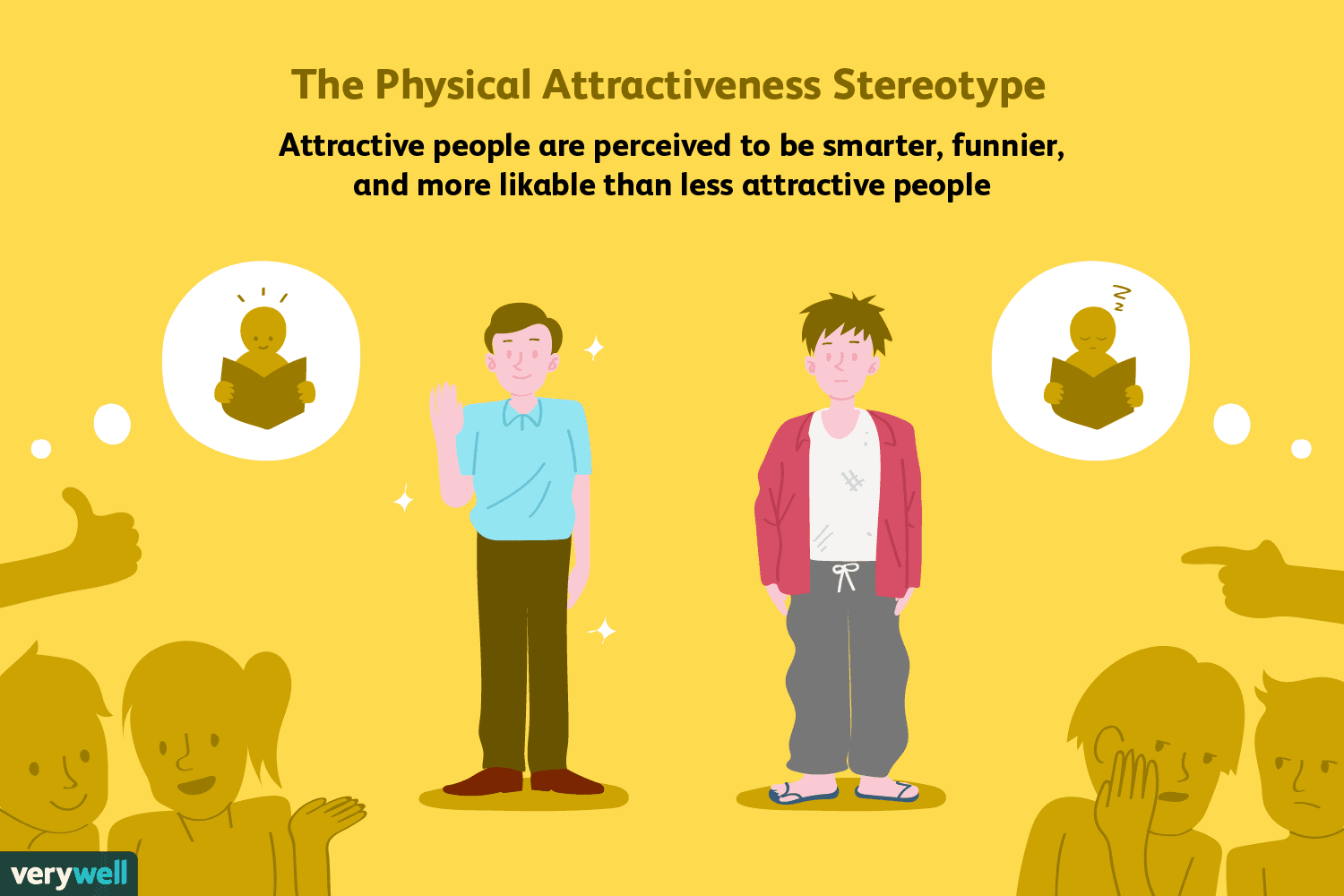
The Halo Effect: The Physical Attractiveness Stereotype
The halo effect is also sometimes referred to as the physical attractiveness stereotype and the “what is beautiful is also good” principle.
Physical appearance is typically a major part of the halo effect. People considered attractive tend to rate higher for other positive traits, too.
However, the halo effect can encompass other traits as well. For example, people tend to see others who are sociable or kind as likable and intelligent, too. The halo effect allows perceptions of one quality to spill over into biased judgments of other qualities.
The expression draws on the image of a halo, which casts a positive light on what it surrounds; thus, the “halo” created by the perception of one characteristic can cover others in the same way.
In religious art, a halo often hovers over a saint’s head, bathing the individual in a heavenly light to create the impression that that person is good.
The History of the Halo Effect
Psychologist Edward Thorndike first coined the term in a 1920 paper titled “The Constant Error in Psychological Ratings.” In the experiment described in the paper, Thorndike asked commanding officers in the military to evaluate a variety of qualities in their subordinate soldiers. These characteristics included such things as leadership, physical appearance, intelligence, loyalty, and dependability.
Thorndike’s goal was to determine how ratings of one quality bled over to assessments of other characteristics. He found that high ratings of a particular quality correlated to high ratings of other characteristics, while negative ratings of a specific quality also led to lower ratings of other characteristics.
“The correlations were too high and too even,” Thorndike wrote. “For example, for the three raters next studied, the average correlation for physique with intelligence is 0.31; for physique with leadership, .39; and for physique with character, 0.28.”
So why do our overall impressions of a person create this halo that influences our evaluations of specific traits? Researchers have found that attractiveness is one factor.
Studies have found that good-looking people tend to be seen as having positive personality traits and higher intelligence. One study even found that jurors were less likely to believe that attractive people were guilty of criminal behavior.
However, this attractiveness stereotype can be a double-edged sword. Other studies have found that, although people are more likely to ascribe positive qualities to attractive people, they are also more likely to believe that good-looking individuals are vain, dishonest, and likely to use their attractiveness to manipulate others.
Impact of the Halo Effect
The halo effect plays out in many arenas.
In Education
Teachers may interact with students differently based on perceptions of attractiveness. For example, in one study, teachers had better expectations of kids that they rated as more attractive.
Another study looked at the academic records of more than 4,500 students. A group of 28 people then rated the attractiveness of the students (based on student ID photos) on a scale of 1 (very unattractive) to 10 (very attractive). Students were then divided into three groups: below-average, average, and above-average attractiveness.
Researchers then compared students’ grades between classes taken in a traditional face-to-face classroom setting and those taken online. Students who were rated as above-average in appearance earned significantly lower grades in online courses than they did in their traditional classes.
The halo effect can influence how teachers treat students, but it can also impact how students perceive teachers. In one study, researchers found that when an instructor was viewed as warm and friendly, students also rated them as more attractive, appealing, and likable.
In the Workplace
Experts suggest that the halo effect is one of the most common biases affecting performance appraisals and reviews. Supervisors may rate subordinates based on the perception of a single characteristic rather than the whole of their performance and contribution. For example, a worker’s enthusiasm or positive attitude may overshadow their lack of knowledge or skill, causing coworkers to rate them more highly than their actual performance justifies.
The halo effect can also have an impact on income. A study published in the Journal of Economic Psychology found that, on average, attractive food servers earned approximately $1,200 more per year in tips than their unattractive counterparts.
Another study found that physical attractiveness has a positive effect not only on a person’s self-confidence but also on their overall income and financial well-being.
Job applicants are also likely to feel the impact of the halo effect. If a prospective employer views the applicant as attractive or likable, they are more likely to also rate the individual as intelligent, competent, and qualified.
In Marketing
Marketers take advantage of the halo effect to sell products and services. When a celebrity spokesperson endorses a particular item, our positive evaluations of that individual can spread to our perceptions of the product itself.
The Reverse Halo (or Horn) Effect
As the name implies, the reverse halo effect occurs when a person judges another negatively based on only one known characteristic. That single trait colors all of the others for someone experiencing the reverse halo effect. For example, a person might assume that someone they view as unattractive is also unkind.
Verywell Mind uses only high-quality sources, including peer-reviewed studies, to support the facts within our articles. Read our editorial process to learn more about how we fact-check and keep our content accurate, reliable, and trustworthy.
-
Liebregts W, Darnihamedani P, Postma E, Atzmueller M. The promise of social signal processing for research on decision-making in entrepreneurial contexts. Small Bus Econ. 2020;55(3):589-605. doi:10.1007/s11187-019-00205-1
-
Batres C, Shiramizu V. Examining the “attractiveness halo effect” across cultures. Curr Psychol. 2023;42(29):25515-25519. doi:0.1007/s12144-022-03575-0
-
Talamas SN, Mayor KI, Perrett DI. Blinded by beauty: Attractiveness bias and accurate perceptions of academic performance. PLoS One. 2016;11(2):e0148284. doi:10.1371/journal.pone.0148284
-
Batres C, Shiramizu V. Examining the “attractiveness halo effect” across cultures. Curr Psychol. Published online August 25, 2022. doi:10.1007/s12144-022-03575-0
-
Patry MW. Attractive but guilty: Deliberation and the physical attractiveness bias. Psychol Rep. 2008;102(3):727-733. doi:10.2466/pr0.102.3.727-733
-
Clifford M, Walster E. The effect of physical attractiveness on teacher expectations. American Sociological Association.1973;46(2):248-258. doi:10.2307/2112099
-
Hernandez-Julian R, Peters C. Student appearance and academic performance. Journal of Human Capital. 2017;11(2):247-262. doi:10.1086/691698
-
Parrett M. Beauty and the feast: Examining the effect of beauty on earnings using restaurant tipping data. Journal of Economic Psychology. 2015;49:34-46. doi:10.1016/j.joep.2015.04.002
-
Judge TA, Hurst C, Simon LS. Does it pay to be smart, attractive, or confident (or all three)? Relationships among general mental ability, physical attractiveness, core self-evaluations and income. Journal of Applied Psychology. 2009;94(3):742-755. doi:10.1037/a0015497
Additional Reading
-
Rasmussen K. Halo Effect. In N. J. Salkind & K. Rasmussen (Eds.), Encyclopedia of Educational Psychology, Volume 1. Thousand Oaks, CA: Sage Publications, Inc.; 2008.
-
Schneider FW, Gruman JA, Coutts LM. Applied Social Psychology: Understanding and Addressing Social and Practical Problems. London: SAGE Publications, Inc.; 2012.
-
Standing LG. Halo Effect. In M. S. Lewis-Black, A. Bryman, & T. F. Liao (Eds.), The SAGE Encyclopedia of Social Science Research Methods, Volume 1. Thousand Oaks, CA: SAGE Publications, Inc.; 2004.
Thanks for your feedback!
What is your feedback?
Helpful
Report an Error
Other
