

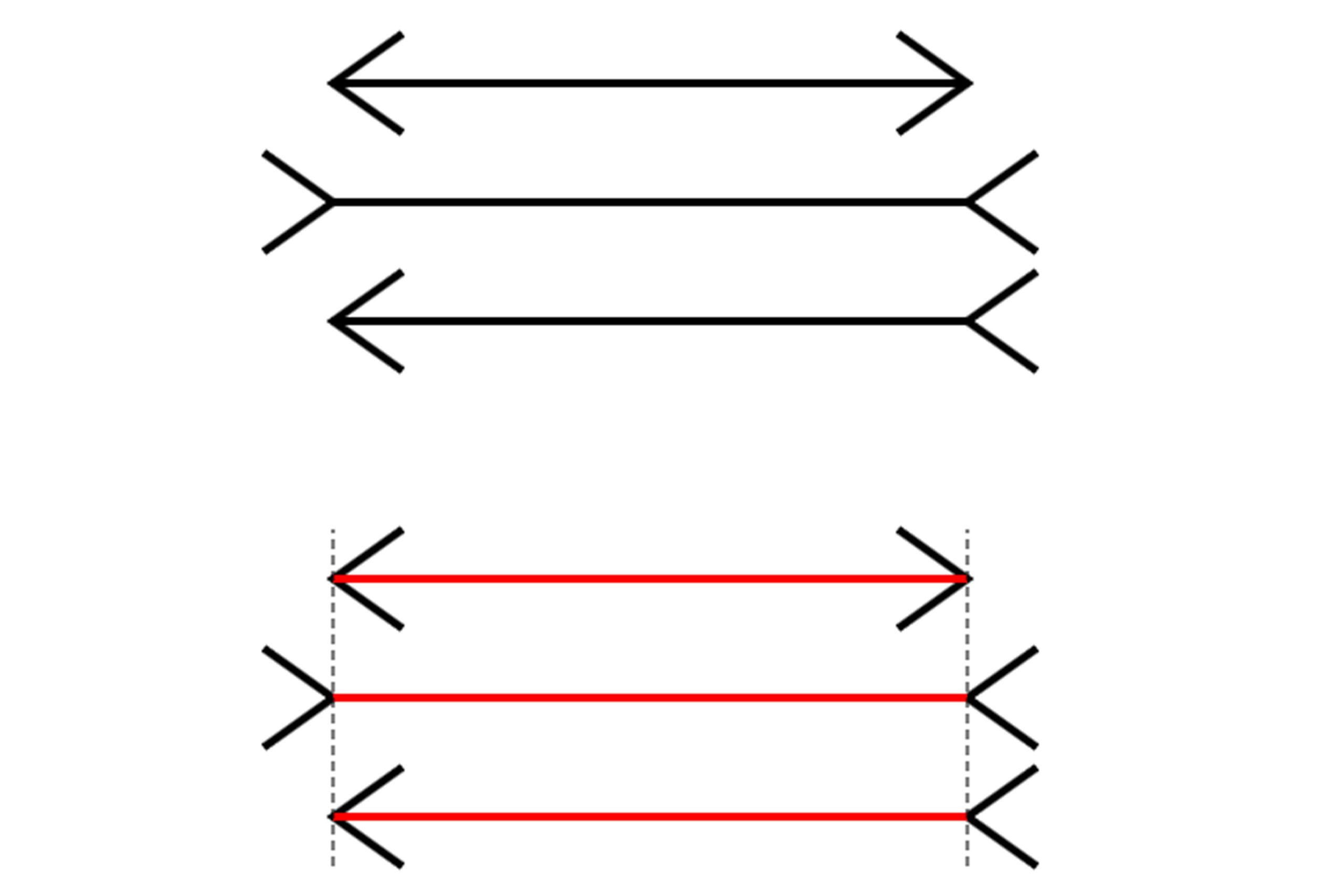
Key Takeaways
- The Müller-Lyer illusion makes two lines look different in length even though they’re the same.
- The illusion shows how our brains use depth cues to judge distance and length.
- Not everyone sees the Müller-Lyer illusion the same way due to factors like culture and environment.
The Müller-Lyer illusion is an optical illusion where two lines of the same length appear to be of different lengths.
A German psychologist named Franz Carl Müller-Lyer created the illusion in 1889. In the original version, he asked people to mark where they thought the midpoint of the line was to gauge if they perceived the lines as being different lengths.
What Do You See?
In the top half of the image above, which line looks like it’s the longest?
For most people, the line with the fins of the arrow protruding outward (the center line) appears to be the longest. The line with the arrow fins pointing inward appears to be shorter.
While your eyes might tell you that the line in the middle is the longest, the shafts of both lines are exactly the same length—which you can see in the bottom half of the image.
Like other optical illusions, the Müller-Lyer illusion has had psychological researchers scratching their heads to try to come up with an explanation. Here are a few theories they’ve come up with.
How the Müller-Lyer Illusion Works
Optical illusions aren’t just fun, they also serve as an important tool for researchers. By looking at how we perceive illusions, we can learn more about how our brains and perceptual processes work.
That said, experts do not always agree on what causes optical illusions—and the Müller-Lyer illusion is a great example.
Müller-Lyer: Real Life Example
If you’ve ever tried to dress a certain way to make your legs look longer, then you’ve used the Müller-Lyer in real life.
One study actually put this piece of fashion wisdom to the test and found that when looking at a drawing of a woman wearing a high-cut swimsuit, people thought her legs were much longer compared to when she was dressed in calf-length tights.
The Size Constancy Explanation
According to psychologist Richard Gregory, the Müller-Lyer illusion happens because of a misapplication of size constancy scaling.
In most cases, size constancy lets us perceive objects in a stable way by taking distance into account. In the three-dimensional world we live in, this principle allows us to perceive a tall person as being tall whether they are standing next to us or off in the distance. When we apply this same principle to two-dimensional objects, Gregory suggests that errors can crop up.
Other researchers say that Gregory’s explanation does not sufficiently explain the illusion. For example, other versions of the Müller-Lyer illusion use two circles at the end of the shaft. In this case, there are no depth cues but the illusion still occurs. It has also been shown that the illusion can occur when viewing three-dimensional objects.
The Depth Cue Explanation
Depth plays an important role in our ability to judge distance. One explanation of the Müller-Lyer illusion is that our brains perceive the depths of the two shafts based on depth cues.
When the fins are pointing inward toward the shaft of the line, we see it as sloping away like the corner of a building. This depth cue leads us to see the line as being further away and therefore shorter.
When the fins are pointing outward away from the line, it looks more like the corner of a room sloping toward us. This depth cue leads us to believe that the line is closer and therefore longer.
The Conflicting Cues Explanation
An alternative explanation proposed by R. H. Day suggests that the Müller-Lyer illusion occurs because of conflicting cues.
Our ability to perceive the length of the lines depends on the actual length of the line and the overall length of the figure. Since the total length of one figure is longer than the length of the lines themselves, it causes us to see the line with the outward-facing fins as longer.
Researchers from the University of London suggest that the illusion demonstrates how the brain reflexively judges information about length and size before anything else.
Dr. Michael Proulx explained that “many visual illusions might be so effective because they tap into how the human brain reflexively processes information. If an illusion can capture attention in this way, then this suggests that the brain processes these visual clues rapidly and unconsciously. This also suggests that perhaps optical illusions represent what our brains like to see.”
Mental Math
Some researchers have even applied complex mathematical concepts like probability to explain how the Müller-Lyer illusion works.
Does Everyone See the Müller-Lyer Illusion?
One of the interesting things about optical illusions, including the Müller-Lyer illusion, is that not everyone sees them the same way.
Research has shown that people from different cultures have different perceptions of the Müller-Lyer illusion—and some people don’t seem to “fall” for it at all. For example, in the early 20th century, researchers discovered that indigenous people from the Murray Islands in Australia were less likely to see the lines as being different lengths than Europeans.
In the 1960s, researchers looking at how culture influences perception used the Müller-Lyer to show that people who live in places with more rectangular structures might be more susceptible to the illusion than people living in places that have fewer edges and straight lines.
Later studies that looked at people living in rural vs. more urban areas supported the idea that seeing a lot of these rectangular structures might affect how they perceived the Müller-Lyer illusion.
Other researchers challenged these ideas and showed that people living in cultures of all shapes and sizes responded to the illusion the same way. Instead, they thought that how much pigment people have in their eyes might play a role in how they perceive illusions.
And another cool thing? In 2021, Professor Susan Goldin-Meadow from the University of Chicago did a study using the Müller-Lyer illusion. The participants included English speakers and American Sign Language users, and they were asked to consider the illusion in different contexts—by just looking at it, by planning to describe it to someone else, or by gesturing like they were going to pick up the lines.
They found that people were more likely to see the illusion when they were only looking at it and less likely to “fall for it” when they were thinking about how to describe it or gesturing.
When describing the study in a press release for the university, Goldin-Meadow said “the Müller-Lyer illusion has always fascinated me. And using it struck me as an ideal way to ask this question about where gestures come from. I thought they were tied to language because gestures and speech are so well integrated. But now we have evidence that gestures may also stem from action.”
So, not only was the study a fascinating look at the illusion itself but it’s also a great example of how these tricks played on our eyes can help us learn more about our brains.
Illusions Like Müller-Lyer
There are a few other optical illusions psychologists have studied that are similar to the Müller-Lyer illusion:
- Vertical-horizontal illusion. This illusion has participants judge the lengths of horizontal (side to side) and vertical (up and down) lines. The vertical line and horizontal line are connected, with the vertical line going up from the center of the horizontal line. Participants usually over or underestimate the length of the bisecting line—even when they’ve been told that the lines are exactly the same length!
- Ponzo Illusion: This illusion has two lines placed over a drawing of a railroad track. Participants are asked which line is longer, but the truth? They’re the same length! How is that so? It’s all about perspective—in this case, linear perspective. The line that appears to be farther away on the track looks longer, while the one that’s closer looks shorter.
