

Key Takeaways
- Gordon Allport is considered one of the founders of personality psychology, rejecting psychoanalysis and behaviorism for his trait theory.
- Allport’s trait theory categorizes personality traits as cardinal, central, or secondary.
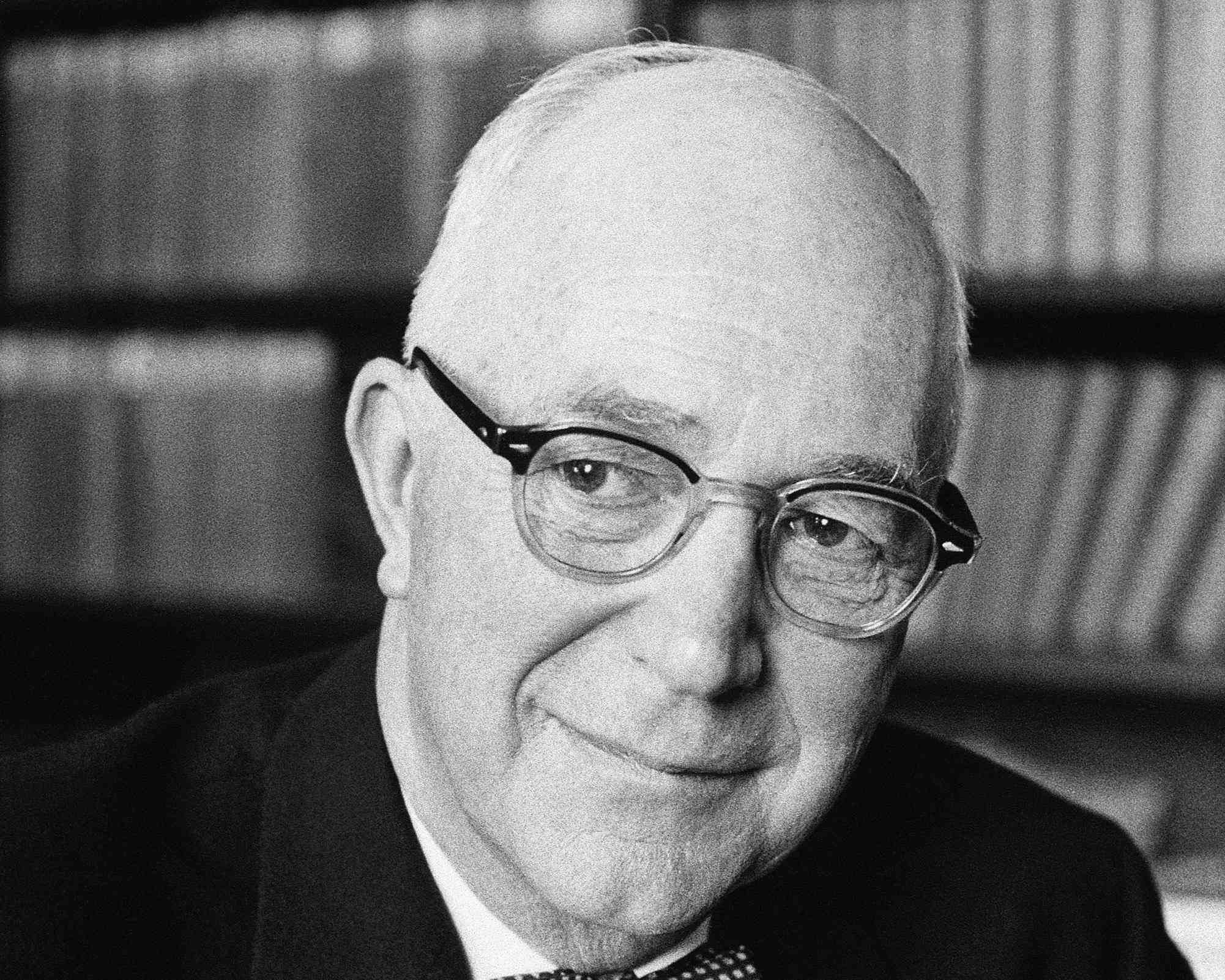
Gordon Allport was a pioneering psychologist often referred to as one of the founders of personality psychology. He rejected two of the dominant schools of thought in psychology at the time, psychoanalysis and behaviorism, in favor of his own approach that stressed the importance of individual differences and situational variables.
Today, he is perhaps best remembered for his contributions to the trait theory of personality. In a review of the most influential psychologists of the 20th century, Allport was ranked as the 11th most eminent psychologist.
Gordon Allport’s Early Life
Gordon Allport was born in Montezuma, Indiana, on November 11, 1897. He was the youngest of four brothers and was often described as shy, but also hard-working and studious. His mother was a schoolteacher, and his father was a doctor who instilled in Allport a strong work ethic.
During his childhood, his father used the family home to house and treat patients.
Allport operated his own printing business during his teen years and served as his high school newspaper editor. In 1915, Allport graduated second in his class and earned a scholarship to Harvard College, where one of his older brothers, Floyd Henry Allport, was working on a PhD in psychology.
After earning his bachelor’s degree in philosophy and economics from Harvard in 1919, Allport traveled to Istanbul, Turkey, to teach philosophy and economics. After a year of teaching, he returned to Harvard to finish his studies. Allport earned his PhD in psychology in 1922 under the guidance of Hugo Munsterberg.
Meeting Sigmund Freud
In an essay entitled “Pattern and Growth in Personality,” Allport recounted his experience of meeting psychiatrist Sigmund Freud. When he was 22, Allport traveled to Vienna, Austria, to meet the famous psychoanalyst. After entering Freud’s office, he sat down nervously and told a story about a young boy he had seen on the train during his travels to Vienna.
The boy, Allport explained, was afraid of getting dirty and refused to sit where a dirty-looking man had previously sat. Allport theorized that the child had acquired the behavior from his mother, who appeared to be very domineering. Freud studied Allport for a moment and then asked, “And was that little boy you?”
Effect on Psychology
Allport viewed the experience as an attempt by Freud to turn a simple observation into an analysis of Allport’s supposed unconscious memory of his own childhood. The experience would later serve as a reminder that psychoanalysis sometimes tended to dig too deeply. On the other hand, Allport believed that behaviorism did not dig deeply enough.
Instead, Allport chose to reject both psychoanalysis and behaviorism and embraced his own unique approach to personality.
At this point in psychology history, behaviorism had become the dominant force in the United States, and psychoanalysis remained a powerful influence. Allport’s approach to human psychology combined the empirical influence of behaviorists with the acknowledgment that unconscious influences could also play a role in human behavior.
Gordon Allport’s Career
Allport began working at Harvard in 1924 and later left to accept a position at Dartmouth. By 1930, he returned to Harvard, where he would remain for the rest of his academic career.
During his first year at Harvard, he taught what was most likely the first personality psychology class offered in the United States.
His work as a teacher also had a profound effect on some of his students, including Stanley Milgram, Jerome S. Bruner, Leo Postman, Thomas Pettigrew, and Anthony Greenwald.
Allport’s Trait Theory of Personality
Allport is perhaps best known for his trait theory of personality. He began developing this theory by going through a dictionary and noting every term he found that described a personality trait. After compiling a list of 4,504 different traits, he organized them into three different trait categories, including:
- Cardinal traits: These are traits that dominate an individual’s entire personality. Cardinal traits are thought to be quite rare.
- Central traits: Common traits that make up our personalities. Traits such as kindness, honesty, and friendliness are all examples of central traits.
- Secondary traits: These are traits that are only present under certain conditions and circumstances. An example of a secondary trait would be getting nervous before delivering a speech to a large group of people.
Allport’s Contributions to Psychology
Gordon Allport died on October 9, 1967. In addition to his trait theory of personality, he left an indelible mark on psychology. Rather than focusing on the popular psychoanalytic and behavioral approaches during his time, Allport instead chose to utilize an eclectic approach.
As one of the founding figures of personality psychology, his lasting influence is still felt today.
If you are interested in learning more about his theories, consider reading some of his best known works, including “Personality: A Psychological Interpretation” (1937), “Becoming: Basic Considerations for a Psychology of Personality” (1955), or “Pattern and Growth in Personality” (1961).
What This Means For You
Gordon Allport’s trait theory of personality influenced the development of more modern approaches to understanding personality, including the widely accepted five-factor theory. Learning more about Allport’s life and theories can give you a better understanding of the history of psychology and how we arrived at our current understanding of the mind and behavior.
Verywell Mind uses only high-quality sources, including peer-reviewed studies, to support the facts within our articles. Read our editorial process to learn more about how we fact-check and keep our content accurate, reliable, and trustworthy.
-
Haggbloom SJ, Warnick R, Warnick JE, et al.The 100 Most Eminent Psychologists of the 20th Century. Review of General Psychology.2002;6(2):139-152. doi:10.1037//1089-2680.6.2.139
-
Hood R. Allport, gordon. In: Leeming DA, ed. Encyclopedia of Psychology and Religion. Springer US; 2014:38-42. doi:10.1007/978-1-4614-6086-2_9114
-
Mautz T, McKnight C, Dunn A, Dunn SM. Allport, Gordon. In: Zeigler-Hill V, Shackelford TK, eds. Encyclopedia of Personality and Individual Differences. Springer International Publishing; 2020:124-128. doi:10.1007/978-3-319-24612-3_1675
-
Allport GW. Personality: a Psychological Interpretation. New York: Holt, Rinehart & Winston; 1937.
Additional Reading
-
Allport, GW. Gordon W. Allport. In: Boring GE, Lindzey G, eds. The Century Psychology Series. A History of Psychology in Autobiography. Vol 5. Appleton-Century-Crofts;1967:1-25. doi:10.1037/11579-001
-
Allport GW. Pattern and Growth in Personality. New York: Holt, Rinehart & Winston; 1961.
-
Harvard University; Department of Psychology. Gordon W. Allport (1897-1967).
-
The Editors of Encyclopaedia Britannica. Gordon Allport. Encyclopaedia Britannica. Updated November 7, 2019.
Thanks for your feedback!
What is your feedback?
Helpful
Report an Error
Other
