

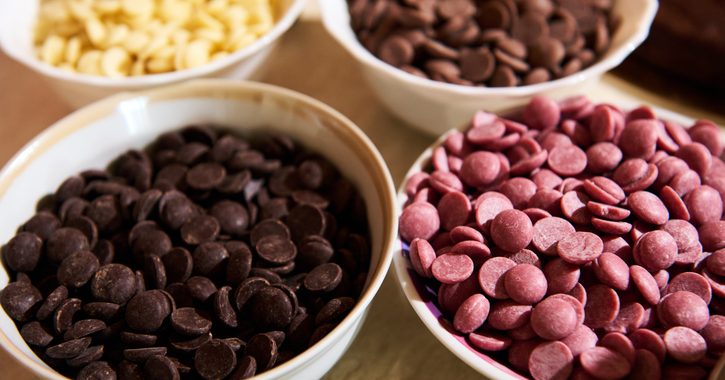
Long before the days of Dubai chocolate, another kind of confectionery item dominated the shelves in the late 2010s – ruby chocolate.
At a time when skinny jeans, wired headphones, fidget spinners and rose gold iPhones were trending, you could walk into any supermarket and pick from four types of chocolate: milk, white, dark and ruby.
When the ruby cocoa bean was discovered, it was seen as a gamechanger. However, you’ll now struggle to find it on the high street and it is no longer part of our conversations, despite people yearning for the past, with 2016 nostalgia taking over social media.
So, whatever happened to ruby chocolate? We spoke to several industry experts, including chocolatiers, supermarket giants, chocolate retailers and brand strategists, to explore its rise, fall and possible return in 2026.
Known for its berry-like flavour and bold pink hue, ruby chocolate is made from ruby cocoa beans, which are sourced from regions such as Ecuador, Brazil and the Ivory Coast.
It was developed and launched in 2017 by Barry Callebaut, one of the world’s largest cocoa processors and manufacturers headquartered in Switzerland. The company claims its recipe involves adding citric acid to the chocolate, but refuses to disclose any further details of its process to protect its trade secret.
Barry Callebaut marketed it as the “fourth chocolate” because of its naturally occurring fruity tang and rose colour. This led to it being billed as “the biggest innovation in chocolate in 80 years” after Nestlé created white chocolate in 1936. Good Food attempted to speak to Barry Callebaut for this article, but received no response at the time of publication.
Once it launched, major brands rushed to incorporate the eccentric cocoa bean into their products. KitKat launched a ruby bar in Japan just five months after ruby cocoa was introduced to the market, and Magnum and Häagen-Dazs used it in their ice cream. Costa developed a pink coloured ruby hot chocolate, and in 2020, Starbucks created a Ruby Flamingo Frappuccino for their cafés in Europe, the Middle East and Africa. Italian chocolate praline brand Baci also released its limited edition Baci Perugina, made with ruby cocoa beans.
Amir Mousavi, founder and creative director of Good Food Studio, a food and restaurant consultancy company, was working as a development chef at Bakkavor when ruby chocolate took the global market by storm.
He said: “For big brands, ruby chocolate was a low-risk innovation. It allowed them to signal progress, creativity and premiumisation without changing production formats or consumer behaviour too much. It was also visually distinctive, which mattered hugely in the Instagram-led food culture of the late 2010s. Being absent from the trend would have felt like being left behind.”
Hayfaa Jawhar, chocolatier and founder of Bloom Delight, said she jumped on the ruby chocolate bandwagon as it “resonated strongly” with her brand’s aesthetic. She said that when the vibrant chocolate first emerged, there was a lot of curiosity around it, from both chocolatiers and customers. “It required a thoughtful approach to pairing and presentation, as its natural acidity and fruit-forward notes behave very differently from classic milk or dark chocolate,” she added.
Lidia Rumley, a brand strategist and founder of The Brand Storyteller, believes that ruby chocolate was successful because it hit a “sweet spot between product and marketing”. “From a branding perspective, it was brilliantly positioned,” she said. “Calling it the ‘fourth type’ of chocolate gave it a clear identity and helped consumers instantly get where it belonged in the market.”
However, despite its widespread success, ruby chocolate disappeared from many stores, cafes and restaurants after the Covid-19 pandemic.
So, what contributed to its fall from grace? Teresa Peck, head of global category strategy at Hotel Chocolat, believes that its unique, natural summer fruits flavour profile, which was the very reason it became so popular, could have also led to its demise. “Typically, there’s always an initial surge of intrigue to want to try something new and for ruby chocolate specifically, having pink hues would have only added to this want to try it,” she said.
“I believe a few factors caused it to disappear rather than take off, with the main reason being that ruby chocolate isn’t a classic chocolatey flavour, making it interesting to try once for its specific taste, but not likely to become a new favourite. I’d also speculate that the specific taste made it harder to pair with additional flavours, narrowing the scope of how it can be used for the future. Ultimately, people have their favourite chocolate grade which they will gravitate back to.”
Hotel Chocolat never introduced a ruby chocolate, with Teresa noting the company chose to focus on its own grades of cocoa instead.
When Amir was incorporating ruby chocolate into menus, he noted that the fruity, slightly acidic notes gave it an identity closer to a fruity white chocolate – but he struggled to make it work in practice. “It didn’t deliver the vibrant ruby colour people imagined,’ he said. “Making a mousse, for instance, often resulted in it being dulled to grey. On menus, I found customers were intrigued by the idea, but the flavour didn’t always resonate. Feedback was mixed; some found it a bit odd, like a strange fruity twist on white chocolate. In high-end patisserie, I ultimately found other ways to achieve those flavours, like raspberries, which gave me more control.”
Paula Bui, chocolatier and founder of Fusion Chocolate, said she does not use ruby chocolate because flavour pairings are limited due to its pH. She said: “The ruby chocolate has a pH of around 5.4. Any fillings you put in shells made with ruby chocolate need to be a pH of around 4 or less, otherwise the colour is lost, and it becomes an insipid grey colour that is not very appealing.”
Darren Litton, the founder of Cocoba, offered ruby chocolate for a while, but didn’t receive much demand, as customers didn’t quite understand what it was. He said: “It was also very expensive, meaning that the end product was very expensive. Our customers preferred a flavoured pink-coloured white chocolate to ruby chocolate.”
Ruby chocolate, Lidia believes, did not necessarily fail, but it just didn’t quite reach the point of becoming a mainstream habit. “Milk, dark and white chocolate are defaults for most people; they’re what you reach for without thinking, whether you’re eating or baking,” she said. “A quick scan of social media at the time tells you that people were curious. They tried it, maybe bought it as a treat or a gift, but ultimately found the flavour somewhat underwhelming, so they didn’t switch their everyday behaviour away from milk, dark or white choices. Once the novelty wore off, there wasn’t a strong enough reason to keep choosing it regularly.”
Geri Martin, founder and chief chocolatier at The Chocolate Manor, said her company worked with Barry Callebaut’s ruby range and was “delighted” to be able to offer a new type of chocolate to their customers.
“Initially, we had a fairly positive response; it was new, different and a novelty. Even now, we do have customers who ask us if they can get ruby chocolate from us,” she said. The company began to phase out ruby chocolate two years ago. Customers expected strawberry or raspberry flavours, but instead got a “tangy but sweet, creamy and yogurty taste”. This led to them requesting no ruby chocolate in their gift boxes, with Geri and her team referring to it as the “Marmite chocolate”.
“We got to a stage in our shop that when someone brought it to the counter to purchase, we would ask them if they had tried it before, as we didn’t want them to buy it if they thought it would taste of strawberry or raspberry,” she added.
Although it doesn’t seem to be popular with chocolatiers due to its challenging nature, customer statistics from Waitrose show that it might be on the cusp of a resurgence. Will Torrent, senior development chef at Waitrose, told Good Food that customer searches for ruby chocolate are up more than 1,000 per cent compared to the same time last year. Waitrose has even brought ruby chocolate back to the high street, offering a No.1 Ruby Chocolate & Raspberry Mousse and a No.1 Ruby Chocolate & Berries Flat Egg for Easter. Will said: “Ruby chocolate is a perfect ingredient for us to use in our products during the spring season, due to its fresh and slightly tart, berry-like taste and striking pink colour.”
Flo Broughton, the founder of Choc On Choc, believes ruby chocolate could return if it becomes a social media sensation. “It needs to move away from being ‘pink chocolate’ and be marketed as a functional ingredient for balance,” she said. “It works perfectly to cut through the sweetness of heavy desserts. If brands use it as a zesty alternative to white chocolate rather than a new category, that might work.”
It seems ruby chocolate’s distinctive flavour and appearance were the very reasons for both its success and its downfall, with more accessible flavours, such as pistachio and fruit-infused white chocolate, replacing it. Whilst trends like ruby chocolate may come and go, Lidia believes the recent trend of Dubai chocolate is here to stay. It has shapeshifted into a format that fits into everyday treats – such as pistachio spread, biscuits and even seasonal items like Easter eggs.
What lies next on the chocolate trend horizon? Several chocolatiers we spoke to said that texture will continue to be popular in 2026, especially after the victory of Dubai. Angel hair chocolate, a pink bar filled with candyfloss and pistachio cream, is also gaining traction. Some brands use coloured white chocolate, whereas others use a mix of ruby and white chocolate together to achieve the colour. Its recent boom in popularity could be enough to thrust ruby chocolate back into the spotlight; however, angel hair is not available to buy in supermarkets.
Teresa said customers are looking for a “multisensory experience”, whether that is a softer texture or chocolate filled with biscuits, nuts, or fruits. She said: “Wellness with chocolate is also interesting. The functional benefits of high cacao dark chocolate continue to grow, plus added ingredients such as nibs, berries, etc. make it a never-ending world of options. We may also see more of a cross-cultural inspiration in the world of chocolate. World cuisines are increasingly influencing innovation, opening the door to interact with chocolate and create fusion recipes.” Only time will tell if that will help ruby chocolate make its grand return.
Craving chocolate now? Try our favourite chocolate recipes…
15 best chocolate cake recipes
Top 10 twists on chocolate chip cookies
Top 10 hot chocolate recipes
Top 10 chocolate desserts
