

Key Takeaways
- Blood type personality, known as ketsueki-gata, is a cultural belief in Japan that links blood type to personality traits.
- There’s no strong scientific evidence proving a connection between blood type and personality.
- The belief in ketsueki-gata persists even without scientific backing and is popular in Japan and some Western countries.
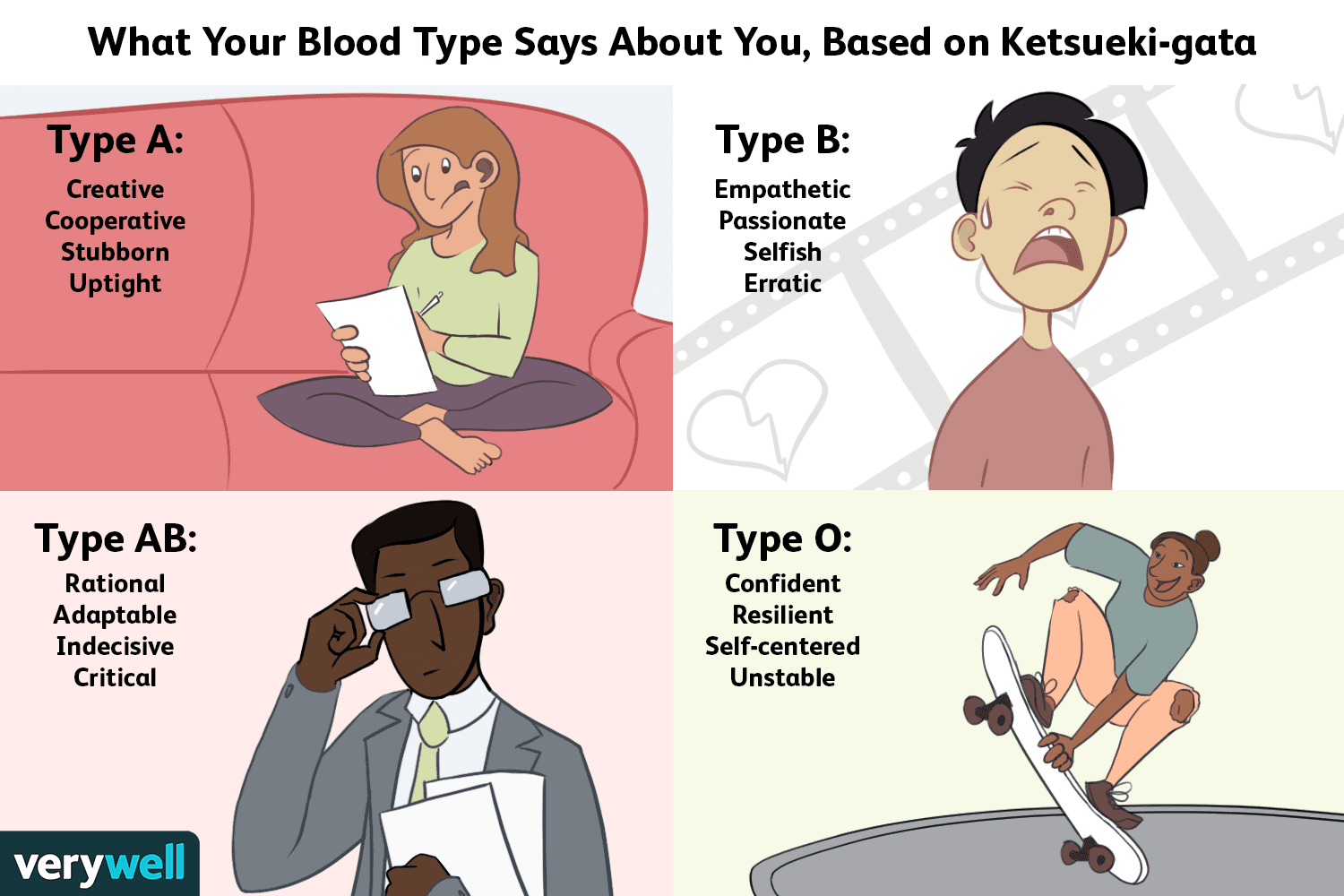
Blood type personality is a Japanese concept called ketsueki-gata, which suggests that a person’s blood type influences their personality, temperament, and behavior. According to the theory, each of the four blood types is associated with certain traits. Common stereotypes suggest that type A is organized, type B is passionate, type O is outgoing, and type AB is adaptable.
Although unsupported by scientific evidence, the belief is widespread in Japan and other Asian nations. It is also increasingly garnering interest in Western countries such as the United States.
Verywell / Laura Porter
Common Blood Type Personality Traits
Ketsueki-gata believers maintain that each of the four blood types corresponds to distinct personality traits, making some blood types more compatible with certain traits than others. Here’s how the blood types purportedly break down by temperament.
- Type A: People with type A blood are thought to have positive traits such as creativity, cleverness, and cooperativeness. Their supposed negative traits include stubbornness and uptightness. Type A individuals are reportedly more common in Japan than people with other blood types.
- Type B: Individuals with type B blood are supposed to be strong, passionate, empathetic, and decisive, but they have also been associated with selfishness and erratic behavior. People with this blood type are said to clash with those with type A blood.
- Type AB: The purported strengths of those with type AB blood include rationality and adaptability, but their weaknesses are indecision, criticalness, and forgetfulness. This blood type is primarily viewed as having the characteristics of type A and type B individuals. Because this blood type is rare, the people who have it are highly valued in Japan.
- Type O: Type O people have been linked to characteristics such as confidence, determination, resilience, and intuition, but they are also supposedly self-centered and unstable. Type As tend to perceive Type Os as selfish.
Can Blood Type Really Predict Personality?
Studies on ketsueki-gata have continued well into the 21st century worldwide, including Australia, Taiwan, and the United States.
So far, no rigorous scientific study including quantitative data has established a link between blood type and temperament. Yet, belief in ketsueki-gata persists—even in the United States, where proponents have found success arguing that a person’s blood type should inform lifestyle factors such as diet.
While there isn’t much research supporting the idea that blood type directly affects personality, some studies examine how it may influence genetic traits. This may indirectly affect certain traits.
The results of one study suggested there was a weak link between blood types and the personality trait of persistence. This is likely due to a genetic link between blood type and a gene that influences dopamine production. Because dopamine influences sensation-seeking and impulsivity, it can affect persistence. It’s important to note that this connection is small, and more research is needed.
Blood Type and Health Conditions
Meanwhile, in the U.S., blood type has not been linked to personality so much as to specific diseases. One study suggested that blood types may be associated with as many as 49 health conditions.
For example:
- Type A individuals have been found to have an increased risk of stomach cancer and heart disease.
- Type B people also have an increased risk of heart disease and ovarian cancer.
- Type AB individuals have an increased risk of heart disease, and pregnant women with this type may be more likely to develop preeclampsia.
- Type O individuals may be more likely to develop ulcers, attract mosquitoes, and have Achilles tendon injuries.
History of Ketsueki-gata
In 1930, Japanese professor Tokeji Furukawa published a report in the Journal of Social Psychology called “A Study of Temperament and Blood-Groups.” In this paper, he argued that establishing a link between personality and blood type “might prove a useful basis for the objective study of temperament.”
He compared this effort to the ancient Greek physician Hippocrates’ classification of temperaments, which is based on the concept of humors. These four temperaments were:
- Sanguine
- Phlegmatic
- Choleric
- Melancholic
According to this concept, four bodily fluids influence personality and behavior, but Furukawa asserted that modern classifications of temperaments typically fell into two groups: physiological and psychological. The concept of blood type personality blends the two categories together, using physiology to explain the psyche.
Blood types A, B, O, and AB each have a unique effect on personality, Furukawa argued. Medically, the blood types are distinct from each other because of their antigens, molecules on the surface of red blood cells that spur the immune system to generate antibodies. But Furukawa’s interest in blood type went far beyond the scope of antigens.
In his paper, he included detailed charts to argue that blood type corresponds with temperament, but his research has been criticized for relying heavily on questionnaires and providing no empirical evidence. Other researchers began challenging Furukawa’s claims about blood type personality just six years after he published his report.
Despite these critiques, the concept of ketsueki-gata never disappeared, as multiple books on blood personality types hit the shelves in the 1970s. Together, they drew attention to the subject once more.
From 1984 to 1985, more than 200 publications printed papers on blood type personality, resulting in the concept’s enduring popularity in countries such as Japan, Korea, and Taiwan and milder interest outside Asia.
Problems With Blood Type Personality Theory
Since blood type personality is widely accepted as reality in Japan, it has some pitfalls. It has been linked to discrimination in both the workplace and in the singles scene. While positive and negative characteristics are associated with each blood type, some blood types are perceived to be better or worse than others.
- Discrimination: Type B individuals, for example, are reportedly viewed as misfits in Japanese society because they’re said to go at their own pace and behave oddly.
- Workplace effects: On the other hand, type AB individuals enjoy workplace advantages. In 1990, Japanese newspaper The Asahi Daily reported that Mitsubishi Electronics hired a team composed mostly of type AB people because of their purported knack for planning.
- Dating culture: In the dating scene, someone might reject a potential partner purely out of fear of incompatibility due to blood type. Fortunately, the question “Ketsuekigata nāni?” (血液型なあに? What’s your blood type?) is typically asked in the very early stages of dating, so no one is likely to truly get their heart broken over a purported blood type mismatch.
Why People Still Believe It
Although no legitimate scientific research linking blood type to personality has been published, people continue to believe in ketsueki-gata. Why? Psychologists have said that many simply enjoy the topic and use it as a way to break the ice with others.
Moreover, in an uncertain world, the blood type personality theory can give people confidence about where they fit in and what their strengths and weaknesses are.
As with astrology, people often consult blood type personality because they believe it provides clues about their future. So, believers in ketsueki-gata aren’t primarily focused on what the science says about blood type personality; they’re largely focused on better understanding their own lives.
Verywell Mind uses only high-quality sources, including peer-reviewed studies, to support the facts within our articles. Read our editorial process to learn more about how we fact-check and keep our content accurate, reliable, and trustworthy.
-
Japan Times. An A-to-O guide to Japan’s obsession with blood types.
-
Tsuchimine S, Saruwatari J, Kaneda A, Yasui-Furukori N. ABO blood type and personality traits in healthy Japanese subjects. PLoS One. 2015;10(5):e0126983. doi:10.1371/journal.pone.0126983
-
Bondu MT. Ketsueki-gata through American eyes: Examining the correlation between blood type and personality. IJHSR. 2021;3(3):6-10. doi:10.36838/v3i3.2
-
Dahlén T, Clements M, Zhao J, Olsson ML, Edgren G. An agnostic study of associations between ABO and RhD blood group and phenome-wide disease risk. eLife. 2021;10:e65658. doi:10.7554/eLife.65658
-
Mao Y, Yang W, Qi Q, et al. Blood groups A and AB are associated with increased gastric cancer risk: evidence from a large genetic study and systematic review. BMC Cancer. 2019;19(1):164. doi:10.1186/s12885-019-5355-4
-
Aga SS, Khan MA, Al Mansour M, et al. Association of blood group types and clinico-pathological features of gynecological cancers (Gcs). BMC Cancer. 2025;25(1):137. doi:10.1186/s12885-025-13527-z
-
Avci D, Karagoz H, Ozer O, et al. Are the blood groups of women with preeclampsia a risk factor for the development of hypertension postpartum?Ther Clin Risk Manag. 2016;12:617-622. doi:10.2147/TCRM.S100557
-
Furukawa Tokeji. A study of temperament and blood-groups. The Journal of Social Psychology. 1930;1:4, 494-509, doi:10.1080/00224545.1930.9714153
-
Scientific American. You are what you bleed: In Japan and other east Asian countries some believe blood type dictates personality.
Thanks for your feedback!
What is your feedback?
Helpful
Report an Error
Other
