

2026 Trends
Initiative Chair: Lahra Tatriele, Co-Founder & Chief Wellness Strategist, Alchemy Concepts and Co-Founder, Fivelements, Asia
Initiative Vice-Chair: Valentina Cereda, Founder & Integrative Architect, Dubai
Discover the latest trends in wellness architecture and design, where primal architecture reconnects us to nature and ancestral patterns, and neuroarchitecture shapes spaces that support mental and emotional wellbeing. Explore how circadian lighting aligns environments with our biological rhythms, and how emerging strategies aim to design out microplastics and hidden pollutants from interiors. From regenerative thinking to healthier material choices, these approaches redefine the built environment as a system that prioritizes wellbeing, sustainability and deeper human connection.
TREND 1: Primal Architecture – Designing for Psychological Safety and Human Regulation
Today, many people live in a constant state of stress due to lifestyle pressures, environmental factors and digital overload. Before conscious awareness, the body continuously scans its surroundings for safety or threat through a process known as neuroception. When stress becomes prolonged, this system can remain on high alert, even in objectively safe environments, leading to fatigue, anxiety and reduced resilience.
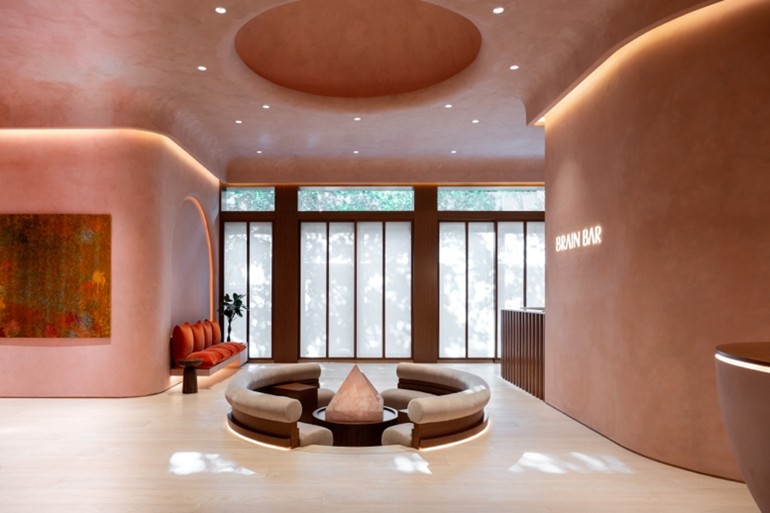
This is where a new wellness design trend, often referred to as primal architecture, is emerging. It places the human nervous system at the center of design thinking. Rather than focusing only on aesthetics or function, it considers how spaces are felt at a physiological level. Elements such as lighting quality, acoustics, spatial clarity, ceiling height, materiality and visual complexity all influence whether a space is perceived as calming or overwhelming.
Design strategies may include softer, indirect lighting, natural materials, clear wayfinding, human-scaled proportions and reduced sensory clutter. These interventions help shift the body from a state of vigilance to one of relaxation and regulation.
Primal architecture moves beyond conventional wellness design by prioritizing safety as a foundational condition. In doing so, it creates environments that not only reduce stress but actively support emotional balance, cognitive clarity and long-term wellbeing.
TREND 2: Neuroarchitecture – How Buildings Change the Way our Brains Function
For decades, modern science and design were shaped by reductionist thinking, dividing knowledge into specialized silos. Yet the human organism does not function in isolated parts. Environment, behaviour, physiology and psychology are deeply interconnected, continuously influencing one another, even at the level of gene expression. Today, a growing body of research is challenging this fragmented approach and reshaping how we think about the built environment.
This shift is driving the rise of neuroarchitecture, an emerging field that integrates neuroscience, architecture, environmental psychology and epigenetics. It explores how the spaces we inhabit directly affect cognition, mood, creativity, stress levels and even immune function. Rather than treating buildings as neutral backdrops, neuroarchitecture recognises them as active participants in human health.
By incorporating scientific measurement tools, such as tracking brain activity, heart rate variability and stress responses, designers can better understand how elements like light, materiality, acoustics, color and spatial configuration impact the body and mind. This evidence-based approach enables more intentional design decisions that support focus, relaxation and emotional balance.
Ultimately, neuroarchitecture represents a paradigm shift: from designing spaces that simply accommodate human activity to creating environments that actively enhance wellbeing, performance and resilience.
Resources:
TREND 3: Designing Out Microplastics
A growing trend in wellness architecture is shifting focus from air filtration to source control, addressing an often-overlooked indoor pollutant: microplastics. As buildings have become more airtight for energy efficiency, they have also begun to trap microscopic particles released from synthetic materials such as carpets, upholstery, paints and finishes. These particles are now being detected in human lungs and bloodstream, raising concerns about long-term health impacts.
This has led to a new design approach centered on “plastic-conscious interiors.” Rather than relying solely on mechanical systems like HVAC and air purifiers, architects and designers are rethinking material selection from the outset. The emphasis is on reducing petrochemical-based products and prioritizing natural, low-emission materials.
Key strategies include specifying natural fibers such as wool, cotton and linen; using solid wood, stone and ceramics instead of engineered or plastic-based materials; and avoiding finishes that release volatile compounds or microplastic particles. Transparency tools like Environmental Product Declarations (EPDs) are increasingly used to assess material composition and lifecycle impact.
Ultimately, plastic-free or plastic-reduced interiors are no longer viewed as a niche or luxury, but as a fundamental component of healthy building design. By addressing pollutants at their source, wellness architecture is evolving to create spaces that actively support human health, rather than simply mitigating harm.
Resources:
- Bodeker, G., Munday, T., Understanding the Microplastics Crisis: Framing a Wellness Response, 20 September 2025
- Baker, P., Banta, J., Elliott, E., Prescriptions for a Healthy House, New Society Publishers, 1 October 2014
- Stelmack, A., Sustainable Residential Interiors, John Wiley & Sons, 2014
TREND 4: Circadian Lighting Design
A key trend in wellness architecture is the integration of circadian lighting, a design approach that aligns indoor environments with the body’s natural biological rhythms. For most of human history, daylight regulated our internal clock, shifting from cool, blue-rich morning light that promotes alertness to warm evening tones that signal rest. Modern lighting, however, has disrupted this balance, exposing occupants to constant, blue-tinged illumination that suppresses melatonin and keeps the body in a perpetual “midday” state.
This has significant implications for sleep quality, mood and overall health. As awareness grows, architects and designers are moving beyond static lighting schemes toward dynamic systems that mimic the natural progression of sunlight throughout the day. These systems adjust both color temperature and intensity, supporting energy levels in the morning and facilitating relaxation in the evening.
Circadian lighting is particularly impactful in windowless or low-daylight spaces, such as bathrooms, basements and work areas, where natural light cues are limited. When integrated thoughtfully, it can also help mitigate seasonal effects, especially in regions with reduced winter daylight.
This trend reflects a broader shift toward human-centric and neuro-responsive design, where lighting is no longer purely functional or aesthetic but a critical component of health. Combined with access to natural daylight, biophilic elements, and consistent daily routines, circadian lighting offers a practical, evidence-based strategy to improve wellbeing.
Ultimately, wellness architecture is moving toward environments that work with human biology rather than against it, using light as a powerful tool to restore balance in increasingly artificial settings.
Resources:
- Figueiro, M.G. et al. (2017) The impact of daytime light exposures on sleep and mood in office workers, Sleep Health, 3(3), pp. 204-215. doi: 10.1016/j.sleh.2017.03.005
- Viola, A.U. et al. (2008) Blue-enriched white light in the workplace improves self-reported alertness, performance and sleep quality, Scandinavian Journal of Work, Environment & Health, 34(4), pp. 297-306.
EXPLORE THE WELLNESS ARCHITECTURE & DESIGN INITIATIVE
