

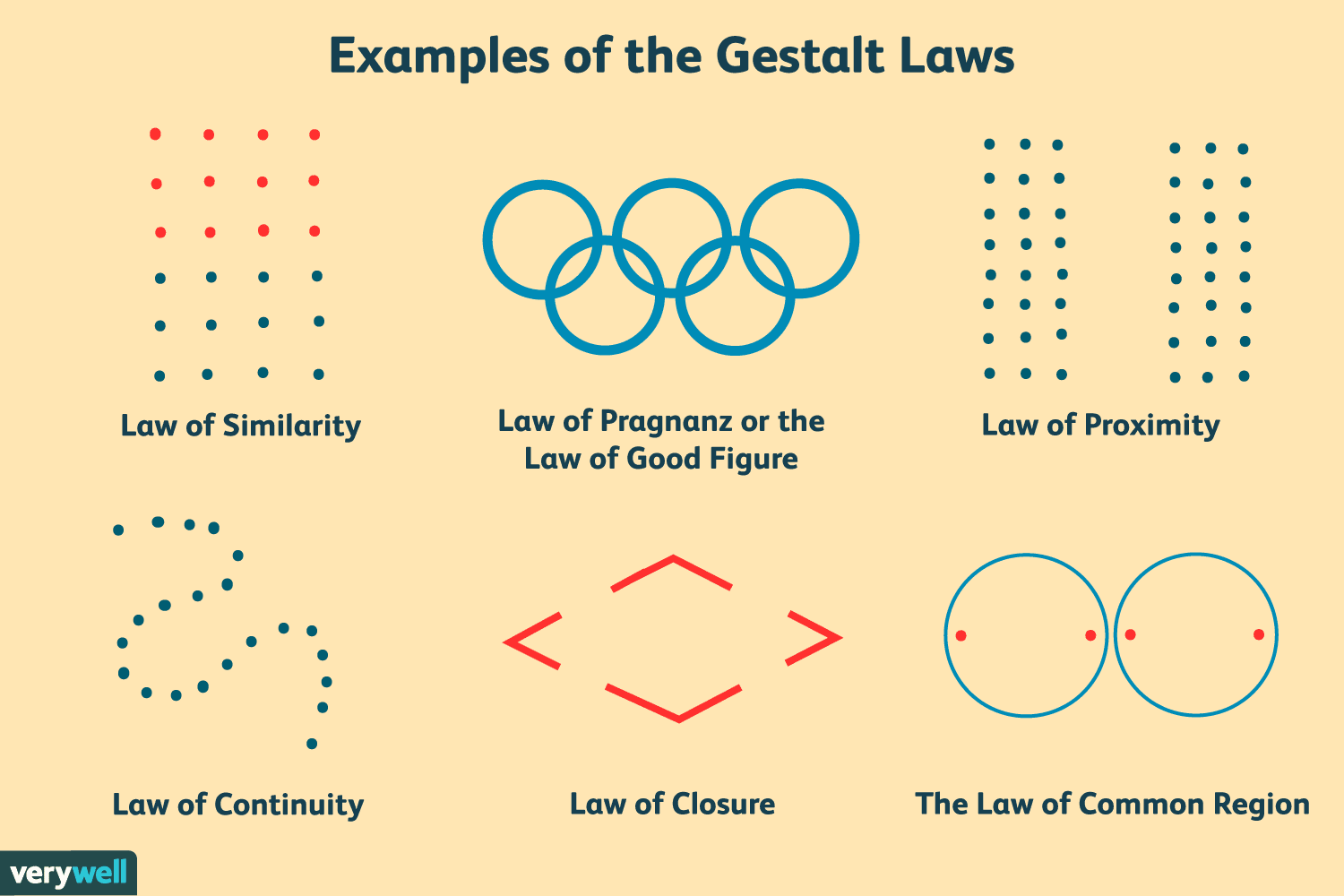
Key Takeaways
- The Gestalt principles explain how our brains group smaller objects to form larger, meaningful patterns.
- These principles, like the law of proximity and the law of closure, show how we perceive relatedness and fill in gaps to create complete images.
- The Gestalt principles are heuristics, meaning they are mental shortcuts that can sometimes lead to perceptual errors.
Gestalt principles explain how people subconsciously perceive and organize visual elements into meaningful patterns. These principles, including proximity, continuity, closure, and similarity, explain how we perceive things as organized wholes that are often more than the sum of their parts.
The principles describe how the mind groups objects, recognizes patterns, and fills in missing information so we experience the world in a cohesive way. They explain why a series of flashing lights appears to be moving, for instance, and why we can read this sentence: notli ket his ort hat.
Verywell / JR Bee
How Gestalt Principles Are Used Today
The Gestalt principles help us understand how perception works. Research continues to offer insights into our perception and how we see the world. These principles play a role in perception, but it is also important to remember that they can sometimes lead to incorrect perceptions.
- User experience (UX) design: UX designers use the Gestalt principles to design navigation, improve readability, and create intuitive user interfaces.
- Marketing and advertising: Brands use these principles to create memorable branding that makes messages clear and grabs consumers’ attention.
- Graphic design: The Gestalt principles help graphic designers create visually appealing designs and layouts that maximize readability and viewer understanding.
- Product design: These principles can help with product labeling and displays so that key information is more noticeable.
- Psychology: These principles help psychologists understand how the brain interprets and organizes visual information.
It is also important to recognize that while these principles are referred to as laws of perceptual organization, they are actually heuristics or shortcuts. Heuristics are usually designed for speed, which is why our perceptual systems sometimes make mistakes, and we experience perceptual inaccuracies.
History of the Gestalt Principles
Have you noticed how alternately flashing lights, such as neon signs or strands of lights, can look like a single light that is moving back and forth? This optical illusion is known as the phi phenomenon. Discovered by German psychologist Max Wertheimer, this illusion of movement became a basis for Gestalt psychology.
According to Gestalt psychology, this apparent movement happens because our minds fill in missing information. Motion pictures are based on this principle, with a series of still images appearing in rapid succession to form a seamless visual experience.
Gestalt psychology focuses on how our minds organize and interpret visual data. It emphasizes that the whole of anything is greater than its parts.
Based on this belief, Wertheimer, along with Gestalt psychologists Wolfgang Köhler and Kurt Koffka, developed a set of rules to explain how we group smaller objects into larger ones (perceptual organization). They called these rules the Gestalt laws of perceptual organization.
It’s important to note that while Gestalt psychologists call these phenomena “laws,” a more accurate term would be “principles.” Gestalt principles are much like heuristics, which are mental shortcuts for solving problems.
