

Key Takeaways
- Anti-racism means taking action to change beliefs, policies, and behaviors that support racism.
- It’s important to recognize and challenge your own biases, even if they are unconscious.
- Listening and learning about racism helps you understand how to address it in your community.
Anti-racism is a process of actively identifying and opposing racism. The goal of anti-racism is to challenge racism and actively change the policies, behaviors, and beliefs that perpetuate racist ideas and actions.
Anti-racism is rooted in action. It is about taking steps to eliminate racism at the individual, institutional, and structural levels. It is not a new concept, but the Black Lives Matter movement has helped increase the focus on the importance of anti-racism.
Why Anti-Racism Is Important
Systemic racism is prevalent in our society and is deeply ingrained in our culture, seen in areas like education, the justice system, government, and healthcare. It’s so widespread that many do not realize how these systems unfairly benefit some while disadvantaging others.
People often mistakenly believe that simply being “not racist” is enough to eliminate racial discrimination. The problem with this perspective is that White people are often unaware of their own unconscious biases. People often don’t fully understand the institutional and structural issues that uphold White supremacy and contribute to racist behaviors, attitudes, and policies.
Saying “but I’m not racist” also allows people to avoid participating in anti-racism. It’s a way of saying “that’s not my problem” while failing to acknowledge that even people who are not racist still reap the benefits of a system that is biased against other people.
Another problem is that research has found that people who believe that they are not racist are often much more prejudiced than they think they are. One study found that people who described themselves as believing strongly in racial equality tended to have significant implicit biases against Black people.
In his book How to Be an Antiracist, Ibram X. Kendi, a leading scholar on race and racial discrimination, examines many of the individual attitudes held by both White and non-White people that play a role in sustaining racism. It is impossible, Kendi notes, to be “not racist” if you hold negative attitudes about entire groups of people based on their race, ethnicity, or cultural heritage.
It is the casual, insidious forms of racism that people are often blind to that play such a pivotal role in upholding racism. People don’t see it because these attitudes are often so deeply ingrained that it takes the ability to be deeply self-critical to examine and challenge those attitudes.
As Kendi explains in How to Be an Antiracist: “the only way to undo racism is to consistently identify and describe it — and then dismantle it.”
Understand What Racism Is
People often think of racism solely in terms of individual actions. The word may conjure up images of people in White cloaks or neo-Nazi’s with shaved heads. While both represent racism, it is important to realize that racial discrimination isn’t always so obvious.
Thinking of racism only as direct actions prevents us from recognizing our own inherent biases, attitudes, and behaviors.
For example, Merriam-Webster dictionary defined racism as, “a belief that race is the primary determinant of human traits and capacities and that racial differences produce an inherent superiority of a particular race.” In the wake of the George Floyd protests, editors of the dictionary decided to update the definition in response to one reader’s request to more clearly include the role that systemic racism plays.
Kendi suggests that a racist is “One who is supporting a racist policy through their actions or inaction or expressing a racist idea.”
The Effects of Racism
Understanding anti-racism involves recognizing the impact of race and racism on individuals and society. Research indicates that racism negatively affects various aspects of life, including healthcare, education, employment, and housing, impacting individuals, families, communities, and society as a whole.
Economic Disparities
Racism influences economic status for a number of reasons. Racialized individuals are discriminated against in educational and employment access. For example:
- White households are on average 13 times wealthier than Black households.
- One 2016 report found that while 72% of White households owned their home, only 44% of Black households and 45% of Latino households owned their homes.
- Black bachelor’s degree-holders earn significantly less than White bachelor’s degree holders.
- According to data from the Bureau of Labor Statistics, in 2021 the median pay for White workers was about 23% higher than it was for Black and Latino workers.
Employment Inequality
Ethnic minorities are less likely to be offered jobs compared to their White counterparts. Black workers are twice as likely to be unemployed as White workers. Statistics also show that Black employees are more likely to be underemployed in comparison to their educational and skill levels.
Incarceration Disparities
Statistics show that there are significant disparities in how the criminal justice and legal system treats White vs. non-White defendants. People who belong to an ethnic minority receive longer, harsher sentences. For example, Black men receive almost 20% longer sentences than White defendants for the same crimes.
Healthcare Inequality
Racial discrimination has a detrimental impact on health for a number of reasons. Research has shown that racism has negative effects on physical and mental health. Studies have also found that BIPOC are less likely to receive adequate healthcare, both because of reduced access to healthcare and because of poor patient experiences.
Understanding these issues as well as how systemic racism contributes to such disparities is an essential part of anti-racism. Redlining, which is the systematic denial of services, is one reason for the significant disparities in homeownership. Racial minorities are less likely to be offered financial services including loans and insurance. They are also less likely to be shown available homes for sale.
They are less likely to receive job offers and are frequently paid less than their non-racialized counterparts for the same work. All of these factors — as well as many others — contribute to the social and economic disparities that are indicative of widespread systemic racism.
Examine Your Own Biases
Anti-racism requires looking at your own beliefs and actions critically. Research has shown that even people who support racial equality often unknowingly hold racist attitudes. This discrepancy is often explained by the existence of implicit biases, or attitudes that are largely unconscious but nevertheless influence behavior. For example:
- While people may consciously support racial justice, they can still hold subtle beliefs about different races, often based upon internalized stereotypes.
- Data from the Implicit Association Test (IAT) has found that while nearly 70% of White respondents claim that they have no preference between Black and White, almost the same percentage of respondents showed some type of preference toward Whites on the test.
- Such biases can have an impact on behavior. One study found that having implicit racial biases made doctors less likely to recommend appropriate treatment to Black patients.
These unconscious, automatic associations are a result of how the brain operates. In order to make sense of a complex world that inundates us with information, our brains like to create categories and shortcuts that help us make sense of the world. The problem is that these shortcuts can lead us astray, causing bias and making it difficult to think critically.
While it is impossible to rid yourself of your cognitive biases entirely, it is possible to develop critical thinking skills that allow you to challenge your assumptions.
If you are interested in learning more about your own implicit biases, you can take the Implicit Association Test free through Project Implicit.
How to Practice
Kendi explains that anti-racism requires the ability to examine your own biases and engage in critical thinking. The events that helped spark the Black Lives Matter movement have helped many see the critical need for anti-racism.
Learn About Racism
Do the research to learn about the history and effects of racism. Learn how racism is still happening today and how it shapes our social, economic, and political landscape. There are many great ways to learn more about the history and effects of racism including books and online resources, including:
Listen
Listen to what racial justice advocates have to say about racist behaviors and policies. Remember that just because you have never experienced or witnessed these things doesn’t mean that they don’t happen. Reflect on things you may have done or believed that might have been rooted in racism.
Also recognize that race intersects with many other aspects of a person’s identity including sexual orientation, gender identity, nationality, and disability. Not all people are impacted by race in the same way. Black women, for example, are affected by both racial discrimination and sexism. And Black and Indigenous people often experience discrimination differently than other people of color.
Listening to these experiences and thinking about how policies may affect people differently can help people adopt an anti-racist stance.
Participate
Take part in events that are designed to combat racial injustice. Steps you can take to help make a difference include:
- Volunteering for and donating to organizations that fight injustice
- Participating in social movements
- Amplifying minority voices
- Voting on issues in your community
- Getting involved in politics such as serving on committees or running for office
Work to make changes in any setting where you have the power to do so. Use your position and voice to effect change in your workplace, your school, your community, and your local government.
Discuss Racism
Talk to friends and family about the effects of racism. Call out racism when you see it. Posting your support on social media can be helpful, but real conversations with the people in your life can often be more influential and effective.
Talk to Your Kids
Opening up a conversation about race and racism with your kids is an essential part of raising kids to be anti-racist. Staying away from conversations about race and skin color can lead kids to think that such topics are bad or taboo. It also leaves kids to draw their own conclusions based on the often stereotyped representations they see in the media.
Adding multicultural books to your child’s reading list can be helpful. Books can also be helpful for guiding conversations about difficult topics such as slavery and segregation.
Seek Diversity
One way to combat racist beliefs is to seek diversity in your life. It’s hard to gain a new perspective if all you do is spend time with people who look like you, think like you, and act like you. It is also hard to learn about other people if the media you consume only reflects people who are similar to you.
One study found that simply living in areas with greater diversity cause people to be less racist and more tolerant. This phenomenon, known as passive tolerance, happens because people are exposed to more positive examples. Rather than basing beliefs on racial stereotypes, people gain a more representative and realistic perspective through direct experience.
Impact of Anti-Racism
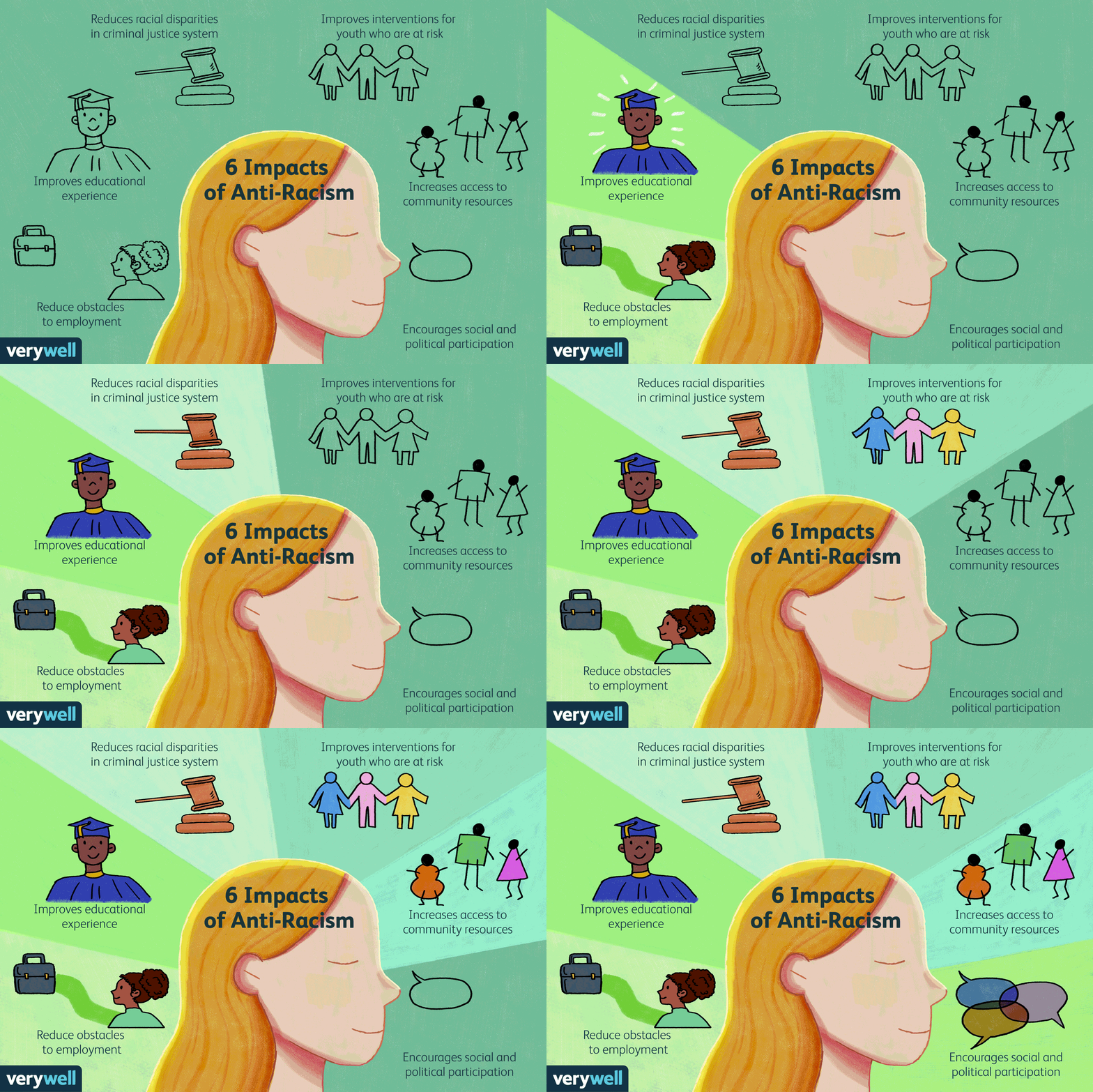
Because anti-racism is an active process, it has the potential to have an impact on the individual, community, and societal levels.
Some of the potential effects include:
- Reducing obstacles to employment
- Improving educational experience and attainment
- Reducing racial disparities within the criminal justice system
- Improving interventions for youth who are at risk
- Increasing access to community resources
- Encouraging social and political participation
- Reducing bullying, hate crimes, and racially motivated violence
- Electing officials to office who are committed to anti-racism
It is important to remember that anti-racism is not a one-time or occasional action. It’s a lifelong commitment to fighting for racial equality and justice.
