

Key Takeaways
- Twenty-four hours after quitting smoking, your risk of heart attack starts to go down.
- Nicotine withdrawal symptoms are at their worst during the first 72 hours.
- By the three-month mark, your body’s circulation improves, allowing better tolerance of physical activity.
There are many serious health risks associated with smoking, like a higher chance of heart disease, lung cancer, and stroke. But what happens when you stop smoking? It can help undo some of the damage created, in addition to improving your health.
Certain health improvements do take time, but positive changes start to occur within minutes, hours, and days of quitting. Learn what changes you can expect when you stop smoking for good.
As of Dec. 20, 2019, in the United States, the legal age is 21 years old for purchasing cigarettes, cigars, or any other tobacco products.
Verywell / JR Bee
Benefits of Quitting Smoking
Quitting smoking can reduce your risk of cardiovascular disease, chronic obstructive pulmonary disease (COPD), and 12 different types of cancer. It can even benefit you mentally.
Quitting smoking can have a significant impact on mental health, bringing about noticeable benefits such as improved mood, reduced anxiety, and enhanced overall well-being.
—
DR. ARMEEN POOR, MD, PULMONOLOGIST, INTENSIVIST
If you’re a smoker, it may seem like the damage has been done, so it isn’t worth quitting—but that’s simply not true. Your body will begin to heal itself shortly after you quit, and the sooner you give up smoking, the greater the benefit is to your health.
Smoking cessation can also carry lifestyle benefits, some of which include:
- Improved sense of taste and smell
- No more scent of cigarette smoke on your hair, breath, and clothing
- More money in your budget
- Less yellowing of your teeth and fingernails
- Fewer instances of feeling out of breath during light activities
Timeline of What Happens When You Stop Smoking
You can expect positive changes to occur roughly on this timeline after you quit smoking. Taking note of these milestones may help you in your smoking cessation process.
First 24 Hours After Quitting
If you are a heavy smoker, your body will immediately realize when the chain-smoking cycle is broken. This is because tobacco smoke causes constriction of blood vessels in the body.
When the smoke stops, constriction starts to cease, resulting in lower blood pressure, reduced pulse rate, and a body temperature that’s returning to normal. These benefits start to occur within the first 20 minutes.
After eight hours of being smoke-free, the carbon monoxide levels in your blood also drop and blood oxygen levels start to normalize. This means that more oxygen is reaching your cells and tissues.
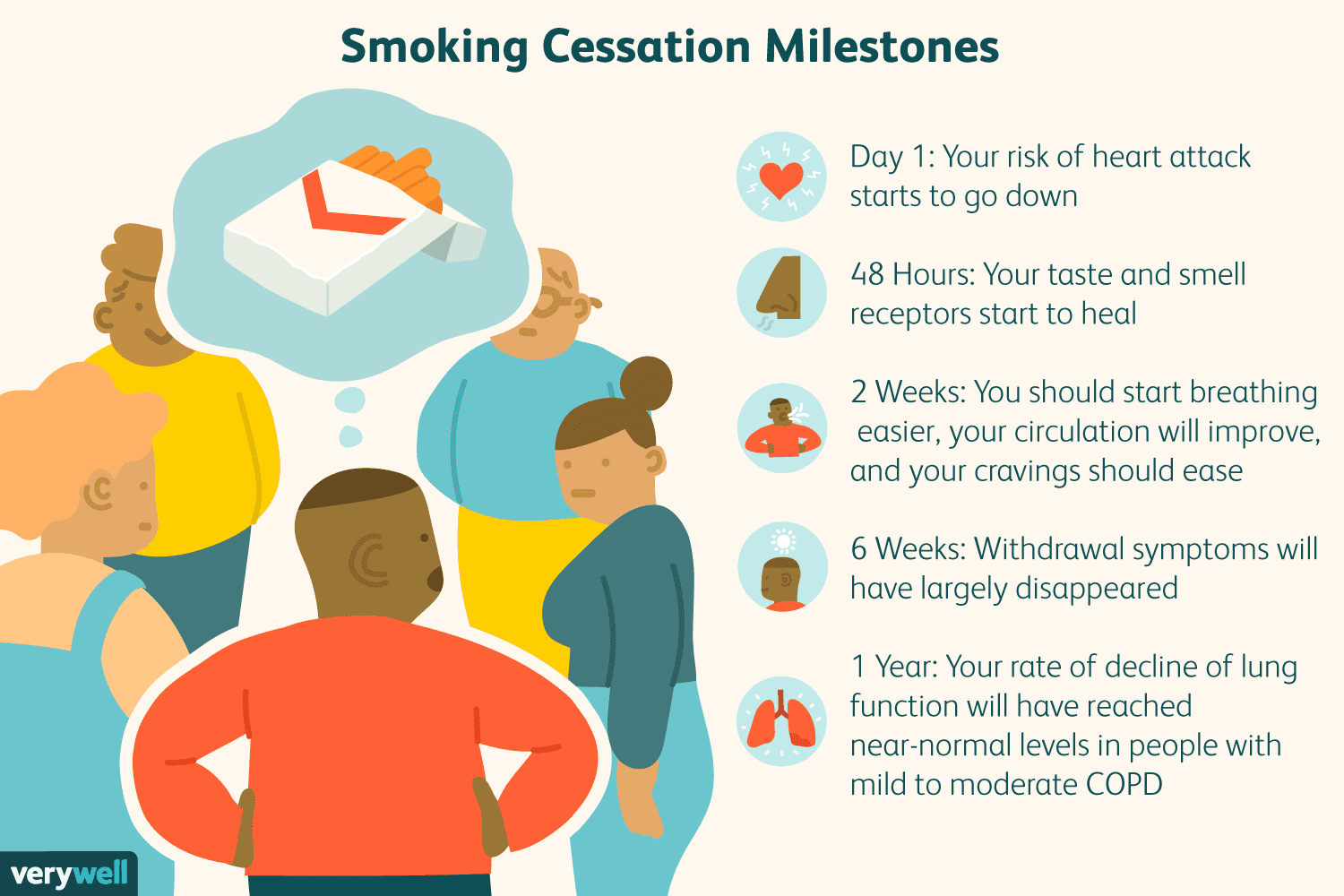
Twenty-four hours after quitting, your risk of heart attack starts to go down. This is important since research has found that smokers aged 40 to 59 are almost two times as likely to have a fatal heart attack without any type of warning.
Within 72 Hours of Quitting
At the 48-hour mark, your taste and smell receptors start to heal, shifting from their abnormally flattened state to a more normal, rounded configuration. Damaged nerve cells also self-repair as the insulating membrane, called myelin, gradually rebuilds itself around exposed nerve endings.
Nicotine withdrawal symptoms are typically at their worst during the first 72 hours of quitting smoking, Though, they do begin to gradually subside after these first three days have passed.
Two Weeks After Quitting
After withdrawal symptoms peak, they start to decrease, impacting you less over time. Though, you may still feel restless or jumpy for a couple of weeks, in addition to sometimes feeling grouchy, irritable, or having trouble sleeping.
It’s important to recognize that cigarette cravings can still persist during the first two weeks of quitting as you work to adjust to your new life without smoking. Finding ways to overcome smoking cravings quickly can help.
Three Months After Quitting
By the end of week six, nicotine withdrawal symptoms (including anger, anxiety, depression, difficulty concentrating, insomnia, and restlessness) will have largely disappeared. At the three-month mark, your body’s circulation has improved, making it possible to tolerate physical activity better, and lung function continues to see improvements as well.
Some people with COPD nearly double one measure of lung function called forced expiratory volume in one second (FEV1) by week six. While these improvements may not be as dramatic moving forward, they tend to continue gradually in people with mild to moderate COPD and remain relatively stable for people with severe COPD.
What About Weight Gain When You Stop Smoking?
The average person gains between five and 10 pounds during the first few months of quitting smoking. If you’re concerned about this, there are steps you can take to minimize quit-related weight gain, such as drinking plenty of water and finding support.
Nine Months After Quitting
Many ex-smokers feel a sudden letdown once they get beyond the three-month mark. Physical improvements taper off while cigarette cravings may persist (albeit at a lesser rate).
This doesn’t mean that your health isn’t continuing to improve. In fact, the tiny, finger-like projections in your respiratory tract, called cilia, will have regrown during the first six to nine months, making it easier to clear debris and mucus from your lungs.
While this may actually cause increased coughing after quitting smoking, it is a sign that your lungs are getting stronger and trying to heal themselves. As a result, you should start feeling more energized and be able to perform daily activities with less shortness of breath and fatigue.
One Year After Quitting
By the end of year one, your risk of heart attack and stroke drops by about half, and people with COPD may continue to see some improvements to their lung function. The improvements you see with COPD can depend on the severity of your condition.
Those with mild to moderate COPD may see more positive changes, while people with severe COPD could experience a leveling off of their earlier gains or even a slight reversal. If this happens, it doesn’t mean that you’re going backward but rather that you need ongoing COPD treatment to further slow the progression of the disease.
Beyond One Year of Smoking Cessation
The health benefits of smoking cessation appear to continue over time:
- After five to 10 years, your stroke risk is reduced and your chance of developing certain cancers is halved.
- After 10 years, your risk of lung cancer is about half of a current smoker’s.
- After 15 years, your chance of developing coronary heart disease is similar to a non-smoker’s.
Your long-term health outlook depends on a variety of factors, like your overall health, how long you’ve smoked, what age you quit, and your other health-related behaviors. Quitting at a younger age can further reduce your risk of developing health issues.
Your Lungs After Smoking
You can’t necessarily undo the structural damage that smoking causes to your lungs. That said, the cilia in the lungs start to return to normal function between one and 12 months of quitting smoking, with continued lung improvements occurring over time.
The length of time it takes the lungs to heal as much as they can depends on how long you smoked, how old you were when you quit, other medical conditions you may have, and other lifestyle factors.
For people with COPD, there are additional lung-based benefits associated with quitting smoking. For instance, many find that they have less frequent exacerbations or acute breathing difficulty attacks after they no longer smoke.
Can You Clean Your Lungs After You Quit Smoking?
While there is no product or quick fix that will clean or “detox” your lungs after smoking, quitting can still improve your overall lung health. Your lungs are self-cleaning and will begin to heal themselves after you stop smoking, though the extent to which they heal depends on your overall health, how long you’ve smoked, and your existing lung damage.
If you’re concerned about your lungs, there are steps you can take to protect them. These include:
- Quitting smoking: Cessation is the best way to avoid lung damage associated with smoking.
- Getting enough exercise: Exercise helps strengthen your lungs and heart, allowing your body to move oxygen around more efficiently.
- Avoiding pollution: Try to limit your exposure to indoor and outdoor air pollutants that can harm your lungs, like secondhand smoke, radon, and wildfire smoke.
- Staying hydrated: Keeping hydrated is helpful for your entire body, including your lungs as being even mildly dehydrated can reduce lung function.
Frequently Asked Questions
-
What happens to your body when you quit smoking?
When you quit smoking, your body begins to heal within 20 minutes. In the short term, your senses of taste and smell begin to improve, as do your breathing and circulation. Your lung function continues to improve and, eventually, your risk of stroke, cancer, and heart disease is reduced (in some cases, to levels similar to that of someone who never smoked).
-
What happens to your skin when you quit smoking?
Quitting smoking helps rejuvenate your skin. It does this by improving the skin’s color as well as making you look younger in age.
-
What happens when you quit smoking and start vaping?
Some people try vaping to help them quit smoking. Some research shows that e-cigarettes may be effective for smoking cessation if accompanied by behavioral support. In a 2019 study, about 18% of people who vaped were not smoking traditional cigarettes after one year. And they reported less coughing than people who quit using nicotine replacement therapy.
However, vaping has significant health risks and may be even more addictive than traditional cigarettes. If you are ready to quit smoking cigarettes, talk to your healthcare provider about the best smoking cessation method for you.
