

Key Takeaways
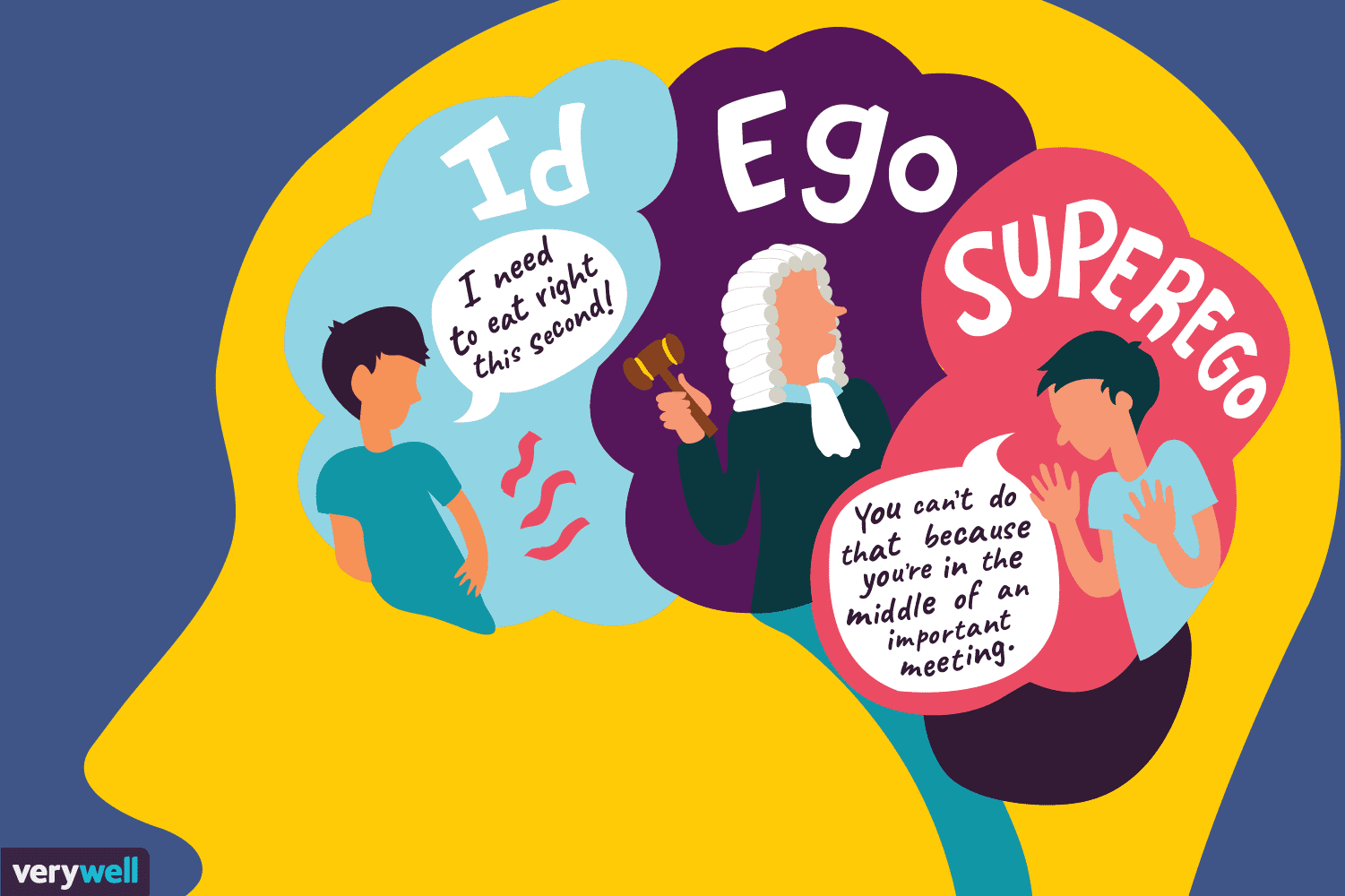
- According to Freud, the id, ego, and superego are three parts of the mind that influence thoughts, emotions, and behaviors.
- The id seeks instant gratification for needs, the ego balances these desires with reality, and the superego strives towards internalized morals.
Freud’s id, ego, and superego are three parts of the mind that he believed shape how we think, feel, and act. The id drives our basic impulses, the ego deals with reality, and the superego guides us to act morally. While the theory isn’t fully accepted by modern psychology, it can be a helpful way to think about how to balance your wants and values in realistic ways.
Verywell
Freud’s Theory of the Id, Ego, and Superego
According to Sigmund Freud, human personality is complex and has more than a single component. In his famous psychoanalytic theory, Freud states that personality is composed of three elements:
- The id
- The ego
- The superego
These elements work together to create complex human behaviors.
“The id is considered the basis of sexual and aggressive energy and is largely held in the unconscious, emerging as illogical or wishful thinking,” explains Shannon Sauer-Zavala, PhD, associate professor of psychology at the University of Kentucky. “The superego is one’s conscience and is established via identification with parental figures or social groups at large.”
Shannon Sauer-Zavala, PhD
The ego is tasked with balancing reality with the demands of desire (id) and morality (superego),
— Shannon Sauer-Zavala, PhD
Each component adds its own unique contribution to personality, and the three interact in ways that have a powerful influence on an individual. Each element of personality emerges at different points in life.
According to Freud’s theory, certain aspects of your personality are more primal and might pressure you to act upon your most basic urges. Other parts of your personality work to counteract these urges and strive to make you conform to the demands of reality.
What the Id Wants
According to Freud, the id is the source of all psychic energy, making it the primary component of personality.
- The id is the only component of personality that is present from birth.
- This aspect of personality is entirely unconscious and includes instinctive and primitive behaviors.
The id is driven by the pleasure principle, which strives for the immediate gratification of all desires, wants, and needs. If these needs are not satisfied immediately, the result is a state of anxiety or tension. For example, an increase in hunger or thirst should produce an immediate attempt to eat or drink.
The id is very important early in life because it ensures that an infant’s needs are met. If the infant is hungry or uncomfortable, they will cry until the demands of the id are satisfied. Young infants are ruled entirely by the id; there is no reasoning with them when these needs demand satisfaction.
Examples of the Id
Imagine trying to convince a baby to wait until lunchtime to eat their meal. The id requires immediate satisfaction, and because the other components of personality are not yet present, the infant will cry until these needs are fulfilled.
However, immediately fulfilling these needs is not always realistic or even possible. If we were ruled entirely by the pleasure principle, we might find ourselves grabbing the things that we want out of other people’s hands to satisfy our cravings.
This behavior would be both disruptive and socially unacceptable. According to Freud, the id tries to resolve the tension created by the pleasure principle through the use of primary process thinking, which involves forming a mental image of the desired object to satisfy the need.
Although people eventually learn to control the id, this part of personality remains the same infantile, primal force throughout life. It is the development of the ego and the superego that allows people to control the id’s basic instincts and act in ways that are both realistic and socially acceptable.
How the Ego Keeps You Grounded
According to Freud, the ego develops from the id and ensures that the impulses of the id can be expressed in a manner acceptable in the real world.
The ego:
- Functions in the conscious, preconscious, and unconscious mind
- Is the personality component responsible for dealing with reality
Everyone has an ego. The term ego is sometimes used to describe your cohesive sense of self, but personality and ego are not the same. The ego represents just one component of your full personality.
The ego operates according to the reality principle, which strives to satisfy the id’s desires in realistic, socially appropriate ways. The reality principle weighs the costs and benefits of an action before deciding to act upon or abandon impulses.
In many cases, the id’s impulses can be satisfied through a process of delayed gratification—the ego will eventually allow the behavior, but only in the appropriate time and place.
Freud compared the id to a horse and the ego to the horse’s rider. The horse provides power and motion, while the rider offers direction and guidance. Without its rider, the horse would wander wherever it wished and do whatever it pleased. The rider gives the horse directions and commands to get it where it wants to go.
The ego also discharges tension arising from unmet impulses through secondary process thinking, in which it seeks an object in the real world that matches the mental image created by the id’s primary process.
The term ego is often used informally to suggest that someone has an inflated sense of self. However, the ego in personality has a positive effect. It is the part of your personality that keeps you grounded in reality and prevents the id and superego from pulling you too far toward your most basic urges or moralistic virtues. Having a strong ego means having a strong sense of self-awareness.
Examples of the Ego
Imagine that you are stuck in a long meeting at work. You find yourself growing increasingly hungry as the meeting drags on. While the id might compel you to jump up from your seat and rush to the break room for a snack, the ego guides you to sit quietly and wait for the meeting to end.
Instead of acting upon the primal urges of the id, you spend the rest of the meeting imagining yourself eating a cheeseburger. Once the meeting is finally over, you can seek out the object you were imagining and satisfy the demands of the id realistically and appropriately.
How the Superego Acts as Your Inner Guide
The last component of personality to develop is the superego.
- According to Freud, the superego begins to emerge at around age 5.
- The superego holds the internalized moral standards and ideals that we acquire from our parents and society (our sense of right and wrong).
- The superego provides guidelines for making judgments.
The superego has two parts:
- The conscience includes information about things that are viewed as bad by parents and society. These behaviors are often forbidden and lead to bad consequences, punishments, or feelings of guilt and remorse.
- The ego ideal includes the rules and standards for behaviors that the ego aspires to.
The superego tries to perfect and civilize our behavior. It suppresses all the id’s unacceptable urges and struggles to make the ego act in accordance with idealistic standards rather than realistic principles. The superego is present in the conscious, preconscious, and unconscious.
Examples of the Superego
For example, if you give in to the urges of the id, the superego is what will cause you to feel a sense of guilt or even shame about your actions. The superego may help you feel good about your behavior when you suppress your most primal urges.
Other examples of the superego include:
- A woman feels an urge to steal office supplies from work. However, her superego counteracts this urge by focusing on the fact that such behaviors are wrong.
- A man realizes that the cashier at the store forgot to charge him for one of the items he had in his cart. He returns to the store to pay for the item because his internalized sense of right and wrong urges him to do so.
- A student forgets to study for a history test and feels an urge to cheat off of a student sitting nearby. Even though he feels like his chances of getting caught are low, he knows that cheating is wrong, so he suppresses the urge.
How These Parts of Personality Work Together
When discussing the id, ego, and superego, it is important to remember that these are not three separate entities with clearly defined boundaries. These aspects are dynamic and constantly interacting to influence an individual’s overall personality and behavior.
With many competing forces, it is easy to see how conflict might arise between the id, ego, and superego.
“A central theme of Freud’s work is that id, ego, and superego are always in conflict, and the specific nature of these discrepancies determines one’s thoughts, feelings, and behaviors (or personality),” says Sauer-Zavala.
Freud further assumed that it takes a lot of mental energy to keep the id’s desires in the unconscious; however, unconscious thoughts must go somewhere and are likely to be expressed in another form that may not be under one’s control (e.g., as symptom, dream, joke, slip of the tongue, or behavior).
Freud used the term ego strength to refer to the ego’s ability to function despite these dueling forces. A person who has good ego strength can effectively manage these pressures, while a person with too much or too little ego strength can be unyielding or disruptive.
What Happens If They’re Out of Balance?
According to Freud, the key to a healthy personality lies in a balance among the id, the ego, and the superego. If the ego can adequately moderate between the demands of reality, the id, and the superego, a healthy and well-adjusted personality emerges. Freud believed that an imbalance between these elements would lead to a maladaptive personality.
“Freud believed that mental health difficulties (anxiety, depression) arise when ‘the ego has lost the capacity to allocate the [id] in some way’ (Freud, 1920), adds Sauer-Zavala. This leads to symptoms worse than the conflict they were trying to replace.
“Though the symptom is a substitute for the instinctual impulse, it has been so reduced, displaced, and distorted that it looks more like a compulsion or even an illness than a gratification of the id’s desire.”
Potential effects of imbalances include:
- Anxiety or tension as the ego struggles to balance competing demands
- Depressive symptoms if the superego becomes overly harsh and judgmental
- Impulsive or risky behaviors if the id overwhelms the ego’s control
- Compulsive behaviors that emerge as a way to substitute for unmet needs
- Difficulty making decisions based on internal conflicts between what you want, your internalized morals, and reality
- Problems in relationships caused by inconsistent responses or emotionally reactive behaviors
For example, an individual with an overly dominant id might become impulsive, uncontrollable, or even criminal. Such an individual acts upon their most basic urges with no concern for whether their behavior is appropriate, acceptable, or legal.
On the other hand, an overly dominant superego might lead to a personality that is extremely moralistic and judgmental. A person ruled by the superego might not be able to accept anything or anyone that they perceive to be “bad” or “immoral.”
How Modern Psychology Sees the Id, Ego, and Superego
Freud’s theory provides one conceptualization of how personality is structured and how the elements of personality function. In Freud’s view, a balance in the dynamic interaction of the id, ego, and superego is necessary for a healthy personality.
“Freud’s accounts of the nature of one’s thoughts, feelings, and behaviors have largely fallen out of favor,” admits Sauer-Zavala. “People began to question whether differences in people’s personalities could accurately be reduced to sexual and aggressive impulses. In fact, there is limited research support for Freud’s theories.”
While the ego has a tough job to do, it does not have to act alone. Anxiety also plays a role in helping the ego mediate between the demands of the basic urges, moral values, and the real world. When you experience different types of anxiety, defense mechanisms may kick in to help defend the ego and reduce the anxiety you are feeling.
