

Key Takeaways
- Spending time in nature can boost happiness and well-being.
- Nature therapy includes activities like gardening, walking, and forest bathing.
- Time in both green and blue spaces helps reduce stress and anxiety.
It’s time to bring nature into our everyday life. While we know intuitively that seeing the birds and squirrels in the local park seems to have a calming effect on us and makes us feel good, empirical evidence is mounting about the benefits of nature therapy.
This article explains what nature therapy involves, how nature therapy can benefit your mental health, and how you can bring nature to you if you happen to be stuck inside.
What Is Nature Therapy and Why Do We Need It?
Nature therapy, which is also called ecotherapy, is based on the concept of using nature to help us heal, especially psychologically.
Generally speaking, we as a society do not spend time outside as much as we did in the past to decompress, let off steam, or recharge. This is also different from how many of us behaved as children: we may no longer bike through a meadow or play games at the lake, for example.
We’ve replaced those leisurely activities with more time spent on social media and video games. Instead of spending time enjoying and benefiting from the natural environment, we are spending more and more time on screens and online. The ramifications of this type of lifestyle are that we are a stressed-out society with a variety of mental health maladies.
Green and Blue Therapy
You might hear nature therapy called “green care,” “green exercise,” or “green therapy.” That is because its powerful benefit lies in spending time in green spaces.
But nature therapy also includes time spent near soothing “blue” spaces: oceans, rivers, and lakes. Being near aquatic environments has a psychologically restorative effect. It puts us in good moods. The color blue also represents calm and tranquility.
The Blue Health project is an organization that has conducted studies about the relationship between blue spaces and health in 18 countries across Europe. After surveying 18,000 people, researchers discovered that people feel better being near waterways.
In fact, evidence showed a positive association between more exposure to outdoor blue spaces and health, particularly in terms of benefits to mental health and well-being. So, researchers have expanded their notion of ecotherapy to include blue spaces as well.
Nature Therapy’s Various Approaches
A host of nature-based therapeutic approaches are available to you without ever having to step inside a therapist’s office. There are relaxed approaches like gardening in the backyard, walking in a field of flowers, or floating on a tube in the river.
Nature therapy or ecotherapy can also encompass activities or therapies in which you are formally guided by therapists and trained leaders, too.
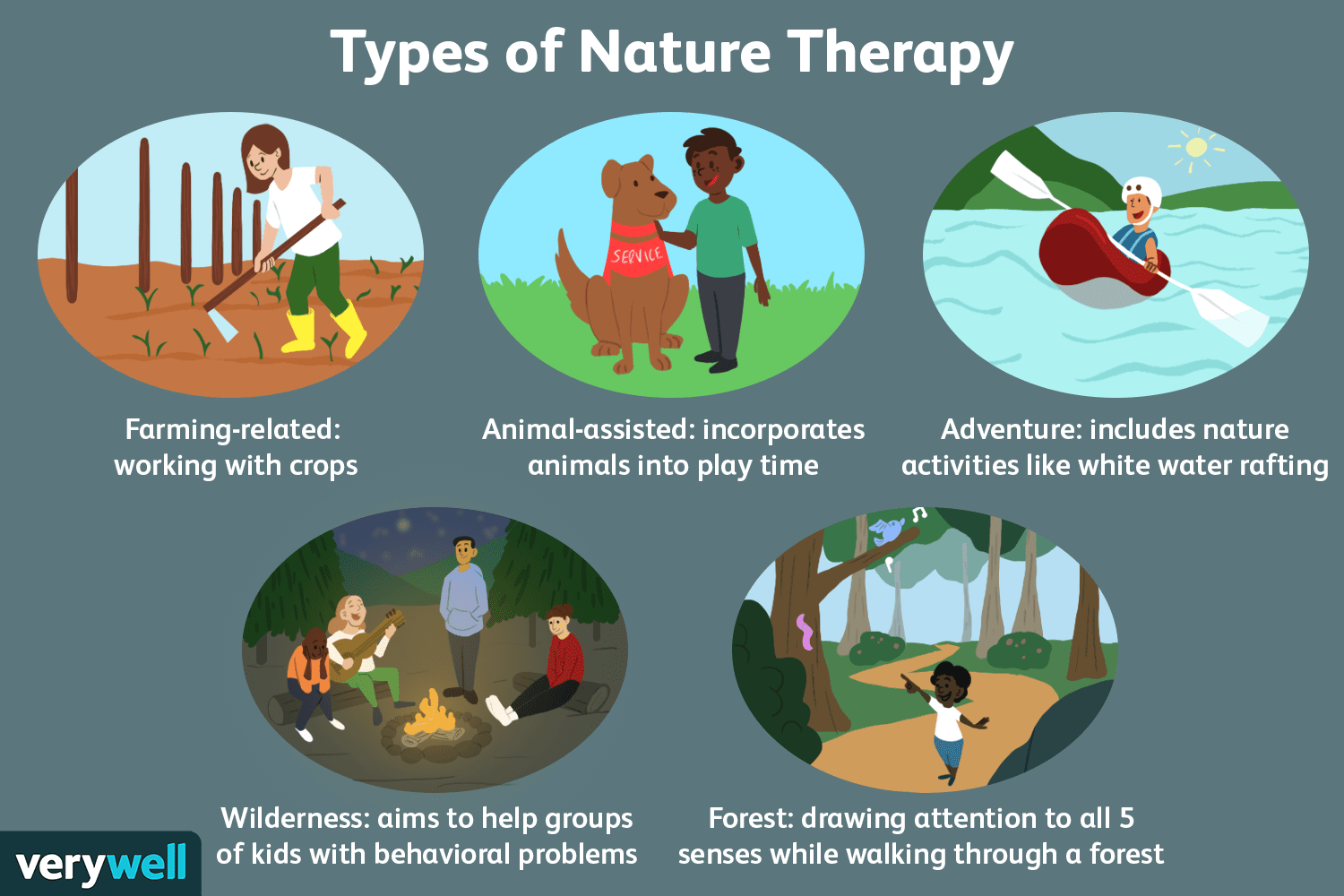
Here are some more formalized types of nature therapies:
- Farming-related therapy, which could involve working with crops, often in a community
- Animal-assisted therapy, which might consist of playing with or training horses or dogs
- Adventure therapy, which may feature white water rafting or rock climbing
- Wilderness therapy, which often helps groups of teens and young adults with behavioral issues
- Forest therapy, also called forest bathing, a mindful practice in which you use your five senses as you walk through a forest
The Benefits of Being in Nature
What science is showing is that we can reap the healing powers of Mother Nature and gain a host of mental health benefits. The question is: are we partaking in what might be an easy, cost-effective solution to our problems?
The latest research in psychology is furthering our knowledge about how spending time in nature is a low-cost and highly effective way to improve various aspects of our psychological wellness.
Increased Happiness
Many books and articles have been published about how to boost happiness. One proven way is by spending more time in nature.
In a review of extensive previous research, Gregory Bratman, PhD, an assistant professor at the University of Washington, helped to chart a course for policymakers. He and his team wanted to create a framework measuring the mental health benefits of nature so city planners could incorporate natural settings into their future plans.
In his 2019 study, published in Science Advances, Bratman and his colleagues found evidence that contact with nature is associated with many benefits, including increases in happiness, a sense of well-being, positive social interactions, and a feeling of meaningfulness in life.
Decreased Anxiety, Stress and Depression
Because anxiety, stress, and depression affect U.S. college students now at alarming rates, another study examined 14 already-published studies involving college-aged adults. Nature-rich environments unequivocally helped reduce mental distress.
The study compared those in urban areas with those in natural environments. What it also revealed was how little time it took in nature to impact these students.
It showed that spending a minimum of 10 minutes either sitting or walking in a wide range of natural settings provided a significant and beneficial impact on the participants’ mental health. Scientists used key psychological and physiological markers to measure this.
Uptick in Cognitive Benefits
Our mind likes it when we spend time in nature. We have better focus, which is also described as sharpened cognition. Another 2019 study showed that our exposure to natural environments is good for our brain. It improves performance on our working memory, cognitive flexibility, and attentional control tasks.
How to Bring Nature Indoors
Due to socio-economic reasons, not every group has easy access to green or blue spaces. Furthermore, during inclement weather and cold winter months, even those with the means might not choose to spend time in nature. The appeal of a stroll by a river or hike through a nature reserve may not be there when it’s freezing outside.
If you have limited time or access, perhaps an intense work schedule, or are just not comfortable spending prolonged periods of time in the cold, you can still access nature conveniently.
How do we bring nature’s benefits inside when we are confined to our homes and workplaces? Here are some easy ways:
- Add plants. They not only remove toxins from the air, but research shows that people who spend time around plants have more concern, empathy, and compassion toward others as well as improved relationships.
- Decorate with paintings or photographs of nature. Choose pretty landscapes, lush gardens, or natural scenes. In yet another study about the health benefits of nature, researchers found that viewing lovely green scenes resulted in the participants having lower stress levels.
- Use soundscapes and download apps of soothing nature sounds. Don’t underestimate the power of listening to a waterfall or the sound of rain. The result isn’t just enhanced relaxation and a sense of chilling out. Results also include attention restoration and better cognitive performance. In one particular study published in Psychonomic Bulletin & Review, participants who listened to nature sounds, specifically that of ocean waves and chirping crickets, performed better on tests than their counterparts who listened to urban sounds like traffic and car horns.
Verywell Mind uses only high-quality sources, including peer-reviewed studies, to support the facts within our articles. Read our editorial process to learn more about how we fact-check and keep our content accurate, reliable, and trustworthy.
-
Zhang X, Zhang Y, Zhai J, Wu Y, Mao A. Waterscapes for Promoting Mental Health in the General Population. Int J Environ Res Public Health. 2021 Nov 10;18(22):11792. doi: 10.3390/ijerph182211792. PMID: 34831547; PMCID: PMC8618438.
-
Gascon M. Zijlema W. Vert C. White M. Nieuwenshuijsen M. Outdoor blue spaces, human health and well-being: A systematic review of quantitative studies. International Journal of Hygiene and Environmental Health, 220. 2017;1207–1221. https://doi.org/10.1016/j.ijheh.2017.08.004
-
Bratman GN, Anderson CB, Berman MG, et al. Nature and mental health: an ecosystem service perspective. 2019;5(7).
-
Meredith GR, Rakow DA, Eldermire ERB. Minimum time-dose in nature to positively impact the mental health of college-aged students, and how to measure it: a scoping review. Front. Psychol. 2020.
-
Schertz KE, Berman MG. Understanding Nature and Its Cognitive Benefits. Current Directions in Psychological Science. 2019;28(5):496-502. doi:10.1177/0963721419854100
-
Texas A & M. Health and well-being benefits of plants.
-
van den Berg MM, Maas J, Muller R, et al. Autonomic Nervous System Responses to Viewing Green and Built Settings: Differentiating Between Sympathetic and Parasympathetic Activity. Int J Environ Res Public Health. 2015;12(12):15860-15874. Published 2015 Dec 14. doi:10.3390/ijerph121215026
-
Van Hedger SC, Nusbaum HC, Clohisy L, Jaeggi SM, Buschkuehl M, Berman MG. Of cricket chirps and car horns: the effect of nature sounds on cognitive performance. Psychonomic Bulletin & Review. 2019;52:522-530.
Thanks for your feedback!
What is your feedback?
Helpful
Report an Error
Other
